
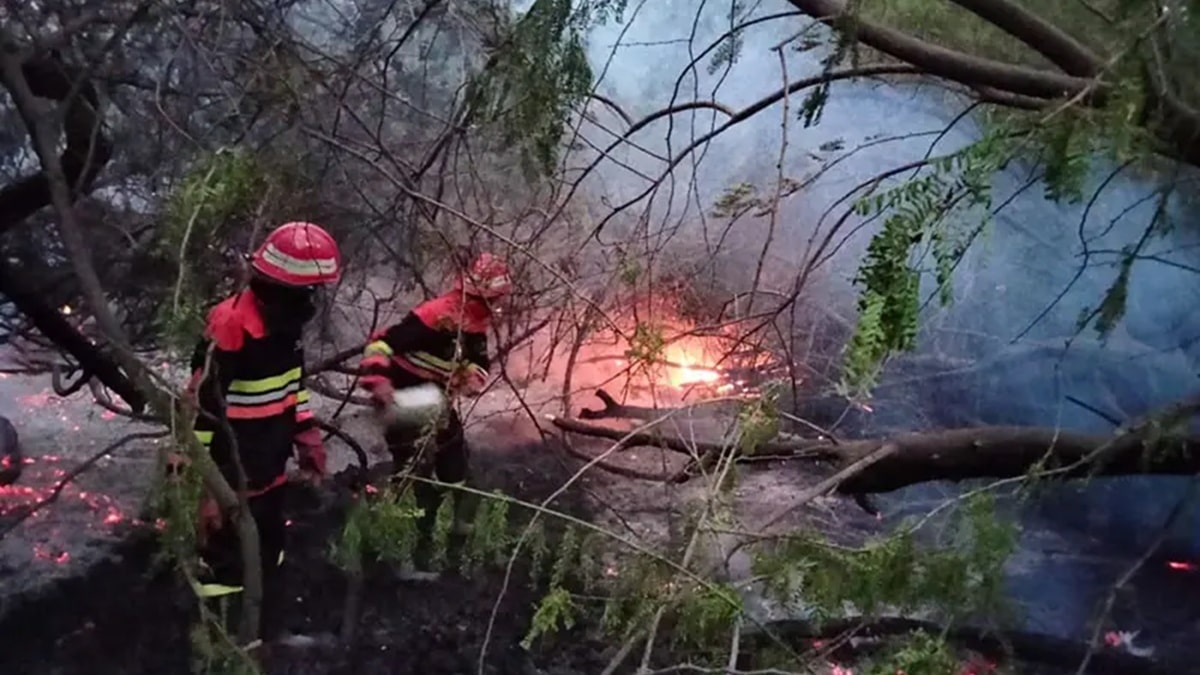
A precision-led rescue operation recently contained a Lal Sohanra fire that consumed approximately 35 acres of vital forest vegetation and shrubs in Bahawalpur. The blaze erupted near the 36-RD sector on a Friday evening, rapidly accelerating through dense thickets. Consequently, firefighting teams faced significant logistical hurdles due to the inaccessible terrain, requiring a calibrated deployment of heavy machinery and water supplies.
The Translation: Calibrating the Event Logic
In technical terms, this incident represents a rapid-onset ecological disruption. The Lal Sohanra fire bypassed traditional containment lines because the dry biomass in the 36-RD sector acted as a high-density fuel source. Rescue 1122 deployed six specialized fire engines, maintaining a continuous hydraulic loop for over six hours to suppress the thermal energy. Furthermore, the persistence of smoldering “hot spots” into the following morning highlights the structural difficulty of deep-root extinguishing in wildland environments.

Socio-Economic Impact: The Citizen Baseline
The degradation of 35 acres within a National Park directly impacts the local climate regulation and air quality for residents in the Bahawalpur region. For the average Pakistani household, such losses mean:
- Reduced Carbon Sequestration: The loss of trees increases the local carbon footprint, affecting long-term temperature stability.
- Biodiversity Erosion: Destruction of shrubs and vegetation disrupts the habitat of indigenous wildlife, potentially impacting local eco-tourism.
- Resource Reallocation: Emergency response costs and the eventual “re-greening” initiatives place a strain on provincial administrative budgets.

The Forward Path: A Stabilization Move
We classify this event as a Stabilization Move. While the containment was successful, the event exposes a critical need for enhanced early-warning sensors and firebreak infrastructure within our National Parks. To move from maintenance to momentum, Pakistan must integrate STEM-driven solutions, such as thermal drone monitoring and automated irrigation zones, to prevent similar escalations. The park administration’s silence must be replaced by a transparent, data-backed restoration strategy.








