
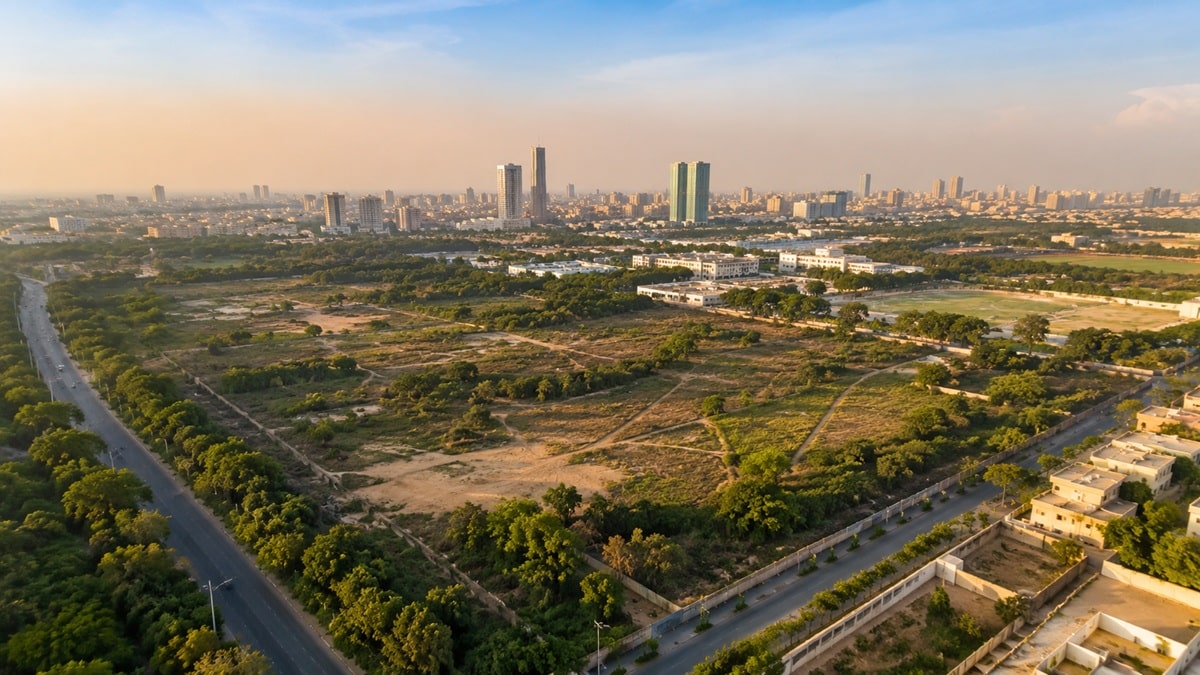
The Karachi Development Authority (KDA) has calibrated a strategic proposal to activate Karachi land development through a Public-Private Partnership (PPP) model, valuing prime real estate at approximately Rs. 90 billion. This architectural shift aims to liquidate structural debt and optimize underutilized urban zones. By integrating private sector efficiency, the KDA seeks to transform stagnant assets into productive economic engines. Consequently, this move could redefine the financial baseline of the authority while modernizing the city’s urban landscape.
The Strategic Karachi Land Development Portfolio
The KDA Director General submitted a formal summary to the Sindh Local Government Department, identifying high-intent land parcels for immediate development. This portfolio includes 28 acres near the KDA Officers Housing Society on Stadium Road and 15 acres in the KDA Staff Colony in North Karachi. Furthermore, the plan incorporates four acres in the Federal Area currently serving as a field office. These precision-targeted locations represent some of the most valuable real estate in the metropolitan core. Karachi land development at this scale requires significant capital injection, which the PPP framework is designed to facilitate.
The Translation: Contextualizing the PPP Framework
To understand this move, one must view the KDA as a land-rich but cash-constrained entity. The Public-Private Partnership (PPP) model is not a simple sale; rather, it is a strategic alliance where the government provides the land and the private sector provides the capital and technical precision. This mechanism allows the state to retain a degree of oversight while offloading the financial risk of construction and management. Effectively, the KDA is leveraging its idle “dead capital” to generate immediate liquidity for operational stability.
Socio-Economic Impact: What This Means for Karachiites
The execution of these projects will directly influence the daily lives of citizens in several ways:
- Financial Stabilization: Revenue will prioritize clearing long-standing pension liabilities and ensuring timely salaries for public servants, stabilizing thousands of households.
- Urban Modernization: Professional development of these tracts usually leads to improved infrastructure, better utilities, and modern commercial or residential spaces.
- Job Creation: Large-scale construction projects act as a catalyst for local employment, benefiting both skilled engineers and daily-wage laborers.
The Forward Path: A Momentum Shift for KDA
This development represents a significant Momentum Shift for the Karachi Development Authority. Transitioning from a traditional bureaucratic land-holding model to an active development partner is a bold, necessary evolution. While employee concerns regarding asset transfer are valid, the structural reality of KDA’s financial deficit demands radical precision. If executed with transparency, this PPP model will serve as a baseline for future urban revitalization projects across Pakistan, proving that state assets can be optimized without being entirely surrendered.








