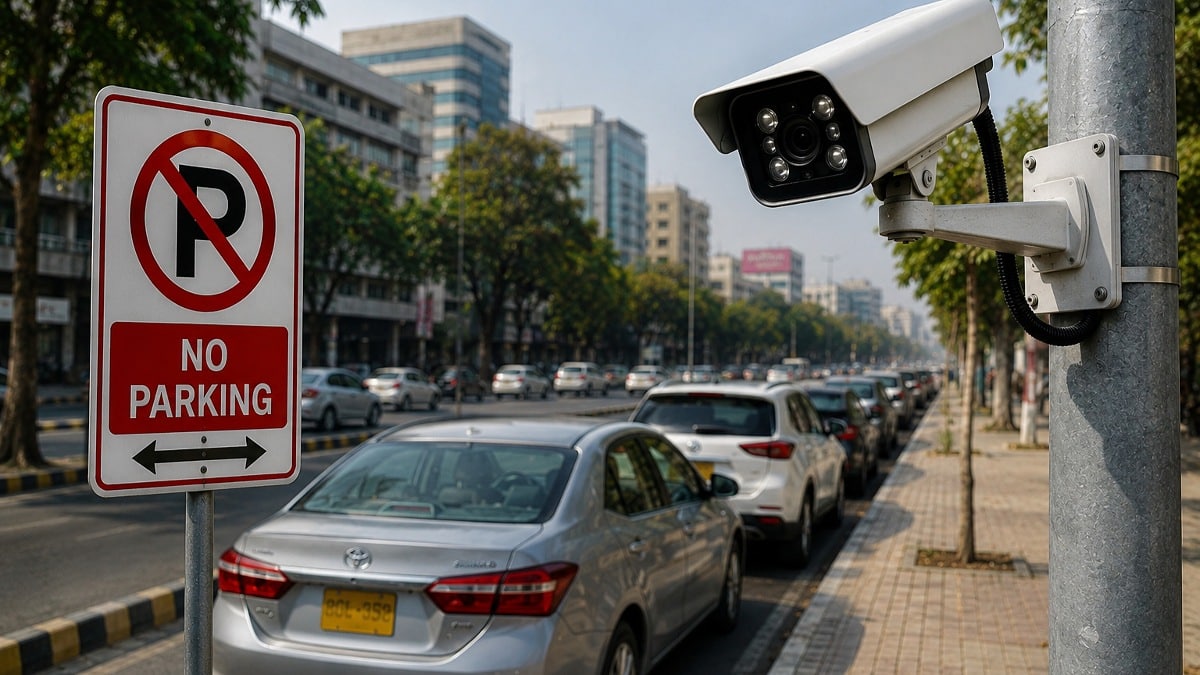
Karachi is deploying smart no-parking cameras to modernize urban traffic management and eliminate manual enforcement friction. The Sindh Safe Cities Authority (SSCA) recently announced this strategic integration to detect illegally parked vehicles automatically. By utilizing high-precision AI, the system will identify violations and issue electronic challans directly through the Traffic Regulation and Citation System (TRACS).
Precision Enforcement Through Smart No-Parking Cameras
The SSCA designed these smart no-parking cameras to function without human intervention, ensuring a faceless and transparent citation process. This system transmits real-time data to the Karachi Traffic Police database, allowing for calibrated penalty issuance. Consequently, the reliance on physical traffic officers for routine parking violations will decrease, freeing personnel for complex traffic control duties.
Director General Sarfaraz Nawaz confirmed that vehicle owners will receive notifications immediately. This structural shift aims to optimize the city’s logistical flow. Moreover, the integration with TRACS ensures that every citation is logged with precision, reducing the potential for disputes or manual errors.
The Karachi Safe City Project Expansion
This initiative represents a core expansion of the Karachi Safe City Project, which already maintains a baseline of 1,300 AI cameras. The authority plans to install these new sensors specifically in high-congestion zones. Furthermore, this upgrade ensures that prohibited areas remain clear, directly improving the baseline flow of metropolitan traffic across the city’s busiest corridors.
The Situation Room Analysis
The Translation (Clear Context)
This development replaces subjective manual policing with objective digital surveillance. The system uses automated optical character recognition (OCR) to link license plates to owner databases. Essentially, the “smart” aspect refers to the camera’s ability to distinguish between moving traffic and stationary violations without a human operator triggering the shutter.
The Socio-Economic Impact
For the average Pakistani citizen, this means reduced bottlenecks and faster commute times. Double-parking is a primary catalyst for urban gridlock; removing these obstacles increases fuel efficiency for households. Additionally, it creates a disciplined urban environment where traffic laws are applied with consistent precision, regardless of the violator’s status.
The Forward Path (Opinion)
This is a definitive Momentum Shift. Moving toward automated systems reduces systemic corruption risks and establishes a precision-based governance model. While surveillance often raises privacy questions, the structural benefit of clear, navigable roads in a mega-city like Karachi outweighs the transition costs. This is the baseline for a truly modern metropolis.