
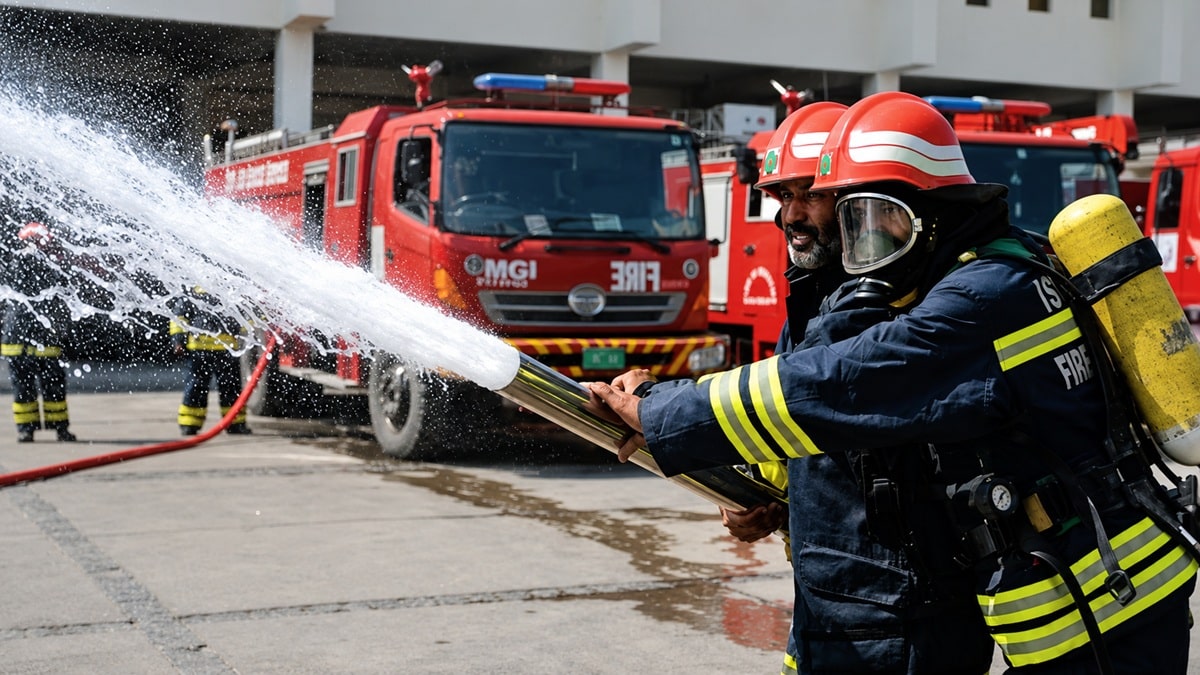
Every resilient urban ecosystem relies on a calibrated emergency response. The launch of the fully integrated Rescue 1122 Islamabad system marks a strategic pivot toward structural safety and operational excellence. Interior Minister Mohsin Naqvi recently catalyzed this transition by directing the Capital Development Authority (CDA) to consolidate fire, ambulance, and water rescue services into one precision-driven network.
Modernizing the Rescue 1122 Islamabad Framework
The Ministry of Interior identified critical gaps in the existing fragmented response models. Consequently, the new directive mandates the immediate construction of four new emergency service centers. This architecture replaces isolated response units with a unified control room. This hub will utilize GPS technology to monitor emergency vehicles in real time, ensuring that the nearest asset reaches the site with maximum speed.
Infrastructure Precision: Underpasses and Revenue Models
Beyond emergency services, the government is focusing on structural traffic flow. The CDA will begin construction on two strategic underpasses next month: one at Kashmir Chowk and another near Faisal Mosque. Furthermore, Naqvi has tasked the authority with developing a long-term revenue model. This move aims to achieve financial self-sufficiency, ensuring that Islamabad’s development remains sustainable without external fiscal dependence.
The Translation: Technical Clarity
In technical terms, this integration represents the centralization of dispatch logic. Instead of three different agencies managing three separate logistics chains, a single digital baseline will manage all assets. By integrating Rescue 1122 Islamabad with GPS-enabled tracking, the city eliminates the “silo effect,” where different departments fail to communicate during large-scale crises.
The Socio-Economic Impact
For the average Pakistani citizen, this shift directly translates to reduced latency during life-threatening moments. A single helpline simplifies the user experience for residents in distress. Economically, a more efficient CDA that generates its own revenue reduces the tax burden on the public while simultaneously increasing the real estate value and safety profile of the federal capital.
The Forward Path: Momentum Shift
This development represents a significant Momentum Shift. By demanding strict timelines for the Expressway Service Road and integrating emergency services, the leadership is moving toward a data-driven governance model. This precision-based approach is a necessary catalyst for transforming Islamabad into a world-class, smart city that prioritizes citizen survival and institutional stability.








