
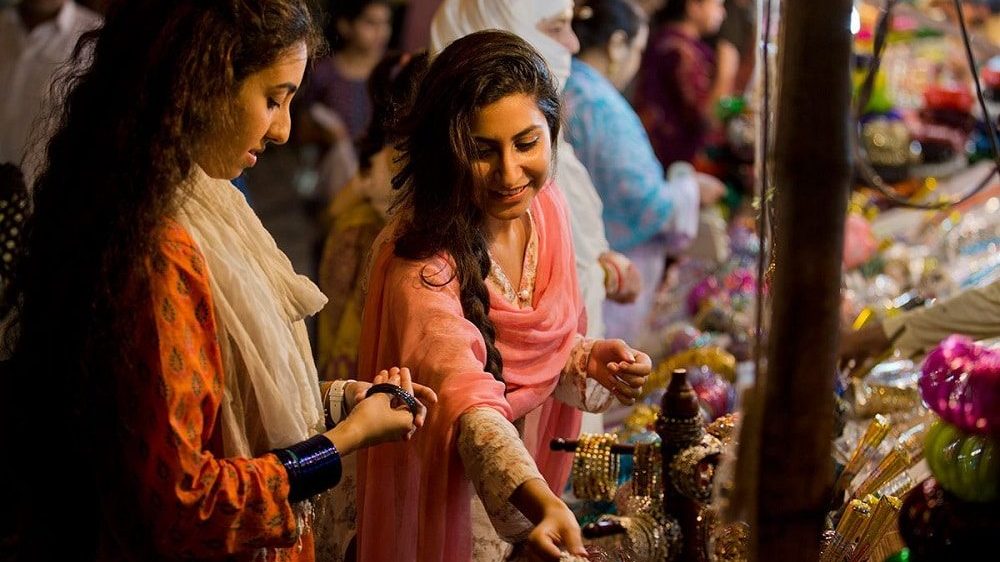
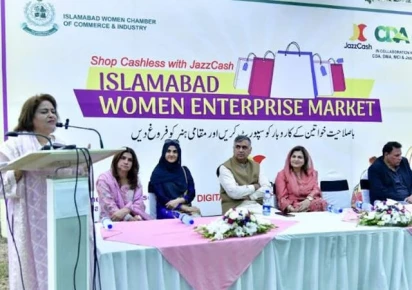
The inauguration of the Women Enterprise Market in Islamabad’s G-11 sector represents a calibrated effort to integrate female entrepreneurs into Pakistan’s formal economy. Parliamentary Secretary Farah Naz Akbar recently led the ceremony, signaling a strategic partnership between the Islamabad Women Chamber of Commerce, the Capital Development Authority (CDA), and JazzCash. This facility serves as a baseline for structural economic reform, providing a dedicated space where women can manage businesses through precision-driven digital tools.
How the Women Enterprise Market Bridges the Capital Gap
Pakistan currently faces a stark gender disparity in its business sector, as women represent only 1 percent of entrepreneurs compared to 21 percent for men. Consequently, the marketplace initiative focuses on digital literacy as a catalyst for change. The facility operates exclusively on cashless transactions, forcing a move toward formal financial systems. By utilizing JazzCash as a technology partner, the project ensures that business owners develop the practical financial capabilities necessary to scale their operations.
Aligning with the National Financial Inclusion Strategy
The Women Enterprise Market aligns directly with the State Bank of Pakistan’s (SBP) National Financial Inclusion Strategy 2024-2028. This framework aims to reduce the banking gender gap from 30 percent to 25 percent within four years. While progress is visible—inclusion rose from 4 percent in 2018 to 52 percent in 2025—structural barriers remain. Specifically, women-led firms received only 3.2 percent of total SME loans in 2022, highlighting the urgent need for institutional trust.
- Digital Integration: Cashless models strengthen the connection between entrepreneurs and formal banking channels.
- SME Representation: Women currently own just 8 percent of Pakistan’s 5 million small and medium enterprises.
- Institutional Trust: 91 percent of women remain hesitant to use traditional institutional financing.
Situation Room Analysis: Precision & Progress
The Translation (Clear Context)
While this looks like a physical market, it is actually a strategic pilot for digital onboarding. The “cashless” requirement is the most important feature. By removing cash from the equation, the government and SBP can track transaction volumes, which allows these women to build a “credit history.” This history is the primary key needed to unlock formal bank loans that were previously inaccessible due to a lack of documentation.
The Socio-Economic Impact
For the average Pakistani household, this development creates a secondary income stream that is protected within a secure, formal environment. For students and young professionals, it provides a blueprint for system efficiency. When women participate in the economy at the same rate as men, national GDP sees a significant multiplier effect. This market reduces the barrier to entry for approximately 2.5 million potential female business owners.
The Forward Path (Expert Opinion)
This development represents a Momentum Shift. While a single market in G-11 is a small baseline, the partnership between the SBP, JazzCash, and the CDA proves that the infrastructure for financial inclusion is finally maturing. To achieve true progress, this model must be scaled to secondary cities where the gender gap is even more pronounced. The success of this facility will be measured not by foot traffic, but by the number of participants who successfully transition to formal bank financing.








