
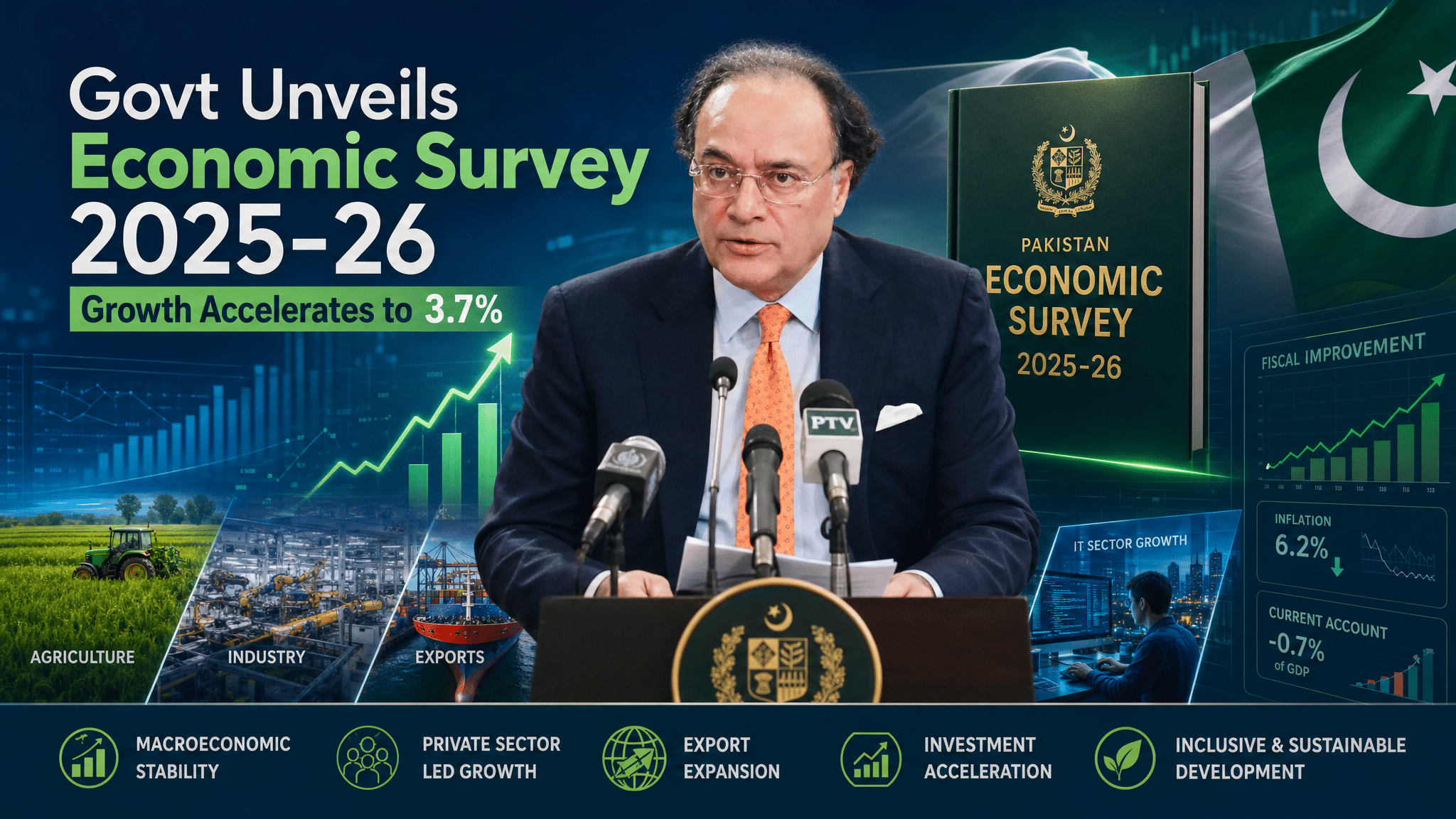
Finance Minister Muhammad Aurangzeb officially unveiled the Economic Survey 2025-26, marking a calibrated pivot from emergency stabilization to sustainable structural growth. Despite persistent global volatility and regional tensions, Pakistan achieved a GDP growth rate of 3.7%, surpassing previous fiscal benchmarks. This performance serves as a baseline for the nation’s transition into a more competitive global export posture, particularly within the North American markets.
Macroeconomic Calibration: The Growth Engine
The national economy reached a historic scale of Rs. 126.9 trillion during this fiscal cycle. Consequently, per capita income surged to $1,901, up from $1,751 the previous year. While geopolitical friction in the Middle East tempered earlier 4% projections, the 3.7% realized growth represents the highest performance in four years. The industrial sector acted as a primary catalyst, with Large-Scale Manufacturing (LSM) expanding by 6.11%.
Fiscal Discipline and Debt Sustainability
The government achieved a significant structural victory by narrowing the fiscal deficit to 0.7% of GDP. Simultaneously, the primary surplus strengthened to 3.2%, driven by a 10.7% increase in total revenue. Debt servicing costs declined by 23.2%, providing the necessary fiscal space for developmental investment. These metrics reflect a disciplined adherence to the IMF’s Extended Fund Facility (EFF) reforms.
Sectoral Performance: Agriculture and Digital Frontiers
The agriculture sector rebounded with a 2.89% growth rate, demonstrating precision resilience after the 2025 floods. Wheat production reached 29.61 million tonnes, while sugarcane and rice outputs saw substantial gains. In the digital sphere, the IT sector emerged as a high-velocity frontier. ICT exports climbed 19.7% to $3.38 billion, and the inaugural 5G spectrum auction generated over $500 million in revenue.

- Manufacturing: 16 out of 22 sectors recorded positive movement.
- Energy: Clean energy (Hydel, Nuclear, Renewable) now constitutes 50.8% of capacity.
- Stock Market: The KSE-100 index gained 18.4% due to monetary easing.
The Situation Room: Strategic Analysis
The Translation (Clear Context)
The Economic Survey 2025-26 signifies that Pakistan has successfully exited the “survival phase.” The logic here is simple: by stabilizing the exchange rate at Rs 281 and reducing debt servicing, the state is now redirecting capital toward productive assets like 5G infrastructure and LSM. The transition from a 1.53% agricultural growth to nearly 3% shows a systemic recovery of our food supply chain.
The Socio-Economic Impact
For the average Pakistani, the data presents a dual reality. While per capita income is rising and literacy has improved to 63%, the national poverty rate remains a concern at 28.9%. The “Next Gen” professional benefits from a 51% surge in freelancer exports, but the urban household still faces an 10.9% inflation peak in oil-sensitive months. This suggests that while the “macro” ceiling is rising, the “micro” floor requires more support.
The Forward Path (Opinion)
This development represents a Momentum Shift. The achievement of a primary surplus alongside record-breaking IT growth indicates that the architectural reforms are working. However, the Rs 822 billion in climate-related damages serves as a stark warning. Pakistan’s future stability depends entirely on its ability to decouple economic growth from climate vulnerability. We are no longer just maintaining; we are building.









