
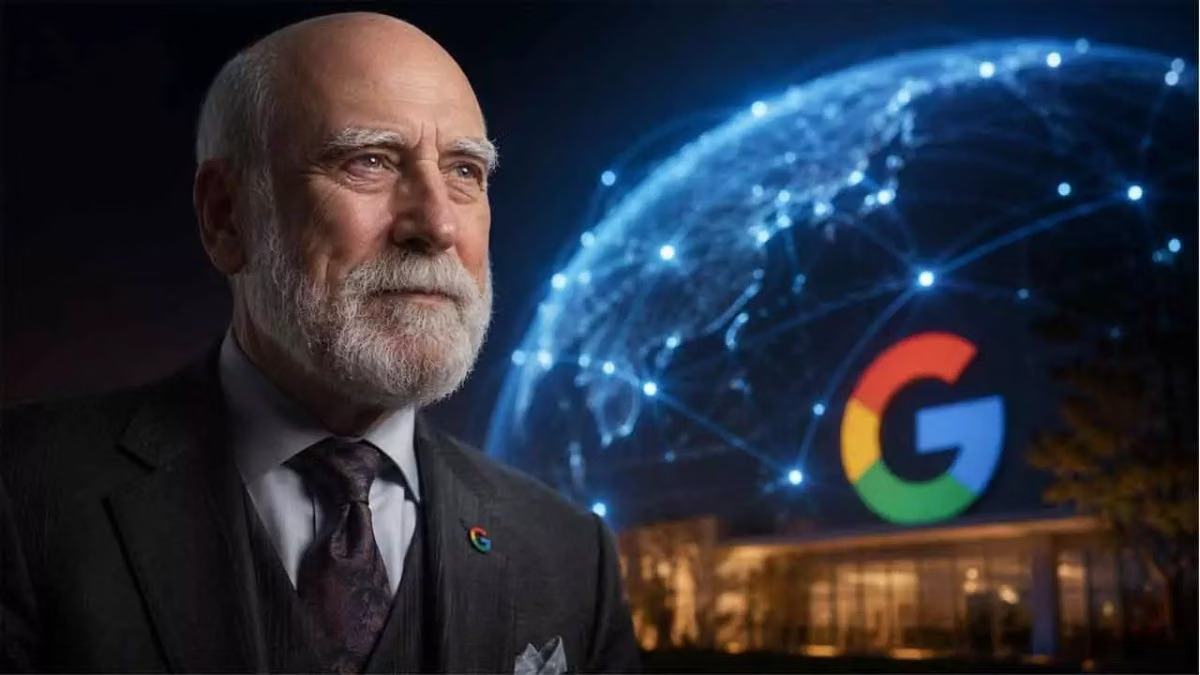
The digital landscape is undergoing a structural recalibration as Vinton Cerf, a primary Internet Protocol Architect, announces his retirement from Google. After a nearly 60-year tenure that redefined global connectivity, Cerf will conclude his role as Google’s chief internet evangelist next week. His departure signifies the end of an era for the foundational systems that power our modern world.
The Legacy of a Strategic Visionary
Alongside Robert Kahn, Cerf engineered the networking architecture and TCP/IP protocols that serve as the internet’s backbone. These calibrated rules allow disparate computer networks to communicate with precision. Consequently, Cerf’s work during the 1970s acted as the catalyst for the decentralized digital economy we navigate today. His contributions have earned him the Presidential Medal of Freedom and the ACM A.M. Turing Award, baseline achievements for any tech luminary.
A New Standard for the Internet Protocol Architect
During a recent open-source panel at UC Berkeley, Cerf joined a group of esteemed computer scientists to discuss the future of digital infrastructure. The panel featured pioneers like Dave Patterson and François Chollet, focusing on how to maintain the utility of open-source systems. This discussion is particularly vital as modern laboratories increasingly centralize control over advanced AI models, diverging from the original decentralized vision of the internet.

The Translation: Complexity to Clarity
In technical terms, Cerf’s TCP/IP protocols are like the universal grammar of the internet. They allow a smartphone in Karachi to “talk” to a server in San Francisco without friction. However, the current shift toward AI agents creates a new problem: fragmentation. Unlike the open internet, many AI systems today are “walled gardens.” Cerf argues that for AI to be effective, agents must use formal, standardized protocols rather than ambiguous natural languages like English to ensure precise and reliable communication.
The Socio-Economic Impact: What This Means for Pakistan
For the Pakistani tech ecosystem, the preservation of open Internet Protocol Architect standards is a matter of economic survival. A decentralized internet allows local startups to compete on a global stage without paying “gatekeeper” taxes to a few tech giants. Furthermore, the push for AI interoperability ensures that Pakistani developers can build “agents” that work across multiple platforms, maximizing the efficiency of our growing digital labor force and enhancing system performance across urban and rural sectors.

The Forward Path: A Momentum Shift
This development represents a Momentum Shift. While Cerf is retiring, his warning about “terrifying” natural-language communication between AI agents sets a strategic roadmap for the next generation. We must move toward formal standards to prevent a “telephone game” error in autonomous software. Just as global icons like Cristiano Ronaldo redefined their fields through discipline, Cerf’s insistence on precision over ambiguity serves as a baseline for future architectural integrity.

Strategic Outlook on AI Standards
- Interoperability: AI agents must share a common language to collaborate.
- Composability: Systems should be built as modular components.
- Standardization: Formal protocols are necessary to eliminate the ambiguity of natural language.








