

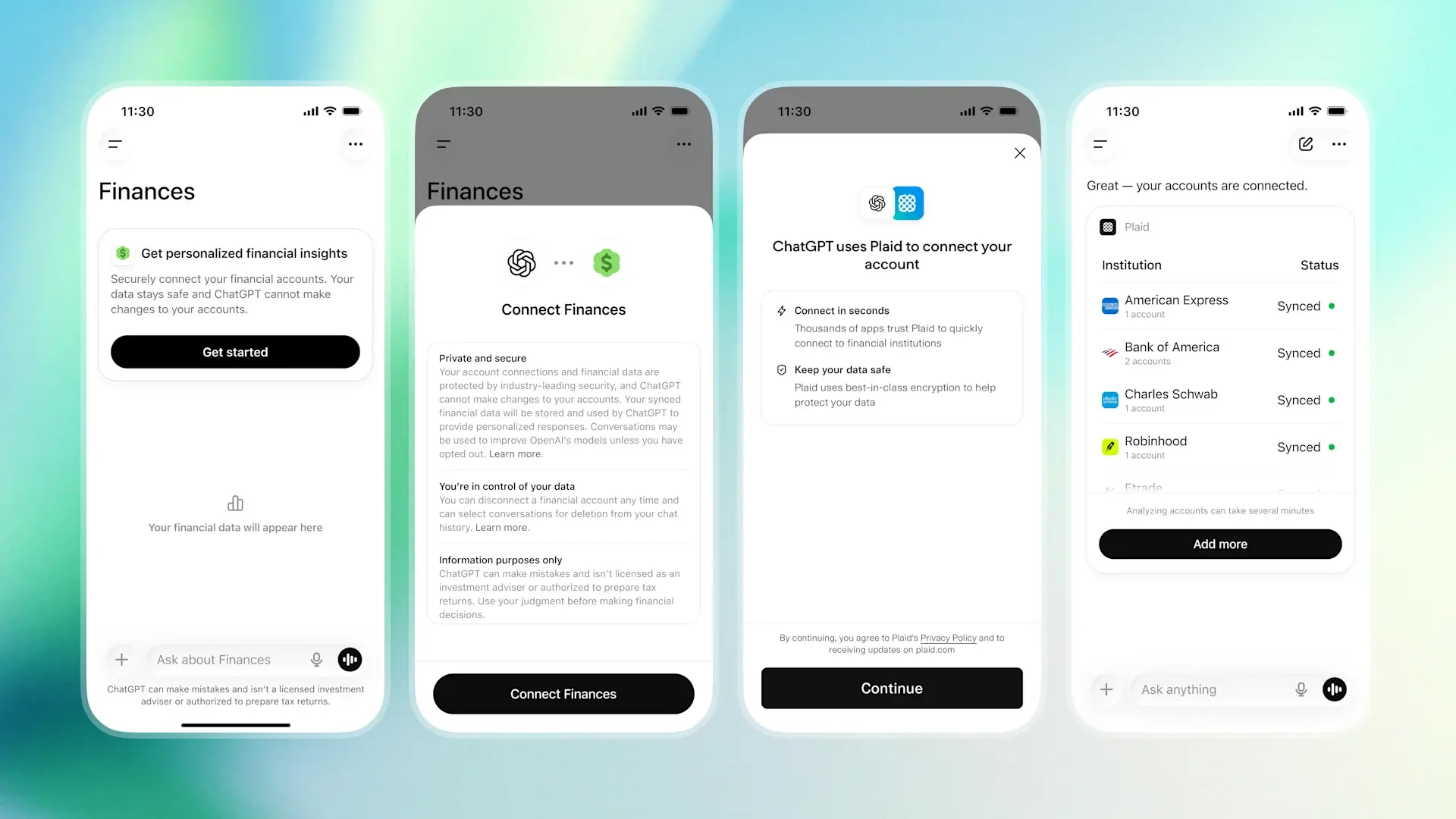
OpenAI has launched a preview of personal finance tools for ChatGPT Pro users, providing AI financial advice through direct integration with over 12,000 banks. By partnering with Plaid, OpenAI allows users to connect accounts from major institutions like Chase, Fidelity, and American Express. Consequently, the AI can now analyze spending, track investments, and help users plan for long-term fiscal goals with calibrated precision.
The Translation: Contextualizing Financial Intelligence
While standard banking apps show you numbers, this integration translates raw data into actionable intelligence. The system utilizes Plaid—a secure middleware—to feed your transaction history into GPT-5.5’s reasoning engine. Therefore, the AI does not just report your balance; it understands the structural logic of your spending patterns. This move converts a simple chatbot into a sophisticated financial architect capable of answering complex inquiries regarding your economic future.

Strategic Connectivity and the New Financial Dashboard
Once users establish a connection, ChatGPT generates a comprehensive dashboard. This interface monitors portfolio performance, active subscriptions, and upcoming debt obligations. Furthermore, users can engage in precision-driven conversations. For instance, you can ask the system to calculate a five-year savings trajectory for a home purchase based on local real estate trends. The underlying GPT-5.5 model provides the reasoning catalyst necessary to handle these sensitive, high-context queries.
How to Activate AI Financial Advice
- Sidebar Navigation: Open the “Finances” option in the ChatGPT sidebar and select “Get started.”
- Direct Command: Type “@Finances, connect my accounts” within any active conversation.
- Third-Party Support: OpenAI plans to integrate Intuit soon, potentially automating tax impact analysis for stock sales.

Privacy Protocols and Data Governance
OpenAI maintains strict boundaries regarding sensitive data. The system cannot view full account numbers or execute financial transfers. In contrast to traditional data mining, users retain full control via the Settings menu. If a user disconnects a service, the system deletes all synced data within 30 days. Additionally, users can manually audit and purge “financial memories” to ensure their digital footprint remains optimized and secure.
The Socio-Economic Impact: Scaling Literacy in Pakistan
For the modern Pakistani professional or student, this technology represents a democratization of elite financial consulting. Historically, high-level fiscal planning was reserved for those who could afford personal advisors. Now, a calibrated AI can provide a baseline for household budgeting and investment education. As these tools evolve, they could bridge the financial literacy gap in emerging markets, allowing individuals to manage resources with unprecedented efficiency.
The Forward Path: A Momentum Shift in AI Utility
This development represents a Momentum Shift. OpenAI is moving beyond general-purpose conversation and into specialized, high-stakes utility. By acquiring the expert team at Hiro, OpenAI has signaled that its goal is to create a “Computer Agent” capable of navigating the complexities of human life. This precision-driven approach will likely force traditional banking institutions to upgrade their own digital interfaces or risk becoming obsolete in the age of AI-driven wealth management.








