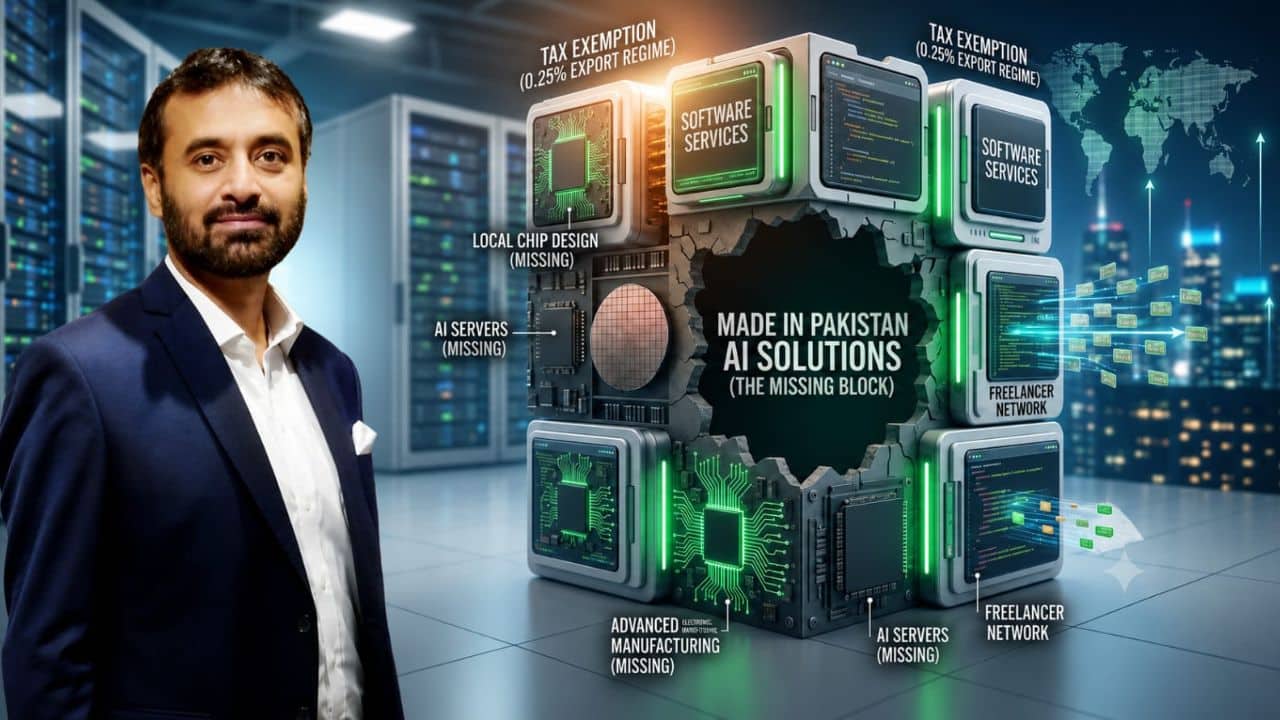
Architecting a Sovereign Digital Economy
The Federal Budget 2026-27 recently calibrated the national digital strategy by extending the 0.25% tax regime for Pakistan IT exports for an additional three years. This fiscal measure provides a necessary baseline of certainty for software houses, freelancers, and global exporters. Consequently, the government has signaled its commitment to maintaining the current momentum of the digital economy through policy continuity.
While the current focus on software-led growth is commendable, the structural roadmap lacks comprehensive support for a “Made in Pakistan” technology ecosystem. Global leaders are currently pivoting toward high-performance computing, robotics, and advanced AI hardware. Pakistan must transition from being a mere consumer of these technologies to becoming a strategic producer of specialized AI hardware.
The Translation: Decoding the Fiscal Logic
The extension of the 0.25% tax regime is a strategic stabilizer. For the technical industry, this means software companies can forecast their operational costs with precision without fearing sudden tax spikes. Furthermore, this policy protects the profit margins of freelancers who bring valuable foreign exchange into the country. It essentially creates a financial buffer that allows companies to reinvest in human capital rather than tax compliance.
Scaling Pakistan IT Exports Through AI Hardware Integration

Pakistan has previously demonstrated the success of targeted policy support within the mobile phone assembly sector. A similar, precision-engineered approach is now required for AI PCs, data center infrastructure, and local server production. Without localized manufacturing, the growth of Pakistan IT exports will eventually hit a glass ceiling imposed by hardware import costs.
- Infrastructure: Developing localized data centers to reduce latency.
- Sovereignty: Building “Made in Pakistan” AI solutions to ensure data security.
- Value Addition: Moving from basic coding services to high-value AI product development.
Socio-Economic Impact: The Citizen’s Perspective
For the average Pakistani professional, this budget ensures that the tech sector remains a viable path for high-paying employment. Continued tax relief for Pakistan IT exports prevents the mass migration of software talent to more tax-friendly jurisdictions. However, the lack of local hardware incentives means that hardware costs for students and startups will remain high, potentially slowing the democratization of AI tools in rural areas.
The Forward Path: A Momentum Shift or Stabilization?
This development represents a Stabilization Move. While the budget secures the existing software landscape, it does not yet act as a catalyst for a hardware revolution. To truly compete on a global scale, the industry requires incentives for local assembly and technology transfer. As Khushnood Aftab Shaikh, CEO of Viper Technology, noted, the next logical step is enabling the country to export products that proudly carry the “Made in Pakistan” label.