

National progress relies on the precise calibration of our primary educational filters. The Board of Intermediate and Secondary Education (BISE) Swat recently published the BISE Swat 9th Class Result 2026 for the SSC Annual-I Examination. This release serves as a critical baseline for assessing the academic health of students across Swat, Shangla, and Buner. Consequently, the data reveals both systemic successes and areas requiring urgent structural intervention.
Statistical Overview of the BISE Swat 9th Class Result 2026
The board processed 50,045 candidates for this examination cycle. From this cohort, 24,808 students achieved passing grades, resulting in a calibrated pass percentage of 49.57%. This metric highlights a competitive academic environment where nearly half of the participants met the necessary proficiency standards.
| Metric Category | Data Point |
|---|---|
| Primary Entity | BISE Swat |
| Academic Cycle | SSC Part 1 / Annual-I 2026 |
| Total Volume | 50,045 Candidates |
| Success Volume | 24,808 Candidates |
| Systemic Pass Rate | 49.57% |

The Translation: Analyzing the BISE Swat 9th Class Result 2026
The “Gazette” is more than a list of names; it is a comprehensive technical audit of the region’s intellectual capital. When we analyze the Science Group versus the Humanities Group, we see a distinct performance gap. The Science Group achieved a 51.85% pass rate, while the Humanities Group struggled with a 24.67% success frequency. This disparity suggests that resource allocation and student interest remain heavily skewed toward STEM subjects, often leaving Humanities students with insufficient support systems.
Socio-Economic Impact: Literacy and Development in Swat
How does this development change the daily life of a Pakistani citizen? For families in Buner, Shangla, and Swat, these results dictate the future workforce’s trajectory. The BISE Swat 9th Class Result 2026 underscores a vital trend: the empowerment of female students. In the Science Group, regular female candidates secured a 64.13% pass rate, significantly outperforming their male counterparts at 46.07%. This surge in female academic precision acts as a catalyst for future economic stability, as educated women increasingly enter the professional sector in rural and urban KPK.
Structural Disparities in Group Performance
The performance of regular students compared to private candidates indicates a need for better institutional oversight. For instance, private boys in the Humanities group achieved only a 16.55% pass rate. This low efficiency suggests that independent study models without standardized mentorship are failing our youth. Educational architects must address these gaps to ensure equitable progress for all students, regardless of their enrollment status.
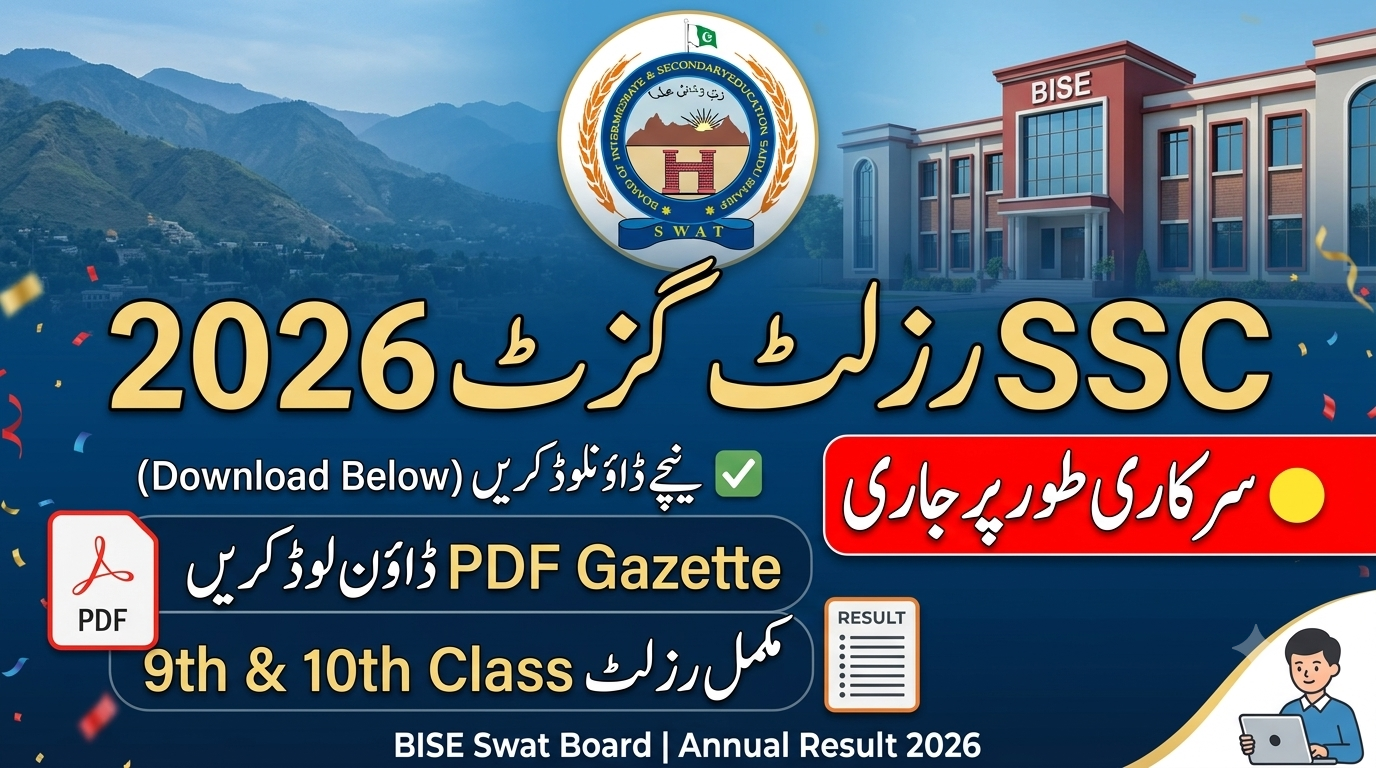
Protocol for Verifying the BISE Swat 9th Class Result 2026
Precision is paramount when accessing official records. To ensure data integrity, students should follow this verified workflow to check their results in the digital gazette:
- Download the official PDF version of the BISE Swat 9th Class Result 2026.
- Execute the Ctrl + F command on desktop or use the magnifying glass icon on mobile devices.
- Input the specific Roll Number to bypass manual scanning errors.
- Cross-reference the DMC (Detailed Marks Certificate) for subject-wise accuracy.
- Submit retotaling applications within the strict 15-day window if discrepancies are detected.
The Forward Path: A Momentum Shift for KPK
We categorize this development as a Momentum Shift. While the overall pass rate remains under 50%, the exceptional performance of female students in STEM subjects represents a strategic pivot for the region. The precision of the Swat Board’s reporting allows for data-driven interventions. To accelerate progress, the province must now focus on stabilizing the Humanities sector and providing boys with the same academic rigor that is currently fueling female success. The foundation is set; the next phase requires targeted institutional reinforcement.








