
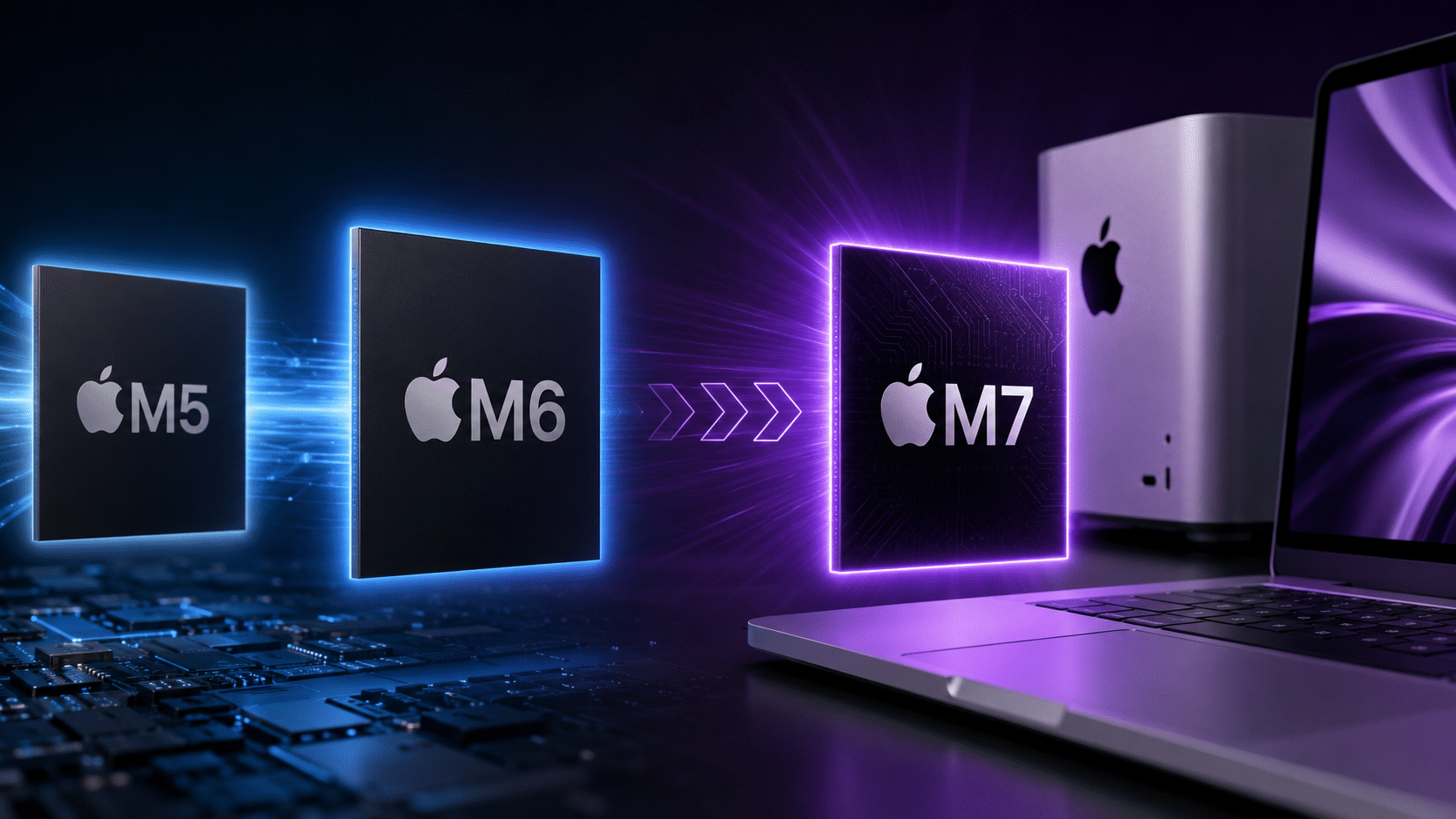
Apple is executing a calibrated shift in its silicon strategy, fast-tracking the development of Apple M7 chips to prioritize generative AI capabilities. By bypassing the Pro and Max variants of the M6 generation, the company focuses on a structural leap in neural processing efficiency. This strategic pivot ensures that Mac hardware remains the baseline for high-performance computing through 2027.
Engineering the Future: The Strategic Shift to Apple M7 Chips
According to recent industry intelligence, Apple will not release M6 Pro or M6 Max variants. Instead, the architectural roadmap redirects resources toward the Apple M7 chips lineup scheduled for 2027. While the base M6 chip will still debut with significant upgrades, the high-end computing segment will jump directly to the M7 architecture. This move suggests a precision focus on integrated AI workflows that require more than just iterative updates.

The base M6 chip currently serves as the technical catalyst for this transition. It is expected to deliver memory bandwidth of approximately 200GB/s, a substantial increase from the 153GB/s found in the M5 series. Furthermore, this processor will feature a redesigned GPU with 12 graphics cores and an upgraded Neural Engine. Consequently, users will experience faster media processing and enhanced CPU performance even before the M7 family arrives.

Apple intends to launch the core M7 family as early as the first half of 2027. The M7 Pro, M7 Max, and M7 Ultra models will follow shortly thereafter, targeting a late 2027 or 2028 release. Meanwhile, professionals requiring immediate power can look toward the M5 Ultra. This flagship chip, powering the refreshed Mac Studio, will boast 36 CPU cores and 80 GPU cores, supporting up to 768GB of unified memory.

The Situation Room Analysis
The Translation (Clear Context)
In technical terms, skipping a chip generation for “Pro” users is a rare structural maneuver. It indicates that the current M6 architecture reached a ceiling for AI optimization. Apple is prioritizing the Apple M7 chips because the hardware must evolve to meet the intense demands of on-device Large Language Models (LLMs). Essentially, Apple is choosing a “quantum leap” over incremental gains to maintain its lead in the global AI race.
The Socio-Economic Impact
For the Pakistani professional, this news provides a clear baseline for long-term investment. Students and creative professionals in Karachi or Lahore should understand that current high-end hardware will remain relevant longer, as the next true “power user” upgrade is delayed until 2027. While the wait for Apple M7 chips is longer, the eventual surge in system efficiency will lower the barrier for AI development in local tech hubs, empowering the next generation of Pakistani engineers.
The Forward Path (Opinion)
This development represents a Momentum Shift. Rather than saturating the market with minor iterations, Apple is consolidating its engineering power. This precision-driven roadmap ensures that when the M7 arrives, it won’t just be faster; it will be fundamentally different. It is a calculated bet on AI as the primary catalyst for personal computing in the next decade.








