
Anthropic has strategically released Claude Opus 5, a large language model engineered to provide flagship-tier performance while reducing operational costs by 50%. This release marks a critical baseline in the evolution of accessible compute, allowing developers to deploy high-precision reasoning at a fraction of previous expenditures. Consequently, this model serves as a catalyst for organizations requiring sophisticated knowledge-based processing without the prohibitive pricing of premium tiers.
Engineering Superior Reasoning and Coding
The architecture of Claude Opus 5 prioritizes structural efficiency in complex tasks. According to Anthropic, this model excels in knowledge-intensive work and significantly upgrades coding capabilities compared to its predecessor, Opus 4.8. Furthermore, it demonstrates calibrated performance in scientific research, specifically in predicting molecular variations within protein sequences. This precision allows researchers to simulate outcomes with higher confidence levels.
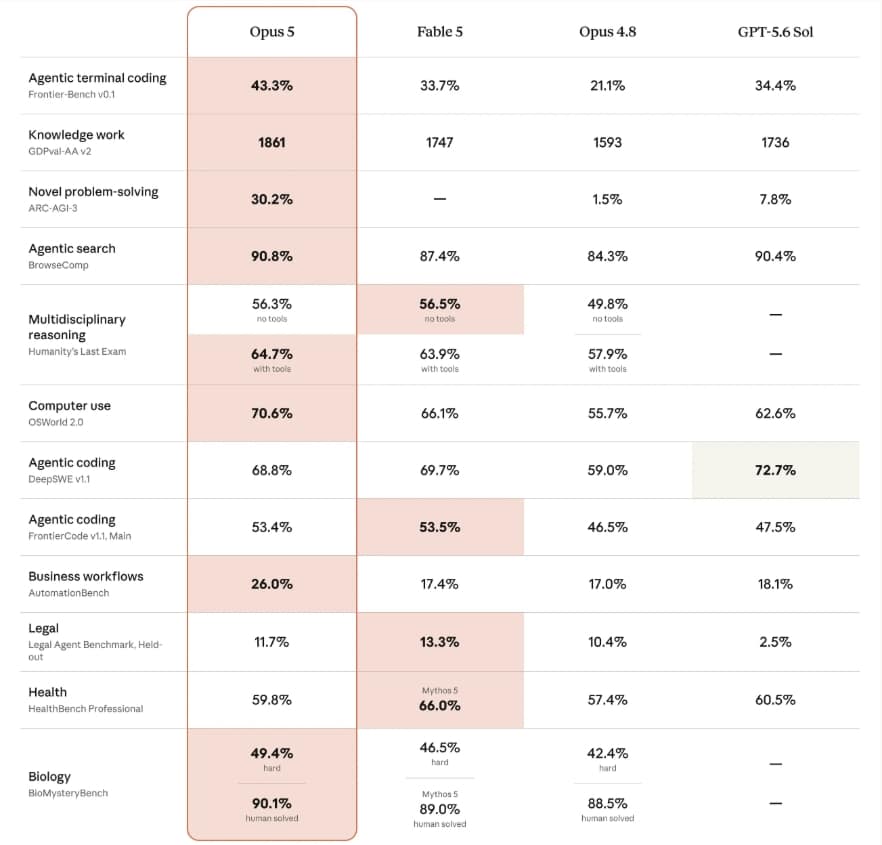
While the model was not explicitly trained for cybersecurity tasks like the restricted Mythos model, its broader structural improvements have naturally enhanced its security profile. It identifies vulnerabilities with greater accuracy; however, Anthropic maintains that it remains a defensive asset rather than an exploitation tool.
Structural Integrity and Reduced Deception
Anthropic has calibrated Claude Opus 5 to exhibit its lowest levels of deceptive behavior to date. By strengthening the model against manipulation attempts, the company ensures a more reliable user experience. In addition, the safety classifiers in this model intervene 85% less frequently than in Fable 5, allowing for a more fluid workflow for legitimate professional inquiries.

Users can now manage system resources through a new “effort” setting. This feature allows users to choose between thorough reasoning for complex problems or faster, token-efficient responses for routine tasks. This flexibility ensures that the model operates at peak system efficiency regardless of the workload.
Economic Accessibility and Competition
The pricing for Claude Opus 5 remains competitive, positioned at $5 per million input tokens and $25 per million output tokens. This strategic pricing directly challenges international competitors like Moonshot AI’s Kimi K3. While Kimi K3 offers lower output pricing, Anthropic’s model remains broadly accessible across all paid tiers without sign-up restrictions.
- Input Pricing: $5 per 1M tokens.
- Output Pricing: $25 per 1M tokens.
- Accessibility: Available on all paid subscription plans.
The Situation Room Analysis
The Translation
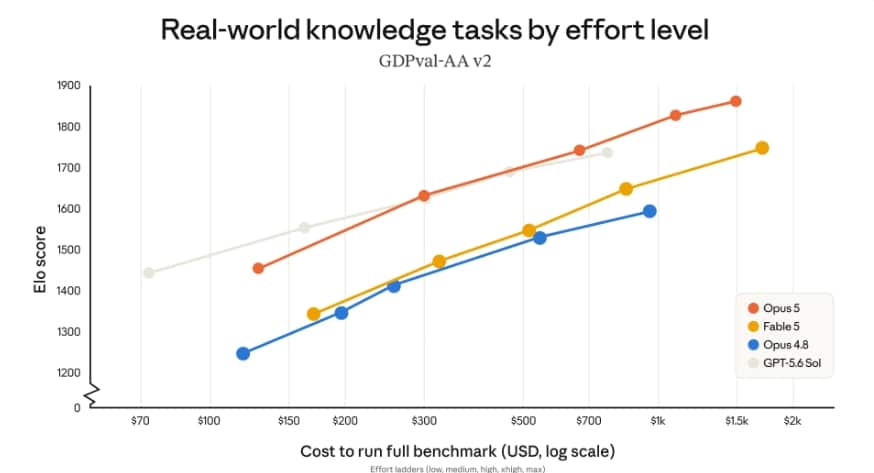
In technical terms, Anthropic has “right-sized” high-end AI. Instead of pushing only for raw power, they have optimized the ratio between intelligence and cost. Claude Opus 5 delivers 95% of the capability of a flagship model at 50% of the cost, making it the most efficient high-end model currently on the market.
The Socio-Economic Impact
For the Pakistani landscape, this development is a structural win for the tech sector. Local startups and freelancers can now integrate world-class AI reasoning into their platforms at a significantly lower baseline cost. This democratizes access to sophisticated tools for students and researchers in Karachi, Lahore, and Islamabad, potentially narrowing the digital divide with Western tech hubs.
The Forward Path
We categorize this as a Momentum Shift. By making high-tier reasoning affordable, Anthropic is forcing the industry to move away from “intelligence at any cost” toward “intelligence for every budget.” This shift will likely accelerate the adoption of AI-driven automation in developing economies.








