

The global landscape of wearable technology is undergoing a structural transformation as hardware moves toward localized intelligence. The introduction of the Anker AI chip, dubbed “Thus,” represents a calibrated shift from cloud-dependent processing to high-efficiency, on-device computation. This initial entry into custom silicon development positions Anker to redefine the baseline for performance in compact consumer electronics, starting with their flagship wireless earbuds scheduled for a May 21 debut in New York City.
Engineering Efficiency: The Architecture of the Anker AI Chip
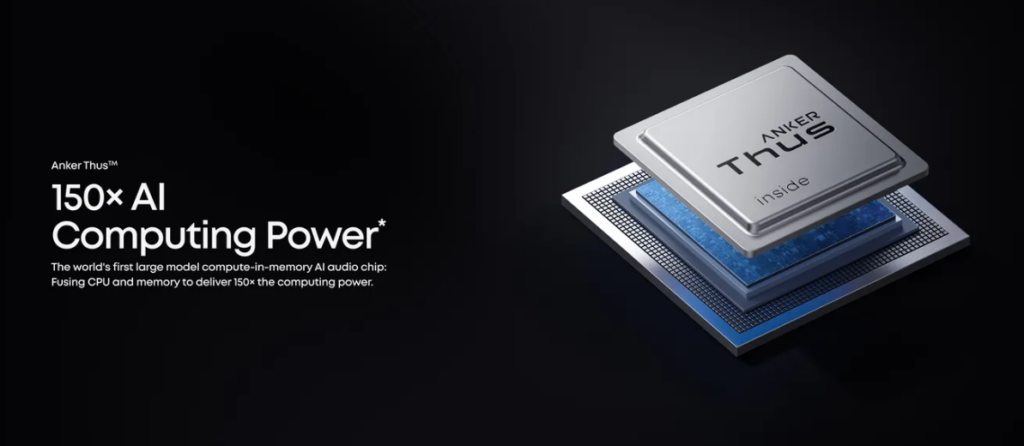
Anker engineered the Thus platform utilizing Compute-in-Memory (CiM) architecture. This design choice represents a strategic departure from traditional computing by integrating memory and processing into a single, unified unit. Consequently, the system processes data exactly where it is stored, effectively eliminating the bottleneck of moving information between separate components.

This architectural precision yields three primary benefits: lower latency, enhanced speed, and a significant reduction in power consumption. By optimizing these variables, Anker claims the new Anker AI chip delivers up to 150 times more AI computing power compared to their previous-generation audio products. This massive leap in capacity provides the necessary headroom for complex real-time audio algorithms.
On-Device Intelligence: Redefining Privacy and Speed
A fundamental catalyst for the Thus platform is the move toward autonomous on-device processing. Traditionally, sophisticated noise cancellation often required cloud assistance or high-drain processors. However, the Thus chip handles environmental noise cancellation and voice enhancement locally. Specifically, the system utilizes eight microphones and bone-conduction sensors to isolate the user’s voice with surgical precision.
Furthermore, on-device processing serves as a robust privacy layer. Because the data does not leave the device, users maintain complete control over their acoustic environment without exposing sensitive audio data to external servers. This localized approach also ensures stable performance in varied environments, regardless of internet connectivity.
The Situation Room: Strategic Analysis
The Translation (Clear Context)
In technical terms, Anker is moving from “generalist” hardware to “specialist” silicon. By building the Anker AI chip in-house, they no longer rely on third-party processor limitations. The Compute-in-Memory architecture is the equivalent of moving a chef’s ingredients directly onto the stove; it removes the “travel time” of data, making every action instantaneous and energy-efficient.
The Socio-Economic Impact
For the Pakistani citizen, this technology signifies a shift toward more durable and capable tools. Students and professionals in urban centers like Karachi and Lahore often navigate noisy commutes and remote meetings. The 150x power boost ensures that clear communication is no longer a luxury but a standard, while the energy efficiency addresses the practical need for devices that last longer between charges in areas with intermittent power access.
The Forward Path (Opinion)
This development represents a Momentum Shift. Anker is no longer just a peripheral manufacturer; they are now a silicon architect. By expanding this chip into mobile accessories and broader smart devices, Anker is establishing a proprietary ecosystem. For Pakistan’s burgeoning tech sector, this serves as a blueprint for how localized hardware innovation can disrupt established global markets.








