
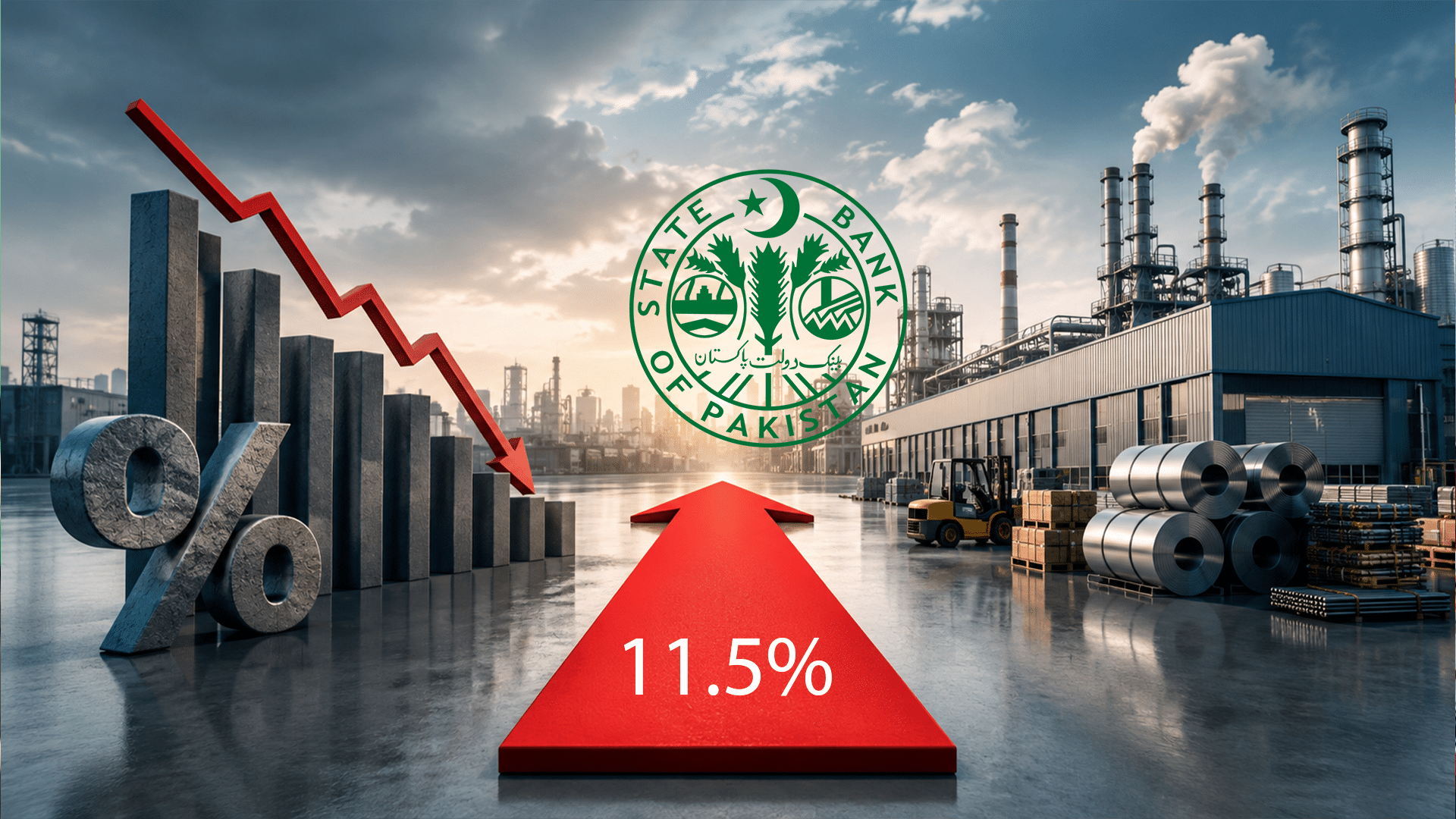
The State Bank of Pakistan (SBP) recently decided to maintain the SBP policy rate at 11.5 percent, a calibrated move that has triggered sharp criticism from the Federation of Pakistan Chambers of Commerce and Industry (FPCCI). Consequently, business leaders argue that this high-interest environment creates a structural barrier to national advancement and industrial efficiency. This high-density decision impacts the baseline of Pakistan’s economic engine, potentially stalling the momentum required for a robust recovery.
The Impact of the SBP Policy Rate on Industrial Growth
Saquib Fayyaz Magoon, Acting President of FPCCI, described the central bank’s decision as a “contractionary” catalyst that suppresses long-term investment. He noted that the combination of high borrowing costs and elevated energy tariffs creates a precision-deficit for Pakistani exporters. Consequently, these manufacturers struggle to maintain a competitive edge in international markets. Furthermore, the business community believes a transition to a single-digit SBP policy rate is essential to lower production costs and improve financial access.
FPCCI Vice President Abdul Mohamin Khan emphasized that core inflation has reached a stabilizing baseline. He argued that maintaining an aggressive 11.5 percent rate imposes an unnecessary burden on the private sector. Furthermore, expensive financing continues to contribute to industrial closures and weakens the structural integrity of Pakistan’s export targets for the current fiscal year.
The Situation Room: Analyzing the Monetary Landscape
The Translation: Breaking Down Contractionary Policy
In technical terms, a “contractionary” policy aims to reduce spending to control inflation. However, the logic here reveals a conflict between price stability and industrial survival. The FPCCI argues that when the SBP policy rate remains high, the cost of capital becomes a deterrent for innovation. Essentially, the central bank is prioritizing a cooled economy over the rapid expansion that businesses need to thrive.
The Socio-Economic Impact: Cost of Living vs. Cost of Doing Business
For the average Pakistani citizen, this high-rate environment acts as a double-edged sword. While it aims to prevent runaway inflation, it simultaneously limits job creation by making business expansion unaffordable. Urban professionals may see a stagnation in salary growth as companies struggle with high overheads. In rural areas, the trickle-down effect of reduced industrial activity can lead to decreased demand for raw materials and labor.
The Forward Path: A Stabilization Move or Momentum Shift?
We categorize this development as a Stabilization Move. While the SBP seeks to maintain a disciplined fiscal baseline, the lack of a rate cut represents a missed opportunity for a momentum shift. For Pakistan to achieve its strategic growth targets, the monetary policy must eventually pivot toward an accommodative stance. Without a clear roadmap for interest rate reduction, the industrial sector may remain in a state of defensive maintenance rather than proactive growth.








