Pakistan banking profits are projected to contract by 10% in the second quarter of 2026, reaching an estimated Rs. 121.9 billion. This structural shift, identified by Topline Securities, stems primarily from the absence of the high capital gains observed in previous quarters. While overall earnings decelerate, net interest income continues to act as a resilient catalyst for the sector’s baseline stability.
Calibrating the Fiscal Shift: Q2 2026 Metrics
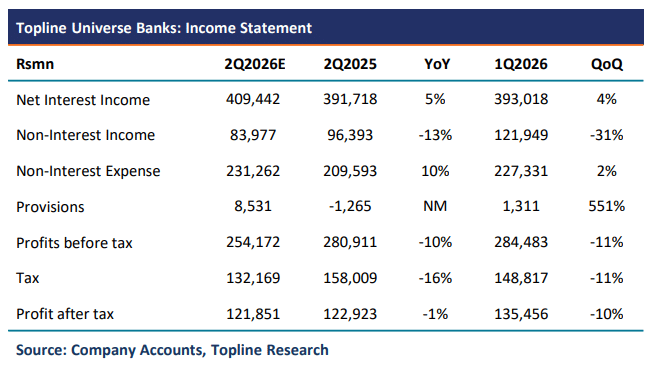
The projected profit after tax of Rs. 121.9 billion represents a significant calibration compared to the Rs. 135.5 billion recorded in Q1. Consequently, on a year-on-year basis, earnings expect a marginal 1% decline. This is largely attributed to higher operating expenses and the return of provision charges. However, a lower effective tax rate of 52% will likely provide a strategic buffer, partially offsetting the weaker profitability across the banking sector earnings landscape.
Core Income vs. Non-Interest Volatility
Despite the downward pressure on net profits, banks demonstrate a precise improvement in core revenue streams. Net interest income is expected to climb 5% year-on-year to Rs. 409.4 billion. This growth is supported by strategic loan adjustments and policy rate repricing. In contrast, non-interest income faces a 31% quarterly decline, dropping to Rs. 84 billion due to depleted capital gains. Furthermore, provision expenses are set to rise to Rs. 8.5 billion, marking a sharp departure from previous reversals.
Individual Bank Trajectories
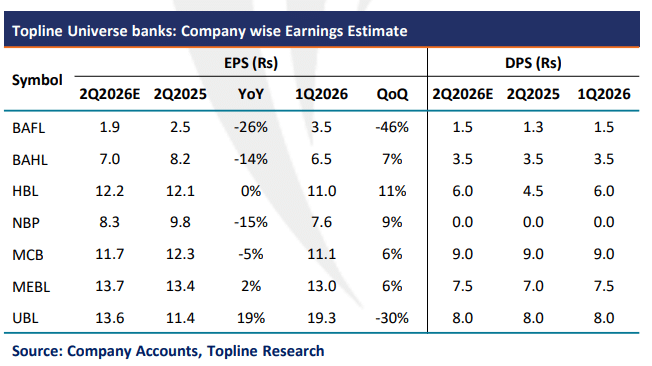
The performance across institutions remains mixed, reflecting varied institutional precision. Key highlights include:
- Meezan Bank: Leads with an expected EPS of Rs. 13.7 (2% YoY increase).
- United Bank Limited (UBL): Forecasts the strongest growth of 19% with an EPS of Rs. 13.6.
- Habib Bank (HBL): Stability maintained with an estimated EPS of Rs. 12.2.
- Bank Alfalah: Projects a 26% decline in EPS to Rs. 1.9.
Crucially, dividend payouts remain stable. Topline Securities anticipates that MCB and UBL will maintain high quarterly payouts of Rs. 9 and Rs. 8 per share, respectively, backed by comfortable capital buffers.
The Translation
In simple terms, Pakistan’s banks are moving away from “easy wins.” Last year, banks made massive profits by selling assets (capital gains) and benefiting from unique accounting reversals. Now, they must rely on their core business: lending money. While the headline profit numbers look smaller, the net interest income Pakistan banks are generating shows that the fundamental engine of the banking system is still functional and growing.
The Socio-Economic Impact
For the average Pakistani citizen, this development signals a period of banking stabilization. While lower profits might slightly impact the stock market valuation of these banks, the “comfortable capital buffers” mean your deposits remain secure. For shareholders, particularly those relying on dividends for household income, the steady payouts from major banks like MCB and UBL provide a necessary financial baseline in an inflationary environment.
The Forward Path: Momentum Shift or Stabilization?
We categorize this development as a Stabilization Move. The decline in Pakistan banking profits is not a sign of systemic failure but rather a return to a normalized baseline. The banking sector is shedding the “inflationary fluff” of capital gains and refocusing on structural lending. This transition is essential for long-term system efficiency, ensuring that banks remain catalysts for national economic growth rather than just beneficiaries of market volatility.