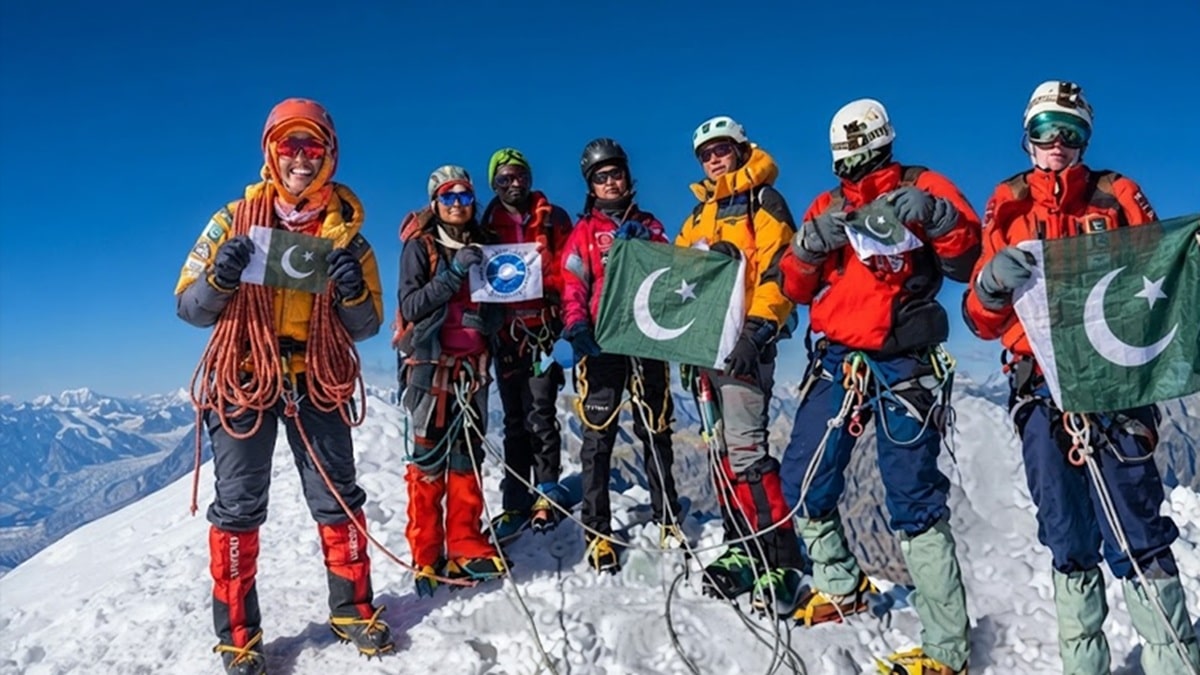
Eight Pakistani women mountaineers successfully summited the 6,040-meter-high Khusar Gang Peak, marking a calibrated advancement for female high-altitude sports. This achievement occurred during the Alpine Club of Pakistan’s second women’s expedition, demonstrating a strategic expansion of professional climbing opportunities. Bibi Afzoon led the diverse unit, which included representatives from Gilgit-Baltistan, Punjab, Khyber Pakhtunkhwa, Balochistan, and Islamabad.
A Calibrated Ascent: Technical Precision and Unity
The expedition functioned as a catalyst for national unity by recruiting talent from across Pakistan’s diverse geography. Consequently, the team benefited from a wide spectrum of endurance profiles and local expertise. Renowned guides Ali Muhammad Sadpara, Sadiq Hussain Sadpara, and Ilyas Hushe provided technical oversight to ensure systemic safety during the ascent. Specifically, Qaid Shigri managed the critical rope-fixing operations, facilitating a precise path to the mountain’s crest.
Professionalizing the Mountaineering Frontier
Alpine Club of Pakistan Secretary General Ayaz Shigri noted that this success validates the professional abilities of Pakistani women mountaineers. Furthermore, the organization aims to continue engineering pathways for female athletes to showcase their skills on international platforms. By establishing a baseline of technical proficiency, Pakistan is positioning itself as a hub for inclusive adventure tourism.
The Translation: Beyond the Summit
In the context of “Next Gen” clarity, this expedition is not merely a sports headline; it is a logistical triumph. High-altitude mountaineering requires sophisticated physiological calibration and synchronized teamwork. By successfully navigating the 6,040-meter threshold, these athletes have transitioned from recreational climbers to high-performance specialists. This shift signifies that Pakistan is moving toward a formalized infrastructure for extreme sports that ignores traditional gender constraints.
The Socio-Economic Impact: Scaling National Progress
This development directly impacts the daily lives of Pakistanis by redefining the “possible” for young girls in both urban and rural sectors. When women from Balochistan and Gilgit-Baltistan collaborate on a global-standard peak, it reinforces geographic inclusivity and social mobility. Moreover, the growth of female-led expeditions creates a new niche in the domestic tourism economy, potentially generating localized employment for female guides and logistics managers in mountain regions.
The Forward Path: A Momentum Shift
We categorize this successful summit as a definitive Momentum Shift. While previous expeditions were often isolated events, the Alpine Club’s recurring commitment indicates a structural transition toward sustainable athletic development. To maintain this trajectory, Pakistan must now invest in precision training facilities and international sponsorships. This expedition serves as the baseline for a future where Pakistani women are standard-setters in the global mountaineering community.