
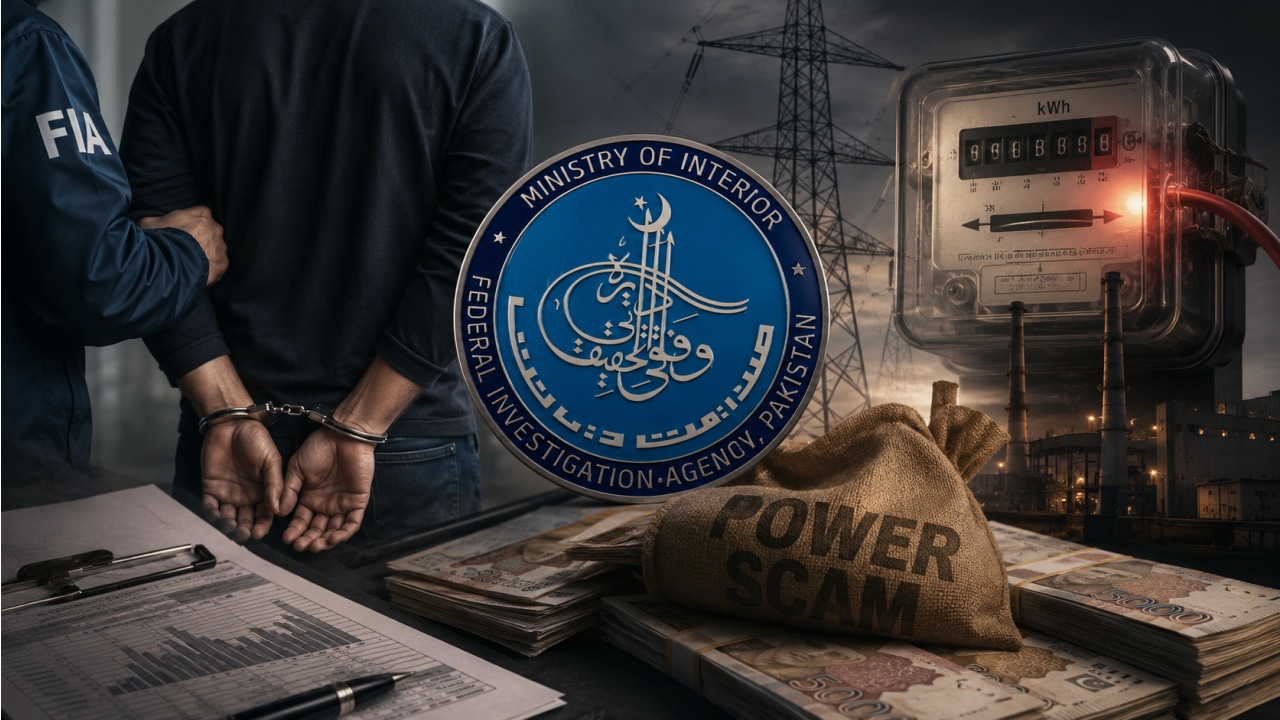
The structural integrity of Pakistan’s energy infrastructure faces a critical recalibration as the Federal Investigation Agency (FIA) cracks down on institutional leakage. The agency recently executed a decisive move in the FESCO corruption case by arresting two former CEOs, Khurshid Alam and Ahmad Saeed Khan, regarding a staggering Rs. 12 billion electricity fraud. This calibrated enforcement action targets systemic inefficiencies that have historically depleted the national exchequer and burdened the public treasury.
Strategic Breakdown of the FESCO Corruption Case
The FIA Composite Circle Faisalabad registered the case under the Prevention of Corruption Act and various provisions of the Pakistan Penal Code. Specifically, the charges include criminal breach of trust, forgery, and conspiracy. To ensure a thorough investigation, a local court granted the FIA a five-day physical remand of the primary suspects. Furthermore, authorities placed the accused on the Exit Control List (ECL) to prevent any movement outside the country during the legal proceedings.

Investigators allege that the accused colluded between 2007 and 2015 to manipulate power purchase and sale arrangements. Consequently, several industrial companies secured unlawful financial benefits at the expense of the state. One company reportedly sold electricity to FESCO at rates exceeding those approved by the Central Power Purchasing Agency (CPPA), while simultaneously receiving subsidized power as a bulk consumer.
The Translation: Decoding the Power Scam
In technical terms, the FESCO corruption case represents a dual-exploitation of the energy grid. The accused utilized “regulatory arbitrage,” where they exploited the price difference between bulk consumer rates and producer supply rates. By presenting misleading documents to the National Electric Power Regulatory Authority (NEPRA) and Sui Northern Gas Pipelines Limited (SNGPL), these entities masqueraded as “small power producers” to gain access to subsidized natural gas. In reality, they functioned as captive plants, effectively “double-dipping” into state resources while providing zero net-gain to the national grid.

The Socio-Economic Impact: Why This Matters
- Household Energy Costs: When Rs. 12 billion is drained through fraud, the resulting deficit contributes directly to the national circular debt, leading to higher tariffs for every Pakistani household.
- Institutional Trust: This case serves as a baseline for restoring faith in public utilities, ensuring that professionals in Faisalabad and beyond are not subsidizing the illicit gains of industrial conglomerates.
- Resource Scarcity: The misuse of subsidized natural gas diverts critical fuel away from efficient national power plants, potentially worsening load-shedding in rural and urban areas.
The Forward Path: A Momentum Shift
This development represents a significant Momentum Shift in Pakistan’s pursuit of systemic accountability. Rather than a mere stabilization move, the FIA’s precision in targeting high-level executives signals that the era of “untraceable leakage” is closing. For Pakistan to achieve economic efficiency, the energy sector must transition from a site of political patronage to a calibrated, STEM-driven utility. This case sets a necessary precedent: technical expertise must be used for national advancement, not structural exploitation.









