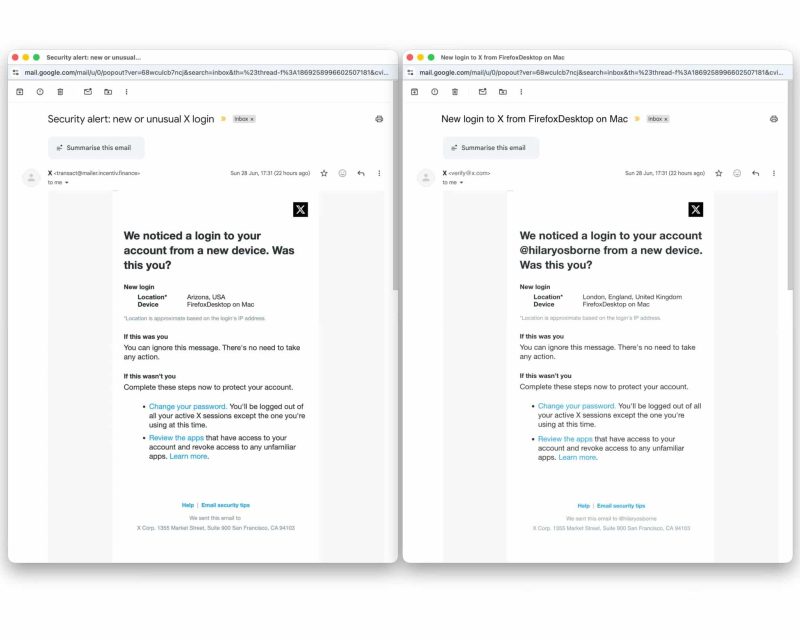
A highly calibrated X login scam is currently infiltrating digital ecosystems, utilizing sophisticated phishing emails that mirror official security notifications. These fraudulent communications claim an unauthorized login occurred from a distant location, pressuring users to “reset” their credentials through malicious links. Consequently, unsuspecting individuals inadvertently grant attackers full administrative control over their digital identities, highlighting a critical vulnerability in standard verification habits.
The Translation: Deciphering the Phishing Architecture
In technical terms, this campaign represents a high-fidelity social engineering attack. Scammers utilize the X logo, precise brand colors, and professional syntax to bypass a user’s initial skepticism. While the email provides legitimate-sounding security advice—such as reviewing connected apps—the underlying hyperlinks lead to a precision-engineered credential harvesting site. This site functions as a structural trap, capturing usernames, passwords, and two-factor authentication codes in real-time. Global cybersecurity experts, including Jake Moore of ESET, emphasize that these actors seek direct account takeover or the authorization of malicious third-party applications to maintain persistent access.
Identifying Tactical Warning Signs
Modern phishing has evolved beyond the baseline of poor grammar and broken layouts. To identify this X login scam, users must examine the structural metadata of the communication. Specifically, check the sender’s domain; X only utilizes @X.com or @e.X.com for official correspondence. Furthermore, hover over buttons to reveal the actual destination URL before clicking. If the link does not point directly to an official X.com subdirectory, it is a catalyst for data theft. On mobile devices, the safest protocol is to bypass email links entirely and verify account status through the official application interface.

Situation Room: Socio-Economic Impact
The compromise of an X account extends far beyond social media presence; it represents a significant risk to the socio-economic stability of Pakistani professionals and students. Stolen accounts frequently serve as platforms for misinformation campaigns, crypto-currency fraud, and identity theft. For a digital entrepreneur in Lahore or a student in Karachi, a hijacked profile can result in reputational damage and financial loss. As our economy increasingly digitizes, the integrity of our digital credentials becomes a baseline requirement for national systemic efficiency.
The Forward Path: Structural Security Upgrades
This development represents a Momentum Shift in the sophistication of cyber-threats targeting the Pakistani digital frontier. We must move beyond reactive measures and adopt a baseline of “Zero Trust” in communication. The structural solution involves enabling hardware-based two-factor authentication (2FA) and regularly auditing third-party app permissions. By verifying security alerts within the genuine app environment rather than through external links, users can neutralize the effectiveness of the X login scam and fortify their personal digital infrastructure.