
Pakistan’s economic landscape faced a calibrated shock as the Pakistan FDI Decline reached a staggering 94 percent in June 2026. Data released by the State Bank of Pakistan confirms that net foreign direct investment plummeted to a mere $14 million. This contraction represents a significant baseline shift from the previous year, requiring a precise evaluation of our national investment catalysts.
The Structural Mechanics of the Contraction
The fiscal year 2026 concluded with a total net FDI of $1.64 billion, marking a 34 percent year-on-year decrease. While direct investment inflows reached $294 million in June, the system experienced massive outflows. Foreign investors repatriated approximately $281 million during the same period. Consequently, this 248 percent surge in repatriation compared to May neutralized nearly all incoming capital.
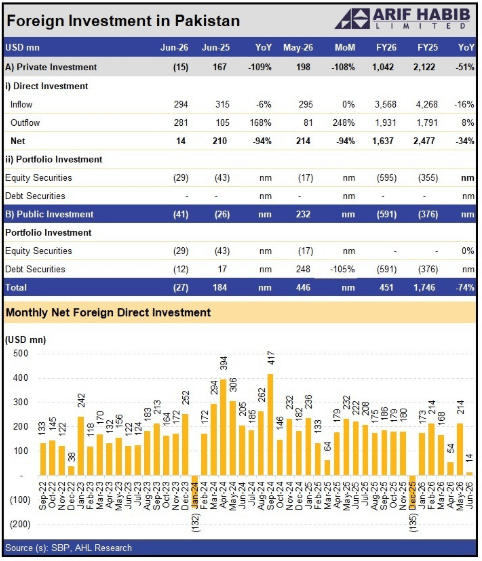
Furthermore, total foreign investment, encompassing both direct and portfolio sectors, recorded a net outflow of $27 million in June. This contrasts sharply with the $446 million inflow recorded just one month prior. Strategically, the private sector and public investment both posted significant net outflows, exceeding $590 million each for the full fiscal year.
The Translation: Breaking Down the Data
In “Next Gen” clarity, these figures indicate that while Pakistan still attracts some interest, the “exit door” is currently wider than the “entrance.” Repatriation refers to foreign companies sending their profits back to their home countries. When repatriation surges by 248 percent, it signals that global investors are prioritizing liquidity over long-term local reinvestment. This Pakistan FDI Decline is not just a lack of interest; it is an active withdrawal of capital.
The Socio-Economic Impact
For the average Pakistani citizen, a 94 percent decline in net investment directly threatens job creation and technological advancement. Students entering the STEM workforce may find fewer opportunities in multinational firms as capital reserves tighten. Moreover, the increased pressure on the Rupee, caused by high repatriation, can lead to inflationary spikes in imported goods, affecting every household budget from Karachi to Gilgit.

The Forward Path: An Expert Assessment
This development represents a Stabilization Move that has unfortunately veered into a liquidity crisis. While the repatriation of profits is a right of any investor, the sheer volume suggests a lack of confidence in local reinvestment cycles. To reverse this Pakistan FDI Decline, we must implement structural reforms that incentivize the retention of earnings within our borders. We are at a critical junction where precision policy is the only catalyst for renewed momentum.