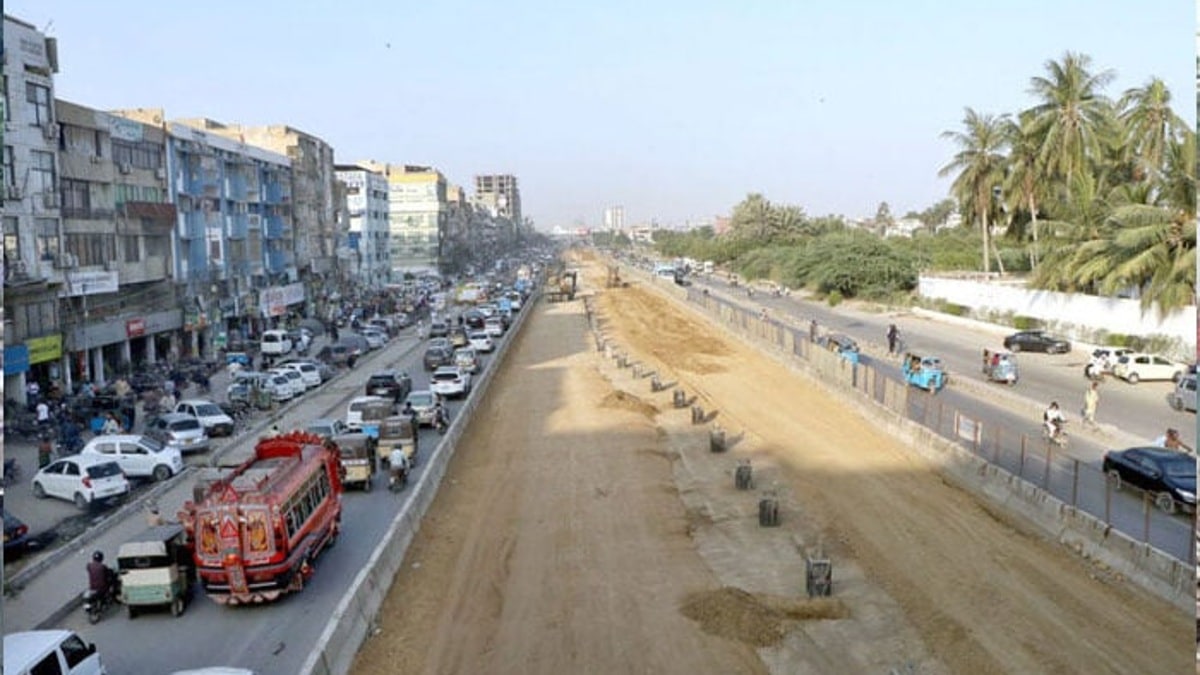
The Sindh Government has strategically reopened the mixed traffic lane on Karachi University Road to mitigate the systemic congestion caused by the Red Line BRT construction. This calibrated adjustment aims to restore transit efficiency for thousands of daily commuters. Sindh Senior Minister Sharjeel Inam Memon finalized the decision during a high-level review of the project’s architectural progress.
Strategic Infrastructure Management and the Red Line BRT
The Red Line Bus Rapid Transit (BRT) serves as a transformative catalyst for Karachi’s outdated public transport system. Officials report that construction across multiple sectors is progressing with precision. Minister Memon emphasized that completing this structural overhaul remains a baseline priority for regional development. Consequently, all relevant departments now operate under strict deadlines to ensure the project meets its calibrated delivery date.
Optimizing Urban Flow on Karachi University Road
By reopening the mixed traffic lanes, the government provides an immediate safety valve for the city’s pressurized road network. The strategic intent is to balance long-term infrastructure goals with the immediate mobility needs of the populace. Minister Memon reiterated the government’s commitment to delivering an environmentally friendly and technologically modern transit solution for Karachi’s residents.
The Situation Room: Analysis
The Translation (Clear Context)
While the Red Line BRT represents a future-proof transit system, its construction has physically constrained one of Karachi’s busiest arteries. A “mixed traffic lane” refers to the space shared by private vehicles and public transport. Reopening this lane effectively increases the road’s “throughput”—the number of vehicles that can pass through a point in a given time—reducing the bottlenecking that has plagued Karachi University Road for months.
The Socio-Economic Impact
This development directly impacts the “Time-Tax” paid by Karachi’s workforce and student body. For a university student or a healthcare professional, reduced congestion translates into:
- Increased Productivity: Less time spent in stationary traffic equals more hours for academic or professional output.
- Reduced Fuel Consumption: Smoother traffic flow decreases the baseline fuel expenditure for middle-income households.
- Lowered Stress Levels: Improved predictability in commute times enhances the overall mental well-being of the urban population.
The Forward Path (Opinion)
This decision represents a Momentum Shift. Rather than adhering to a rigid construction schedule that ignores citizen friction, the Sindh government is demonstrating “Agile Governance.” By calibrating the road usage in real-time, they are maintaining public support for the Red Line BRT while ensuring the city’s economic heart continues to beat. This precision in management is exactly what Karachi requires to transition into a modernized metropolis.