
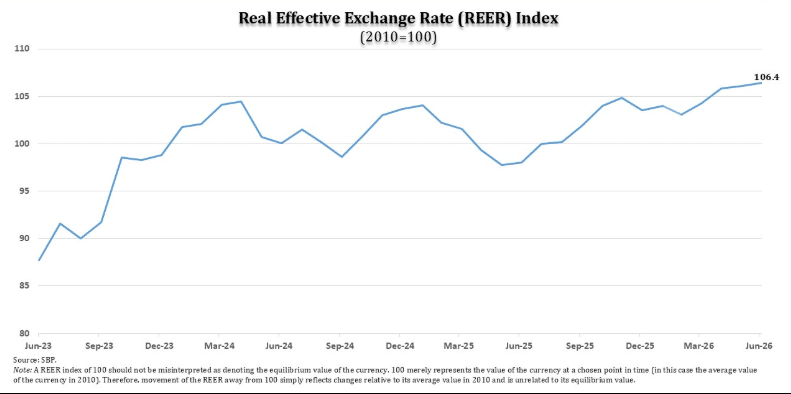
Pakistan’s economic architecture faces a critical calibration challenge as the Rupee Overvaluation reached a seven-year peak in June 2026. The Real Effective Exchange Rate (REER) serves as a primary metric for assessing our currency’s global standing. Consequently, the recent climb to 106.44 signals a significant departure from historical norms, exceeding the 10-year average of 102.52.
The Structural Data of Rupee Overvaluation
Topline Securities recently analyzed the upward trajectory, noting that any REER value exceeding 100 indicates an overvalued currency. Specifically, the rate moved from 106.08 in May to 106.44 in June. This steady ascent began in early 2024, driven by macroeconomic stabilization efforts and easing inflation differentials. However, this stability creates a dual-edged sword for the national economy.
Analyzing the Mechanism of REER
The REER index measures the rupee’s value against a basket of currencies from Pakistan’s primary trading partners, adjusted for relative inflation. When the index stays high, Pakistani goods effectively become more expensive for international buyers. Therefore, our textile and manufacturing sectors face diminished price competitiveness on the global stage. While the exchange rate remains stable, the underlying “real” value is putting pressure on our trade balance.
The Translation: Context for the Next Gen
Think of REER as a “competitive handicap” in global trade. A value of 106.44 means the Rupee is roughly 6.44% more expensive than it should be to maintain parity with our competitors. Consequently, even if a factory in Karachi remains efficient, its products might cost more than similar items from Vietnam or India simply because of currency valuation. This is not just a banking figure; it is a measure of our national “sales price” in the global mall.
The Socio-Economic Impact
This development directly impacts the household level through a complex trade-off. For the urban professional, a high REER keeps the price of imported fuel, electronics, and food items relatively stable. However, for the millions employed in the export sector—such as textiles and leather—this overvaluation threatens job security and wage growth. If our exports become too expensive to sell, the industrial engine slows down, leading to a wider trade deficit that eventually requires more external borrowing.
The Forward Path: Strategic Analysis
This current trend represents a Stabilization Move rather than a momentum shift. While a stable rupee provides a baseline for short-term planning, the persistent overvaluation acts as a structural brake on export-led growth. To achieve long-term prosperity, Pakistan must calibrate its currency policy to support productivity. We must ensure that stability today does not come at the cost of our industrial competitiveness tomorrow. Precision in exchange rate management is now a national imperative.








