
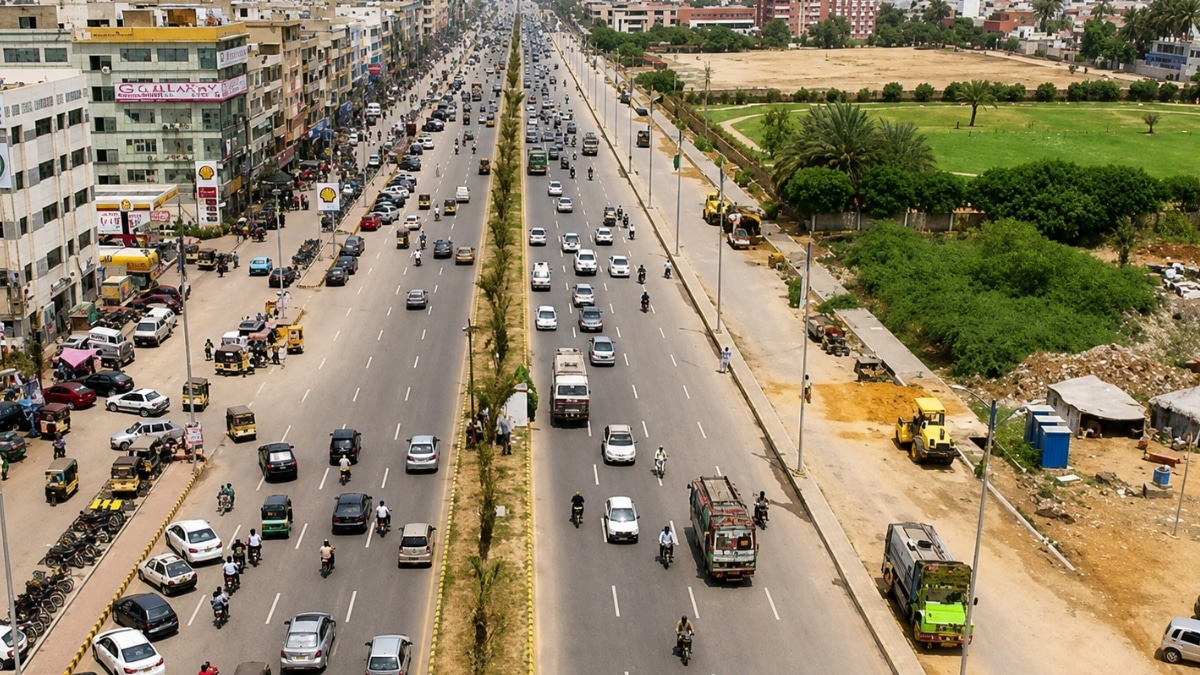
The structural integrity of Karachi’s urban mobility is witnessing a calibrated restoration as authorities reopen critical arteries of the Karachi University Road corridor. This development marks a primary milestone in the city’s ongoing effort to optimize its transit baseline. Officials confirmed that the newly completed carriageways between Hassan Square and Jail Road are now operational in both directions. Consequently, this shift facilitates an uninterrupted traffic flow along one of the metropolitan area’s most vital commercial and educational lifelines.
Strategic Connectivity and Traffic Optimization
The rehabilitation project has successfully restored the link between Jail Road and Mazar-e-Quaid, effectively bridging central Karachi with its outlying districts. These strategic openings specifically target the high-density congestion that previously plagued surrounding secondary roads. By diverting the volume back to the primary corridor, the system regains its intended efficiency. While the Safari Park to NIPA section is already functional, the Frontier Works Organization (FWO) continues to accelerate work on the Safora to Mazar-e-Quaid stretch.

The Translation: Logic Behind the Logistics
In technical terms, the reopening of Karachi University Road represents a transition from “reactive maintenance” to “structural rehabilitation.” By involving the FWO, the Sindh government has signaled a move toward disciplined engineering standards. The focus is no longer just on patching surfaces but on creating a durable carriageway capable of handling heavy axle loads. This precision-driven approach ensures that the road serves as a long-term catalyst for movement rather than a recurring point of failure.
The Socio-Economic Impact
For the average Pakistani citizen, this development translates directly into “Time Equity.” Students attending nearby universities and professionals commuting to the city center will experience a significant reduction in idle time. Furthermore, improved road conditions lead to:
- Reduced Fuel Consumption: Lower congestion minimizes stop-and-go driving, saving household income.
- Vehicle Longevity: Smoother surfaces reduce the mechanical strain on motorcycles and family cars.
- Enhanced Logistics: Local businesses benefit from more predictable delivery schedules and reduced transit costs.
This progress directly improves the baseline quality of life for thousands of households in Karachi’s central and eastern districts.
The Forward Path: Momentum Shift
We classify the recent developments on Karachi University Road as a genuine Momentum Shift. The transition of the project to the FWO in April 2026 provided the structural discipline required to break the cycle of delays. However, the true test remains the completion of the Safora-to-Mazar-e-Quaid segment. If authorities maintain this calibrated pace, Karachi will successfully convert a long-standing logistical bottleneck into a high-performance transit asset. System efficiency is finally catching up with the city’s rapid expansion.








