
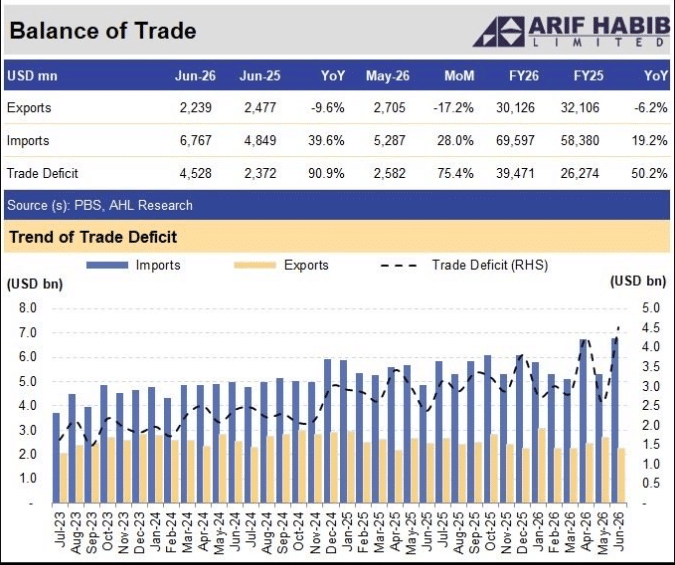
Structural imbalances in a nation’s balance of payments act as a friction coefficient against sustainable growth. Consequently, the Pakistan Trade Deficit surged by 50% to reach a staggering $39.5 billion by the end of FY26. Data from the Pakistan Bureau of Statistics (PBS) indicates that while imports climbed to $69.597 billion, exports contracted by 6.2%, creating a widening gap that threatens long-term currency stability and industrial precision.
Decoding the FY26 Pakistan Trade Deficit Expansion
The cumulative deficit represents a significant departure from the $26.27 billion baseline recorded in FY25. Over the 12-month period, imports rose by nearly 20% year-on-year. In contrast, the export sector struggled, dropping to $30.126 billion. This divergent trajectory suggests a calibration error in national trade policy, where consumption-driven imports outpace production-oriented exports.
June 2026: A Critical Monthly Snapshot
The month of June served as a catalyst for these worsening figures. The trade gap for the month reached $4.528 billion, representing a 90.9% increase compared to June of the previous year. Furthermore, the deficit worsened by 75.4% compared to May 2026. This sharp monthly spike indicates an accelerating trend of capital outflow that requires immediate structural intervention.
The Situation Room: Data-Driven Analysis
The Translation (Clear Context)
In “Next Gen” terms, a trade deficit occurs when a nation spends more on foreign goods than it earns from selling its own. The 50% increase signifies that Pakistan is increasingly reliant on external markets for energy, raw materials, and finished products. The 6.2% decline in exports is particularly concerning, as it indicates that our local industries are losing competitive ground in the global marketplace.
The Socio-Economic Impact
This development directly affects the daily lives of Pakistani citizens through the mechanism of currency devaluation. As the Pakistan Trade Deficit widens, demand for foreign currency increases, putting downward pressure on the Rupee. Consequently, households will likely face higher costs for fuel, electricity, and imported food items. For students and professionals, this translates to a higher cost of living and increased prices for essential technology and hardware.
The Forward Path (Opinion)
This development represents a Momentum Shift toward economic instability. To stabilize the baseline, Pakistan must pivot from a consumption-based economy to an export-led growth model. Precision investments in value-added sectors like IT and high-tech manufacturing are no longer optional; they are structural necessities. Without a calibrated strategy to boost export volume, the fiscal gap will continue to erode national purchasing power.








