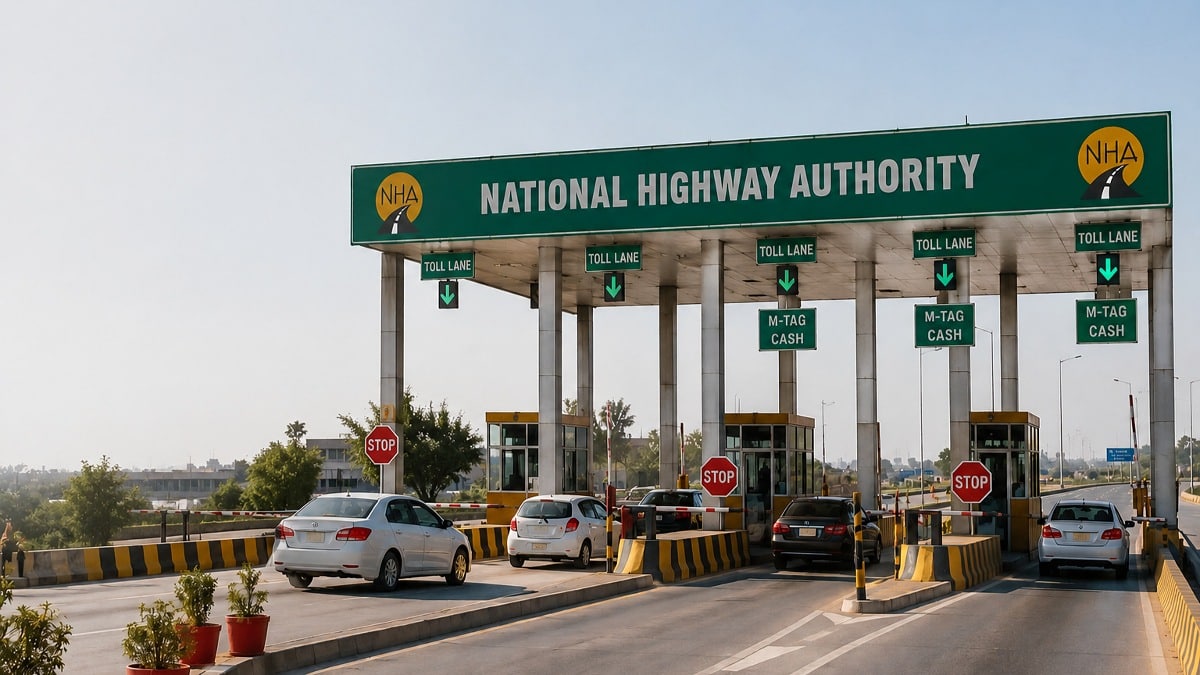
The Islamabad High Court currently evaluates a strategic legal challenge against the National Highway Authority (NHA) regarding the imposition of an Extra Toll Tax. This litigation questions the structural validity of a 50% penalty levied on vehicles without functional M-Tags or sufficient prepaid balances. Petitioner Muhammad Jalal Haider asserts that this fiscal measure lacks a calibrated legislative foundation under current Pakistani law. Consequently, the judiciary must now determine if the NHA overextended its administrative mandate by transforming a regulatory requirement into a punitive financial instrument.
The Legal Challenge Against the Extra Toll Tax
According to the petition filed on May 30, 2025, the NHA initiated a notification that mandates a 50% surcharge for non-compliant commuters. The petitioner argues that Section 10 of the NHA Act exclusively empowers the authority to collect baseline tolls. Furthermore, the law does not provide a precision-based mechanism for the NHA to impose fines for M-Tag deficiencies. Therefore, the petitioner contends that these penalties violate Articles 4, 18, 24, and 25 of the Constitution. The legal filing seeks a complete refund of all funds collected under this unauthorized notification.
The Translation: Systemic Logic and Legal Overreach
In technical terms, the NHA is attempting to utilize a “Service Fee” structure to enforce a behavioral shift toward digital automation. However, the Extra Toll Tax effectively acts as a fine without the requisite parliamentary oversight. While the NHA aims for operational efficiency through M-Tags, the transition lacks the legislative framework to penalize citizens for technical non-compliance. In contrast to standard toll collection, these surcharges represent a structural shift toward executive-led taxation, which the IHC is now asked to recalibrate.
The Socio-Economic Impact: Impact on Pakistani Commuters
This development directly impacts the daily expenditure of thousands of professionals and logistics operators across Pakistan. For the average household, an unexpected 50% increase in transit costs acts as a catalyst for financial strain, particularly during periods of high inflation. Moreover, students and small-scale traders who rely on highway networks for connectivity face higher operational costs. If the court strikes down the notification, it will restore the baseline cost of mobility and protect citizens from arbitrary fiscal adjustments at toll plazas.
The Forward Path: A Momentum Shift for Governance
In my expert opinion, this legal intervention represents a critical Momentum Shift toward accountability in national infrastructure management. While digital adoption is vital for system efficiency, the enforcement must remain within the parameters of constitutional law. For Pakistan to achieve a precision-based transport ecosystem, authorities must incentivize technology through utility rather than punitive surcharges. Consequently, this case will serve as a baseline for how future digital mandates are integrated into the public sphere without compromising civil liberties.