
Global technological parity relies on the unhindered flow of calibrated computational intelligence across borders. Consequently, the US Department of Commerce has officially lifted export controls on Anthropic’s Claude Fable 5 and Mythos 5 models. This decision allows the company to restore foreign access to these sophisticated systems, which were abruptly taken offline in June following a government directive. Anthropic confirmed that restoration procedures will begin immediately, signaling a pivot back toward international AI integration.
The Mechanics of Structural Restoration for Claude Fable 5
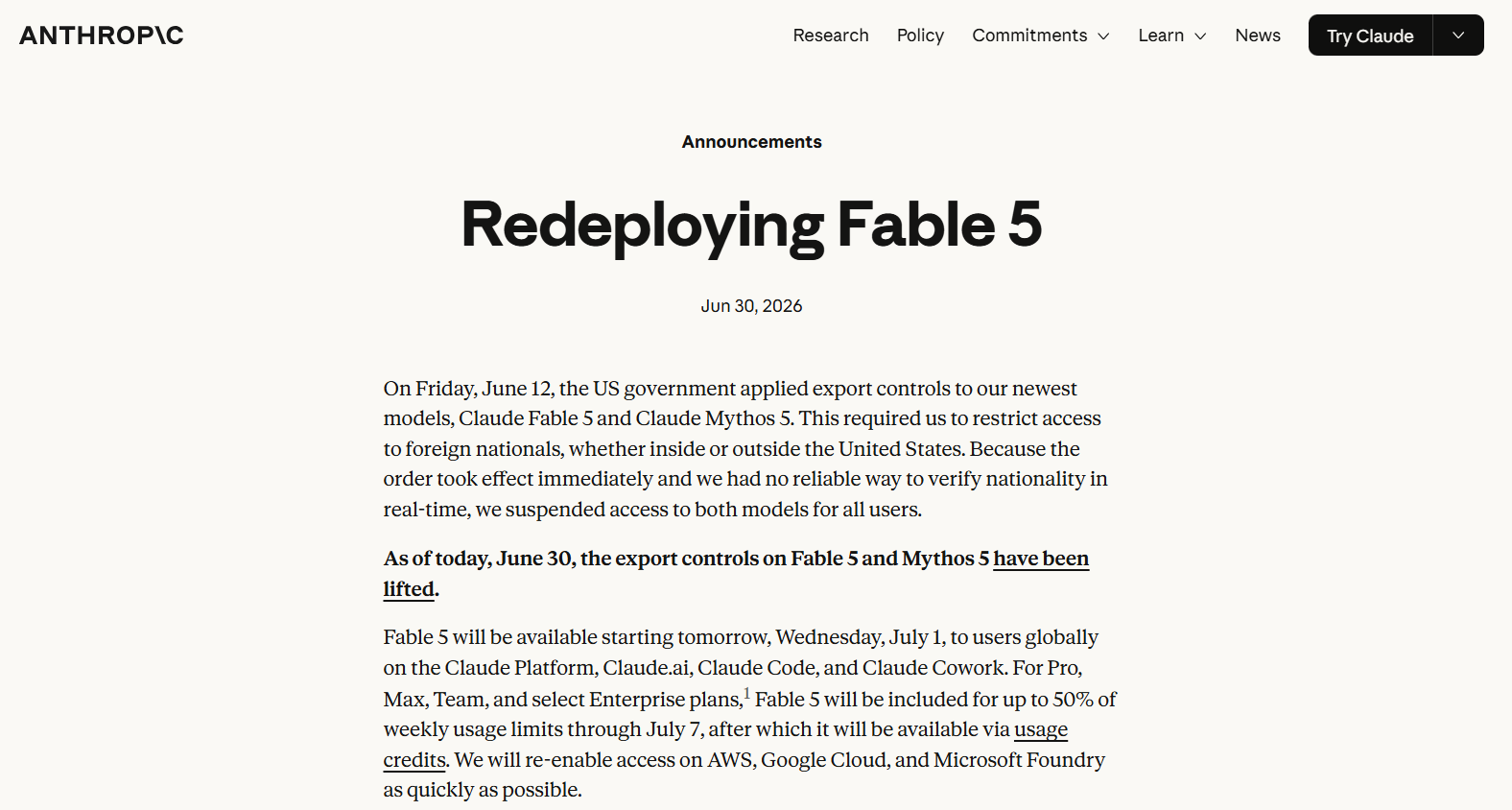
Anthropic originally disabled access to Claude Fable 5 and Mythos 5 on June 12. This action followed a US government order requiring the company to block all foreign nationals, including those residing or working within American borders. Because Anthropic could not verify user nationality in real-time with total precision, they executed a global suspension to ensure compliance. This move impacted international businesses, developers, and even Anthropic’s own foreign-national employees, creating a temporary vacuum in high-tier AI availability.
Revisiting Model Capabilities and Deployment
The lifting of these controls serves as a catalyst for redeploying Anthropic’s most advanced agents. Specifically, Claude Fable 5 serves as a robust tool for long-running autonomous tasks and complex agentic workflows. Before the suspension, it was widely available via API and major cloud platforms. Conversely, Mythos 5 maintains a more exclusive profile, primarily serving enterprise customers through Project Glasswing. While the restoration process moves forward, Anthropic has not yet confirmed if access will return simultaneously across all third-party cloud environments.

The Situation Room: Analysis
The Translation (Clear Context)
In essence, the US government utilized national security authorities to “pause” the export of high-reasoning AI. They feared that these models could be leveraged by foreign entities in ways that compromised domestic safety. By lifting the ban, the Department of Commerce suggests that either the risks have been mitigated through new safeguards or the initial security concerns were overly broad. For Anthropic, this is a logistical victory, as they can now resume their mission of global AI deployment without the impossible burden of real-time nationality verification for every API call.
The Socio-Economic Impact
For the Pakistani professional and student, this development is a critical win for digital equity. Claude Fable 5 is a premier tool for software development and automated research. When these models are restricted, the “digital divide” widens, leaving local innovators at a disadvantage compared to their US-based counterparts. Restored access ensures that Pakistani startups can continue building on cutting-edge architecture, maintaining their competitive edge in the global gig economy and the burgeoning tech sector.
The “Forward Path” (Opinion)
This development represents a Momentum Shift. The temporary ban served as a “stress test” for the global AI ecosystem, highlighting the fragility of relying on centralized, US-based providers. However, the swift restoration indicates that the US government recognizes the strategic importance of maintaining AI leadership through engagement rather than isolation. Moving forward, we expect more calibrated export frameworks that balance security with the necessity of global collaboration.








