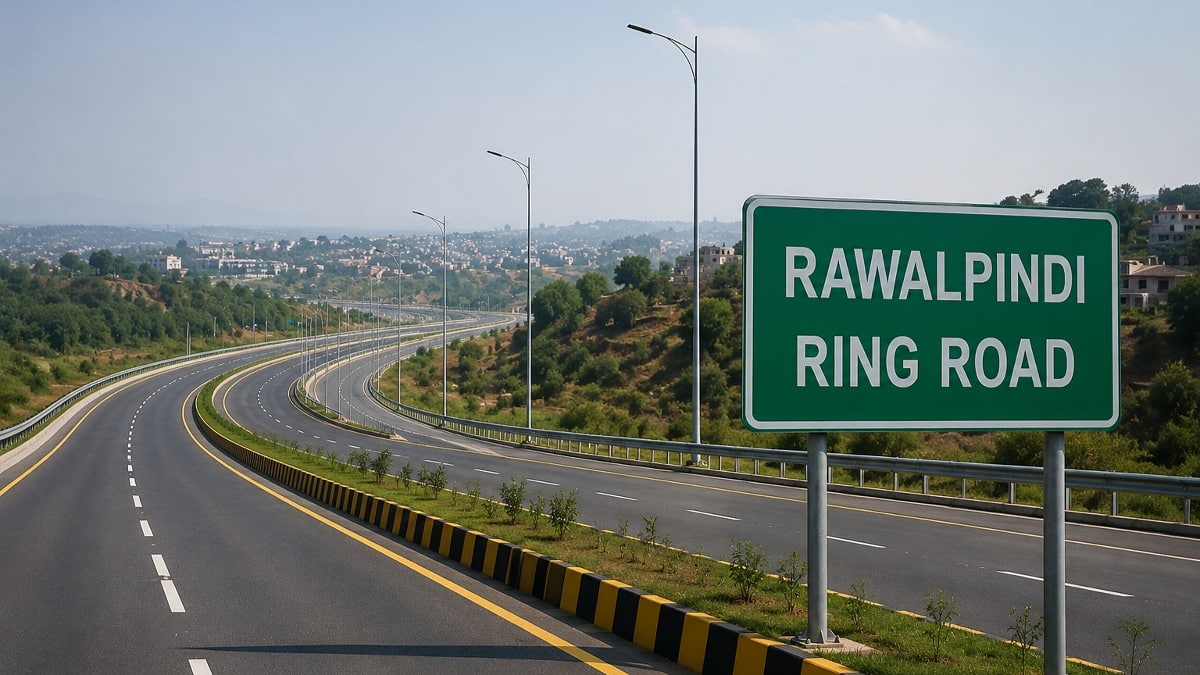
The Rawalpindi Ring Road project serves as a strategic catalyst for regional mobility, with authorities confirming a scheduled opening for July. This Rs. 47 billion infrastructure scheme introduces a 38.3-kilometer high-speed corridor designed to optimize traffic flow between Rawalpindi and Islamabad. Consequently, the project is currently undergoing final calibrations, including lane markings and lighting, to ensure operational readiness for the Punjab government’s inauguration.
Technical Specifications and Transit Efficiency
Project officials have established a maximum speed limit of 120 kilometers per hour for this new arterial highway. Specifically, the route connects Baanth on G.T. Road to Thalian near the Motorway, integrating five precision-engineered interchanges at Baanth, Maira Mohra, Khasala, Kolian Parr, and Thalian. Moreover, the road will utilize a sophisticated toll collection system modeled after the Lahore Ring Road to maintain financial and structural sustainability.
Data-driven projections suggest that more than 30,000 vehicles will traverse the Rawalpindi Ring Road daily. By providing a dedicated corridor for heavy transport, the system will effectively divert approximately 70% of goods-carrying vehicles away from the congested urban cores. This structural shift is expected to reduce general city traffic by up to 30%, significantly enhancing the baseline efficiency of the twin cities’ road networks.
The Translation: System Logic
In “Next Gen” terms, this project is not merely a road but a bypass engine designed to decouple heavy logistics from civilian transit. By setting a 120 km/h limit, the authorities are prioritizing high-velocity throughput. The introduction of five distinct interchanges ensures that the industrial and residential sectors have calibrated entry and exit points, preventing the “bottleneck” effect common in older infrastructure designs.
The Socio-Economic Impact
For the average Pakistani citizen, the Rawalpindi Ring Road translates to recovered time and reduced fuel expenditure. Students and professionals in Rawalpindi and Islamabad will experience a marked decrease in gridlock. Furthermore, the planned industrial zone along the corridor acts as an economic multiplier, promising new employment opportunities and localized commercial growth for households in the surrounding rural-urban fringe.
The Forward Path: Momentum Shift
This development represents a significant Momentum Shift for Punjab’s infrastructure landscape. The transition from planning to a functional, high-speed corridor demonstrates a commitment to structural modernization. While the immediate focus remains on the July opening, the subsequent expansion of the Thalian interchange suggests a long-term vision for a fully integrated regional logistics network. This is precision engineering meeting national necessity.