
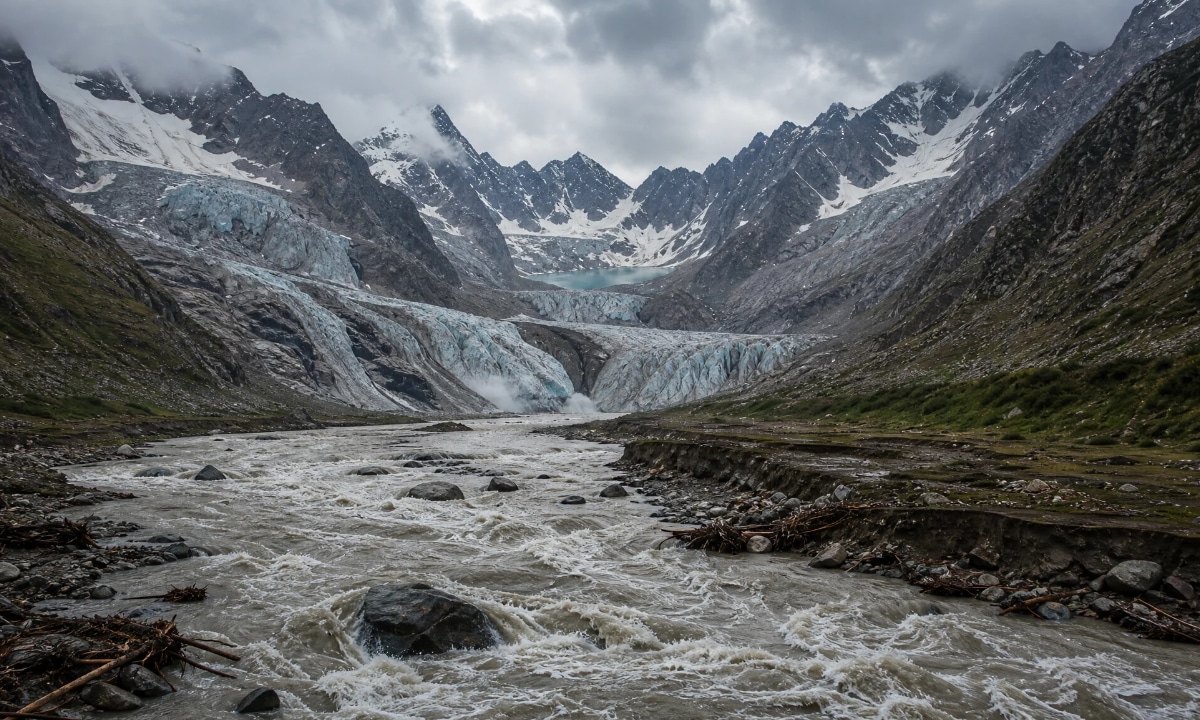
The Pakistan Meteorological Department (PMD) has issued a critical GLOF alert Pakistan for Gilgit-Baltistan and Khyber Pakhtunkhwa as rising thermal baselines threaten northern ecosystems. Through the first week of July, projected temperature surges will likely trigger glacial lake overflows, flash floods, and strategic shifts in river morphology. Consequently, authorities are monitoring high-altitude regions where accelerated snowmelt is destabilizing the structural integrity of natural dams.
The Technical Mechanism of Glacial Instability
Persistent high temperatures act as a catalyst for rapid cryospheric melting across Pakistan’s northern mountainous corridors. As a result, river flows remain at peak capacity while existing glacial lakes undergo rapid volumetric expansion. The PMD warns that this increased volume creates immense pressure on moraine dams, significantly increasing the probability of a GLOF alert Pakistan event.
- Thermal Forcing: Sustained heat accelerates the melting of ancient ice reserves.
- Lake Expansion: Increased meltwater creates new, unstable water bodies in high-altitude basins.
- Structural Failure: Rapid growth destabilizes natural ice and rock barriers, leading to sudden downstream releases.
The Translation: Converting Data into Clarity
In precise terms, the current climate trajectory is forcing a phase change from solid ice to liquid water faster than the natural drainage architecture can accommodate. The logic behind this alert rests on the destabilization of "moraine dams"—barriers composed of loose rock and debris. When these natural structures reach a breaking point, they don’t just leak; they fail catastrophically, sending a high-velocity wall of water and debris into narrow valleys.
The Socio-Economic Impact: Daily Life and National Safety
This environmental shift directly impacts the safety and economic baseline of households in Gilgit-Baltistan and Khyber Pakhtunkhwa. Specifically, the alert identifies the following risks:
- Infrastructure Risk: Low-lying communities and bridges along riverbanks face an elevated threat of sudden inundation.
- Agricultural Stability: Mudflows and debris flows in steep terrain can destroy vital irrigation channels and terrace farms.
- Public Health: The KP Health Department has already calibrated its response by establishing heatwave emergency units to treat thermal-related illnesses.
- Tourism Safety: The alert advises tourists to avoid unstable slopes and narrow valleys where landslides are most probable.
The Forward Path: Momentum Shift or Stabilization?
This development represents a Momentum Shift in Pakistan’s climate adaptation timeline. While the PMD and SUPARCO have successfully identified 130 potentially dangerous glacial lakes, the move from observation to active mitigation is critical. We must transition from reactive alerts to structural precision, utilizing real-time telemetry to protect our northern frontiers. National resilience now depends on how efficiently we integrate these early warning systems into our urban and rural planning.








