
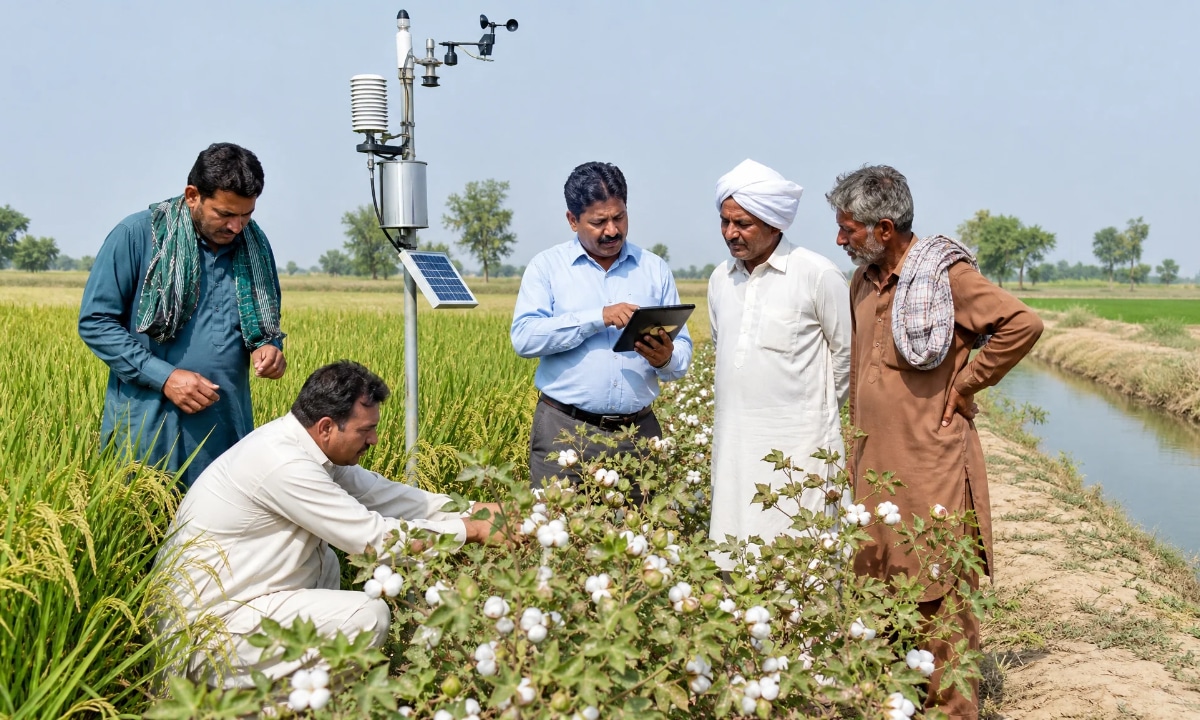
The Food and Agriculture Organization (FAO) is currently executing a calibrated expansion of climate-resilient agriculture and water management systems within Pakistan’s vital Indus Basin. This strategic initiative, financed by the Green Climate Fund (GCF) and co-funded by the provincial governments of Punjab and Sindh, represents a critical shift toward structural food security. By integrating advanced data analytics with traditional farming, the project targets a direct benefit for 1.3 million citizens, while creating a protective socio-economic buffer for an additional 16 million people across eight core districts.
Deploying Precision Infrastructure for the Indus Basin
Precision is the cornerstone of this modernization effort. Consequently, the FAO and the Pakistan Meteorological Department (PMD) have successfully operationalized 24 automatic weather stations. These assets, distributed across 15 sites in Punjab and nine in Sindh, serve as the technical baseline for Impact-Based Forecasting (IBF). Unlike traditional reporting, IBF translates raw atmospheric data into actionable farming intelligence, allowing for high-accuracy interventions during critical crop cycles.

Furthermore, this network empowers the agricultural sector to anticipate and mitigate the risks associated with extreme rainfall and rising thermal baselines. During a recent adaptation workshop in Multan, industry stakeholders calibrated strategies specifically for the Kharif 2026 cotton and rice crops. This collaborative framework ensures that climate-resilient agriculture practices remain grounded in local indigenous knowledge while utilizing global scientific standards.
The Translation: Deciphering the Digital Harvest
To understand this development, one must look beyond the hardware. The “Next Gen” logic here is the transition from reactive to predictive farming. Impact-Based Forecasting (IBF) does not simply tell a farmer “it will rain”; instead, it calculates how that specific rainfall volume will interact with soil moisture and crop maturity. We are moving from a system of guesswork to a system of precision-calibrated outputs where every drop of water is optimized for maximum yield.
The Socio-Economic Impact: Protecting the Pakistani Household
This project directly stabilizes the daily life of the average Pakistani citizen by securing the domestic food supply chain. For the small-scale farmer in South Punjab or Sindh, these climate-smart practices provide a catalyst for higher crop yields with significantly lower resource input. Increased efficiency at the farm level leads to price stabilization in urban markets, ensuring that households face fewer shocks from climate-induced food inflation. Essentially, agricultural resilience is the frontline defense for national economic stability.
The Forward Path: An Architectural Momentum Shift
This expansion represents a definitive Momentum Shift in Pakistan’s developmental trajectory. We are no longer merely maintaining a legacy system; we are building a proactive agricultural architecture. By institutionalizing climate-resilient agriculture, Pakistan is setting a baseline for regional leadership in STEM-driven climate adaptation. The successful integration of PMD data with grassroots farming tactics serves as a blueprint for future infrastructure projects across the Global South.








