

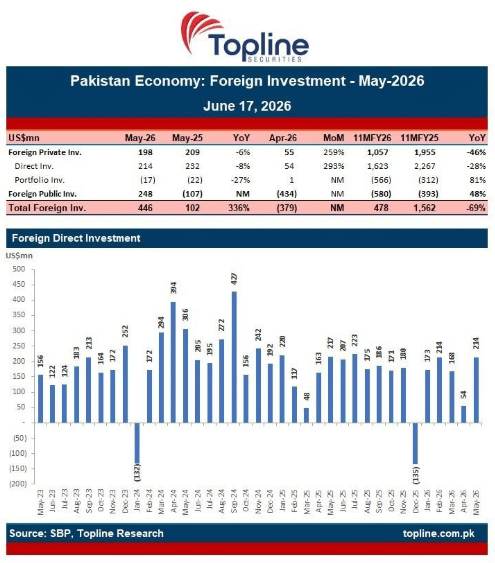
Pakistan’s economic landscape recalibrated in May 2026 as net FDI in Pakistan surged to $214 million. This represents a strategic 293% month-on-month (MoM) increase compared to the $55 million baseline recorded in April 2026. While year-on-year figures show an 8% decline, the immediate acceleration signals a crucial stabilization of capital inflows. This shift is primarily driven by targeted investments in the Power and Financial sectors from key regional catalysts like China, the UAE, and Hong Kong.
The Translation: Decoding the Structural Rebound
The dramatic 293% spike from April to May 2026 highlights a recovery from temporary divestments. In April, the Cement sector experienced a significant outflow due to the Attock Cement divestment, which artificially suppressed the monthly total. The May rebound indicates that the structural appetite for Pakistani assets remains resilient. Furthermore, the total foreign investment, including public and private capital, reached $446 million, marking a massive 336% year-on-year increase for the month. These figures confirm that while volatility exists, the underlying interest in Pakistan’s core industries is expanding.
The Socio-Economic Impact: Precision Benefits for Citizens
For the average Pakistani citizen, this influx of foreign capital acts as a catalyst for system efficiency. When the Power and Financial sectors attract global investment, it leads to infrastructure modernization and improved liquidity in the banking system. Consequently, students and young professionals can anticipate a more stable job market within these high-growth industries. In rural areas, precision in power sector funding eventually translates to more reliable energy access, supporting local productivity and household stability. Stronger FDI in Pakistan fundamentally strengthens the national currency’s baseline against global volatility.
The Forward Path: Momentum Shift Analysis
We categorize this development as a Momentum Shift. Although the 11-month fiscal year total of $1.623 billion is down 28% compared to the previous year, the monthly surge suggests that the downward trend is hitting a floor. For Pakistan to sustain this trajectory, policymakers must maintain calibrated regulatory environments that protect long-term investors while streamlining the entry of new capital. The resilience of the Power sector confirms that Pakistan’s utility infrastructure remains a high-intent target for international architects of growth. We expect this precision-led recovery to continue if geopolitical stability remains constant.








