

Pakistan’s external sector has achieved a calibrated milestone as the Current Account Surplus reached $459 million in May 2026. This structural recovery from April’s deficit signifies a strategic pivot in national capital flows, primarily driven by a surge in overseas remittances. Consequently, the cumulative balance for the first 11 months of the fiscal year 2025-26 now stands at a surplus of $255 million, a stark contrast to the $1.62 billion deficit recorded during the same period last year.
Analyzing the Current Account Surplus Drivers
The State Bank of Pakistan (SBP) reported that workers’ remittances served as the primary catalyst for this month’s performance. Remittances surged to a record $4.25 billion in May, representing a 20% increase from the previous month. Furthermore, this figure reflects a 15% growth compared to May 2025. This influx of foreign exchange successfully calibrated the nation’s external position against ongoing trade pressures.
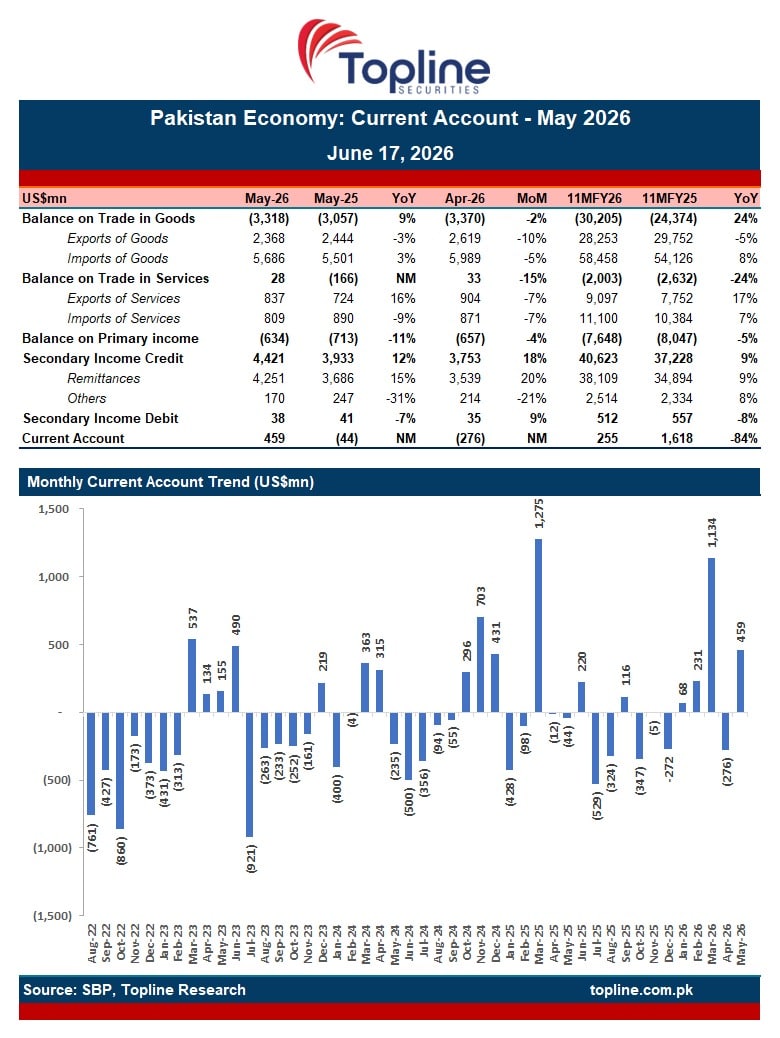
While remittances peaked, the trade of goods showed a contraction in volume. Exports declined to $2.37 billion from $2.62 billion in April. Simultaneously, imports eased to $5.69 billion. Consequently, the trade deficit in goods narrowed to $3.32 billion. According to analysis from Topline Securities, the moderation in imports helped offset the primary income balance pressures, allowing the nation to maintain its Current Account Surplus trajectory.
The Situation Room
The Translation (Clear Context)
A “Current Account” is essentially a nation’s macroeconomic scorecard for international transactions. When we record a surplus, it means the money flowing into Pakistan from exports and remittances exceeds the money flowing out for imports and debt payments. Transitioning from a deficit to a $459 million surplus indicates that the economy is generating more foreign exchange than it is consuming, which reduces the immediate need for external borrowing.
The Socio-Economic Impact
This development directly impacts the daily lives of Pakistani citizens by stabilizing the exchange rate. A surplus reduces the pressure on the Pakistani Rupee, which helps curb “imported inflation”—the rising cost of fuel and electricity. For households, this precision in capital management translates to a more predictable baseline for the cost of living. For students and professionals, it signals a more stable environment for international trade and educational investments.
The Forward Path (Opinion)
We categorize this development as a Momentum Shift. While the rebound from April’s deficit is encouraging, the reliance on remittances rather than export growth remains a structural vulnerability. For long-term progress, Pakistan must leverage this stabilization to aggressively expand its export base. Nevertheless, returning to a surplus territory provides the necessary fiscal breathing room to implement deeper structural reforms.








