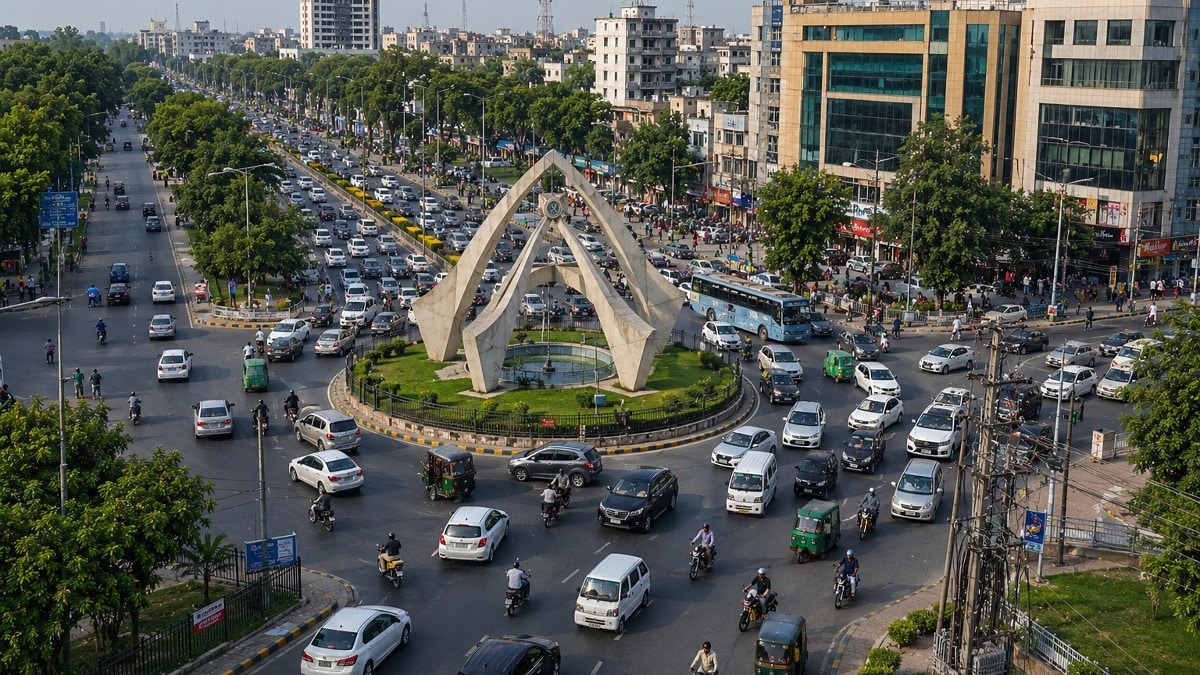
National progress relies on calibrated urban mobility; consequently, the proposed reconfiguration of Lahore’s Defence Mor serves as a strategic catalyst for system efficiency. The Defence Mor upgrade represents a critical structural intervention designed to resolve chronic traffic congestion at one of the city’s most volatile junctions. Following a series of rigorous technical inspections led by Chief Traffic Officer (CTO) Syed Abdul Raheem Shirazi, authorities have finalized a blueprint to modernize the intersection’s flow. By expanding the turning lane and streamlining vehicle movement, the project aims to stabilize the area’s logistical baseline.
Optimizing Flow: The Mechanics of the Defence Mor Upgrade
The core of this architectural shift involves widening the primary turning lane from 22 feet to a precise 33 feet. Consequently, this expansion will increase the junction’s traffic-handling capacity from 6,000 to approximately 9,000 vehicles per hour. Furthermore, the Traffic Engineering and Planning Agency (TEPA) and the Walton Cantonment Board have calibrated these changes to improve average vehicle speeds. Currently, commuters crawl at 15 to 20 kilometres per hour, but the new design targets a baseline of 40 to 45 kilometres per hour.
The Translation: Deconstructing the Engineering Logic
In “Next Gen” terms, this project is a throughput optimization. The current junction acts as a bottleneck where the physical capacity cannot handle the data (vehicle) load. By increasing the lane width by 50%, engineers are reducing the “latency” or the time vehicles spend idling. This transition from 20 km/h to 45 km/h effectively doubles the efficiency of the existing infrastructure without requiring a total demolition of the corridor.
The Socio-Economic Impact: Reclaiming Time for Citizens
How does this change the daily life of a Pakistani citizen? For the thousands of students, professionals, and families navigating Walton and DHA, this intervention slashes peak-hour queues that currently stretch up to 600 metres. Consequently, commuters will save significant time and fuel, reducing the daily stress associated with urban gridlock. Improved flow at Defence Mor also means faster emergency response times and lower emissions from idling engines, contributing to a more functional urban environment.
The Forward Path: A Momentum Shift in Urban Planning
This development represents a Momentum Shift. Rather than applying a temporary patch, the coordination between the CTO, TEPA, and the Walton Cantonment Board suggests a move toward data-driven infrastructure. While stabilization is often the goal in crisis management, this upgrade pushes for progress by aligning physical assets with modern demand. Success will depend on the precision of the implementation phase to ensure these theoretical gains become a daily reality for Lahore.