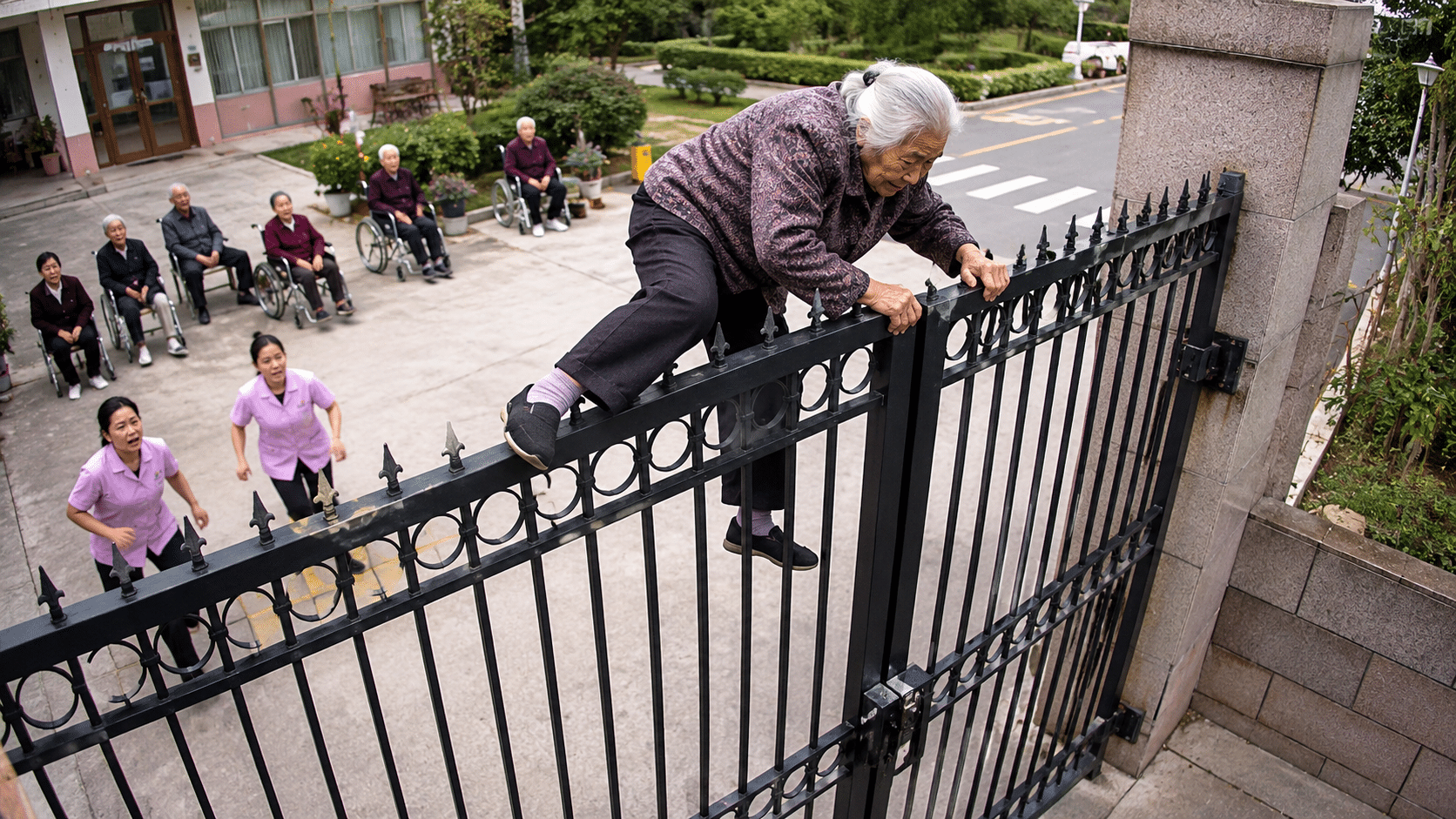
Precision and muscle memory recently collided in Yantai, China, when a 92-year-old resident executed a high-stakes nursing home escape. In just 24 seconds, the woman scaled a 2.15-meter-high metal gate, bypassing facility security with an efficiency that redefined the baseline for geriatric physical capabilities. Consequently, the footage has catalyzed a global conversation regarding the intersection of elderly independence and structural safety protocols in specialized care environments.
Analyzing the Mechanics of a Nursing Home Escape
The viral footage demonstrates a calibrated level of physical coordination. Despite living with advanced Alzheimer’s disease, the 1.6-meter-tall resident utilized precise footing and upper-body leverage to clear the barrier. Historically, her physical stamina originates from decades of intensive labor in mountain orchards. Essentially, her biology maintains a high-performance baseline that surpasses conventional expectations for her demographic.

Facility staff responded with a strategic search operation immediately upon identifying the breach. They deployed specialized vehicles and ground personnel to secure the perimeter. Ultimately, they located the resident unharmed within 25 minutes. This incident highlights a critical paradox: the preservation of physical vitality versus the necessity of restrictive security for cognitive health patients.
The Translation (Clear Context)
In technical terms, this incident represents “functional fitness retention.” While the resident’s cognitive faculties have declined due to Alzheimer’s, her motor pathways—honed by years of orchard climbing—remain intact. This suggests that the body can maintain complex physical algorithms even when the mind loses its navigational anchor. For caregivers, this means that security measures must be calibrated to the patient’s individual history, not just their current age.
The Socio-Economic Impact
For the average Pakistani household, this event underscores the shifting landscape of elderly care. As urban families increasingly transition toward professional care facilities, the structural design of these buildings becomes paramount. We must balance system efficiency with human dignity. Furthermore, the event serves as a catalyst for local healthcare providers to invest in smarter surveillance that doesn’t rely on physical barriers, ensuring that our elders remain mobile yet protected.
The Forward Path (Opinion)
This development represents a Momentum Shift. It forces an architectural and philosophical pivot in geriatric care. We must move away from the “containment model” toward a “monitored freedom model.” Precisely because residents retain high-level physical skills, our facilities must utilize biometric sensors and geofencing rather than higher fences. True progress lies in integrating advanced technology to protect our citizens without compromising their inherent physical agency.