
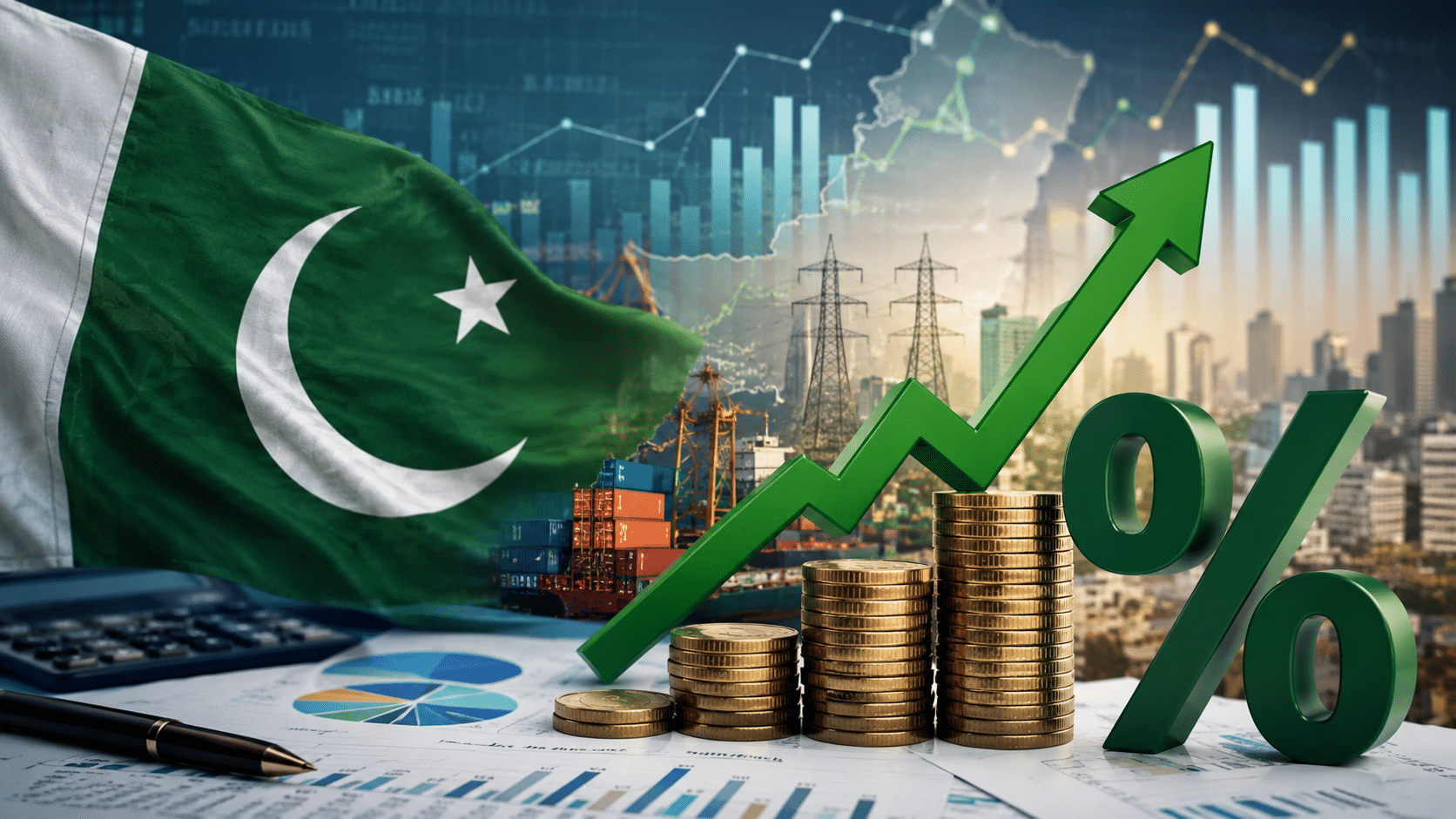
A nation’s economic architecture requires precise calibration to balance rapid expansion with fiscal stability. The federal government has recently defined a strategic Pakistan’s growth target of 4% for the upcoming fiscal year, while simultaneously projecting an inflation baseline of 8.2%. This structural roadmap prioritizes critical energy, water, and transport infrastructure to catalyze long-term national efficiency and systemic progress.
Analyzing Pakistan’s Growth Target and Sectoral Benchmarks
The government has established specific productivity goals across primary economic pillars. Agriculture remains a cornerstone with a 3.8% growth target, while the industrial sector aims for a 4.5% increase. To fuel this expansion, the development plan projects overall investment at 15% of the total GDP. These figures represent a disciplined effort to stabilize the economy following periods of high volatility.

On the external front, the government expects exports to reach $32.9 billion, supported by an additional $11.3 billion from services. Consequently, the plan relies heavily on remittances, which officials project at $42.4 billion. However, imports are anticipated to rise to $70 billion, highlighting the ongoing need for structural trade reforms to manage the balance of payments effectively.
Strategic Infrastructure and Energy Expansion
The Public Sector Development Program (PSDP) has allocated substantial capital to energy and water security. Specifically, the Mohmand Dam Hydropower Project receives Rs. 26 billion, while the Dasu Hydropower Project gains Rs. 21 billion. Furthermore, the Karachi Bulk Water Supply Project will receive Rs. 10 billion to address urban water scarcity. These investments aim to expand the national power grid by 3,787 megawatts, supported by a Rs. 151 billion energy sector allocation.
Transport logistics also see a significant boost in the current fiscal roadmap. Key projects include:
- N-25 Quetta Project: Rs. 100 billion allocation for regional connectivity.
- Sukkur-Hyderabad Motorway: Rs. 30 billion to bridge critical trade corridors.
- ML-1 Railway Upgrade: Rs. 25 billion for modernizing the national rail spine.
- Coastal and Mehran Highways: Combined allocation of Rs. 46 billion for industrial mobility.
Social Development and Environmental Stewardship
Beyond heavy industry, the plan earmarks Rs. 22 billion for Daanish Schools to foster high-tier education in underserved areas. Additionally, the Prime Minister’s Health Program receives Rs. 3 billion to expand the social safety net. Environmental precision is also a priority, with a calibrated goal to plant 11.3 million trees, ensuring that economic growth does not come at the cost of ecological stability.
The Situation Room Analysis
The Translation (Clear Context)
While economic jargon often obscures reality, the “4% growth” and “8.2% inflation” targets signal a transition from crisis management to controlled expansion. The government is essentially shifting its focus from just “surviving” price hikes to “building” the foundations of the Pakistan’s growth target. By investing in dams and railways, the state is betting that improved logistics will naturally lower the cost of doing business over the next decade.
The Socio-Economic Impact
For the average citizen, an 8.2% inflation projection offers a significant reprieve compared to the double-digit pressures of previous years. Students in rural regions will benefit from the Rs. 22 billion Daanish Schools expansion, while urban professionals in Karachi and Quetta will see improved utility reliability through water and road upgrades. Increased water storage (from 13.5 to 23.5 million acre-feet) directly secures the food supply for every Pakistani household.
The Forward Path (Opinion)
This development plan represents a Stabilization Move with the potential for a Momentum Shift. While the 4% Pakistan’s growth target is modest by global standards, the heavy emphasis on the energy-water nexus and transport infrastructure suggests a strategic pivot toward “System Efficiency.” If the government executes the 3,787 MW power grid addition without delays, Pakistan will finally move beyond temporary fixes toward a precision-engineered economic engine.








