
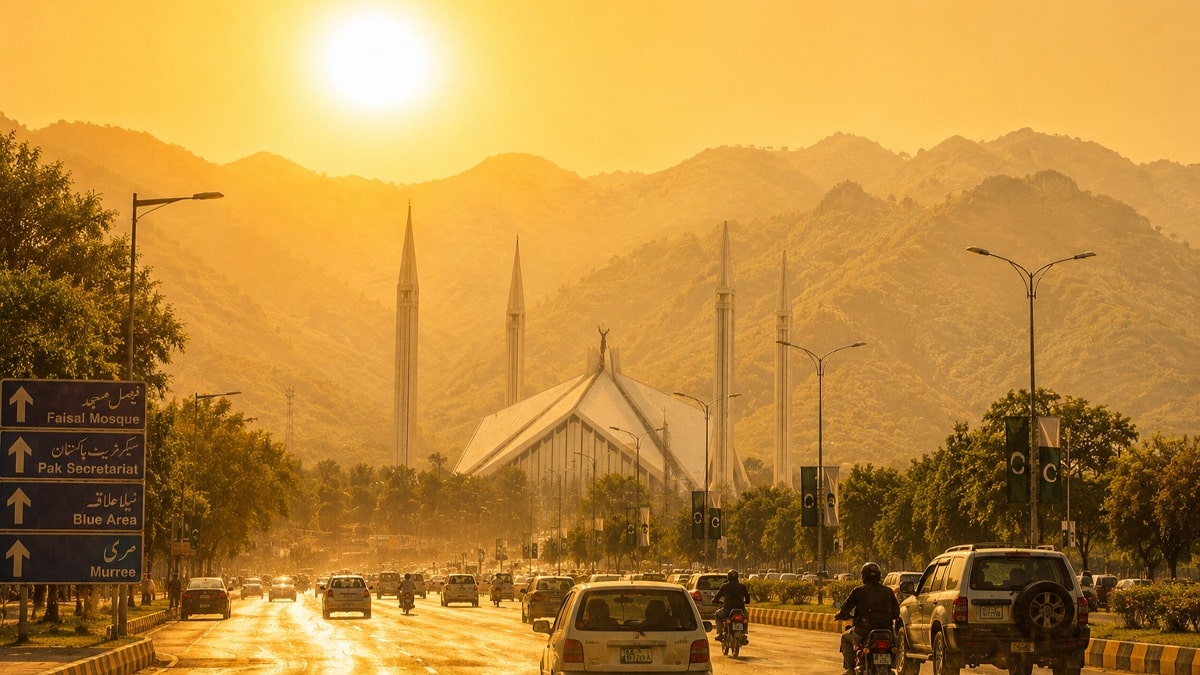
Urban thermal stability reached a critical stress test on Wednesday as Islamabad and Rawalpindi recorded their highest summer temperature of the season, peaking at 44°C. According to data from the Pakistan Meteorological Department (PMD), this extreme heat suppressed public mobility and strained the regional power grid. Consequently, health authorities issued immediate advisories to mitigate heat-related illnesses across the Potohar region.
Analyzing the Data: The Highest Summer Temperature Benchmarks
The PMD calibrated the current weather conditions as a standard pre-monsoon surge. Currently, a seasonal low-pressure area dominates North Balochistan, while a westerly system approaches the upper country. Furthermore, moist currents from the Arabian Sea are expected to enter the northeastern regions shortly. This atmospheric convergence suggests that while the heat is intense, relief remains on the horizon.
The Translation (Clear Context)
The term “seasonal low-pressure” explains why the heat feels so stagnant. Essentially, the air is rising and creating a vacuum that draws in hotter air from the surrounding plains. Strategically, this is the “calm before the storm” that precedes the monsoon cycle. The current 44°C benchmark serves as a baseline for measuring the intensity of the upcoming rainy season and its potential to break the existing heat cycle.
Socio-Economic Impact: Precision and Pressure
Extreme temperatures do more than cause discomfort; they recalibrate the economic output of a city. The record heat on Wednesday resulted in several structural challenges for residents:
- Infrastructure Strain: Water shortages escalated across Rawalpindi and its cantonment regions due to increased evaporation and consumption rates.
- Market Deceleration: Commercial activity in major hubs declined as residents prioritized thermal safety over retail engagement.
- Health Resource Allocation: Medical professionals redirected focus toward heatstroke prevention and hydration management for vulnerable populations.
The Forward Path (Opinion)
This development represents a Stabilization Move for the environment. While the 44°C peak is challenging, it acts as a catalyst for the necessary atmospheric changes that bring the monsoon. We must view these events not as random weather anomalies, but as structural signals for urban planning. Moving forward, Pakistan requires calibrated investments in “cool-roof” technologies and enhanced urban forestry to buffer against future record-breaking heat cycles.
Fortunately, PMD forecasts indicate that temperatures will likely decline within the next 48 to 72 hours. Rain-thunderstorms are expected in Gilgit-Baltistan, Kashmir, and Islamabad by Thursday night, offering a strategic window for temperature normalization.








