
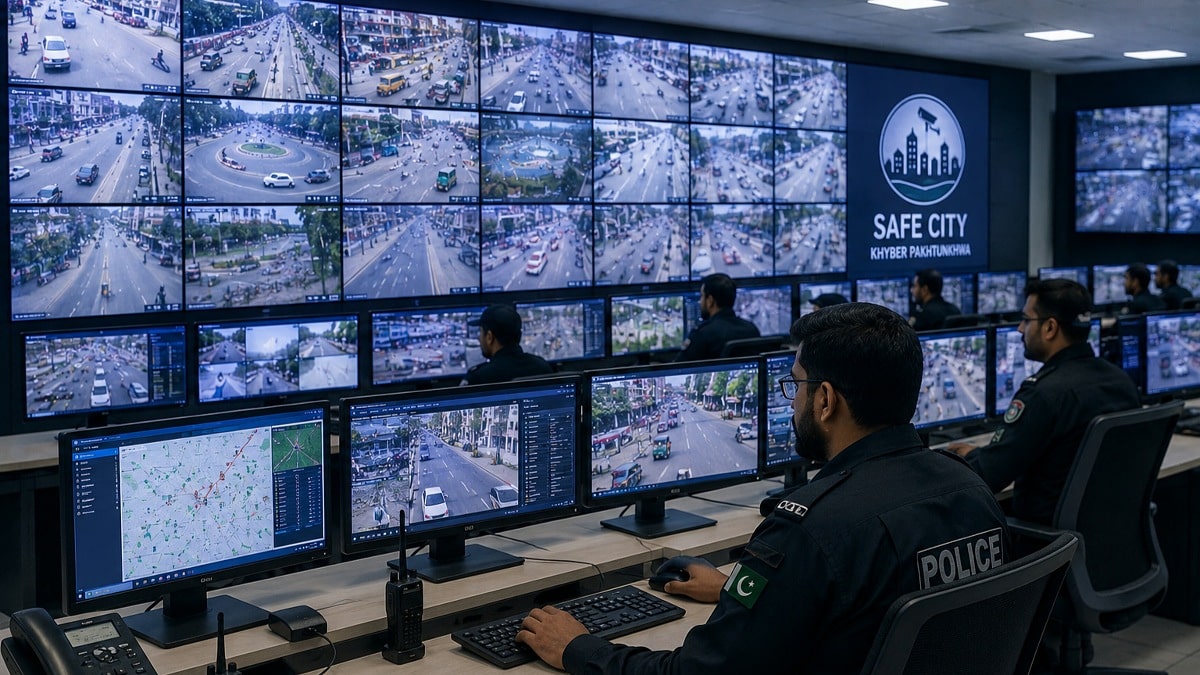
The KP Safe City Project represents a calibrated effort to modernize urban security through high-precision surveillance and digital oversight. However, the system currently operates at a baseline capacity because the provincial government has not yet enacted the necessary legal framework. Consequently, while the infrastructure exists, its integration into the provincial justice and traffic systems remains incomplete.
Legal Framework for the KP Safe City
Government officials confirm that the KP Safe City Project cannot reach full functionality without the approval of the Khyber Pakhtunkhwa Safe City Authority Act. Although the project was officially inaugurated on March 4, the legislation required to empower its operations remains in the draft stage. This structural delay prevents the system from acting as a catalyst for comprehensive urban safety.
The provincial police department finalized the draft law nearly two months ago, submitting it to the Home Department for review. Furthermore, the draft must pass through the Khyber Pakhtunkhwa cabinet and the provincial assembly before becoming law. Law Minister Aftab Alam recently indicated that the Law and Home departments are jointly finalizing the Khyber Pakhtunkhwa Safe City Authority Act 2026 to resolve these bottlenecks.

The “Situation Room” Analysis
The Translation (Clear Context)
In technical terms, the hardware is ready, but the “operating system” of the law is missing. Without the Safe City Authority Act, data captured by high-definition cameras faces significant hurdles in court admissibility. Legally, evidence must follow a specific chain of custody defined by law to be used against criminals or traffic violators. Therefore, the current delay is not a failure of technology, but a pause in legislative precision.
The Socio-Economic Impact
For the average Pakistani citizen in urban centers like Peshawar, this delay manifests as a lack of accountability on the roads and in public spaces. Effective traffic management—linked to automated ticketing—cannot proceed without this law. Consequently, students and professionals continue to navigate inefficient traffic flows, and the structural deterrent against street crime remains under-optimized.
The “Forward Path” (Opinion)
This development currently represents a Stabilization Move. While the physical installation of the KP Safe City Project is a success, the inability to sync law with technology suggests a lack of departmental synergy. A true “Momentum Shift” will only occur when the provincial assembly prioritizes this act, transforming a passive network of cameras into an active, precision-driven security asset.








