
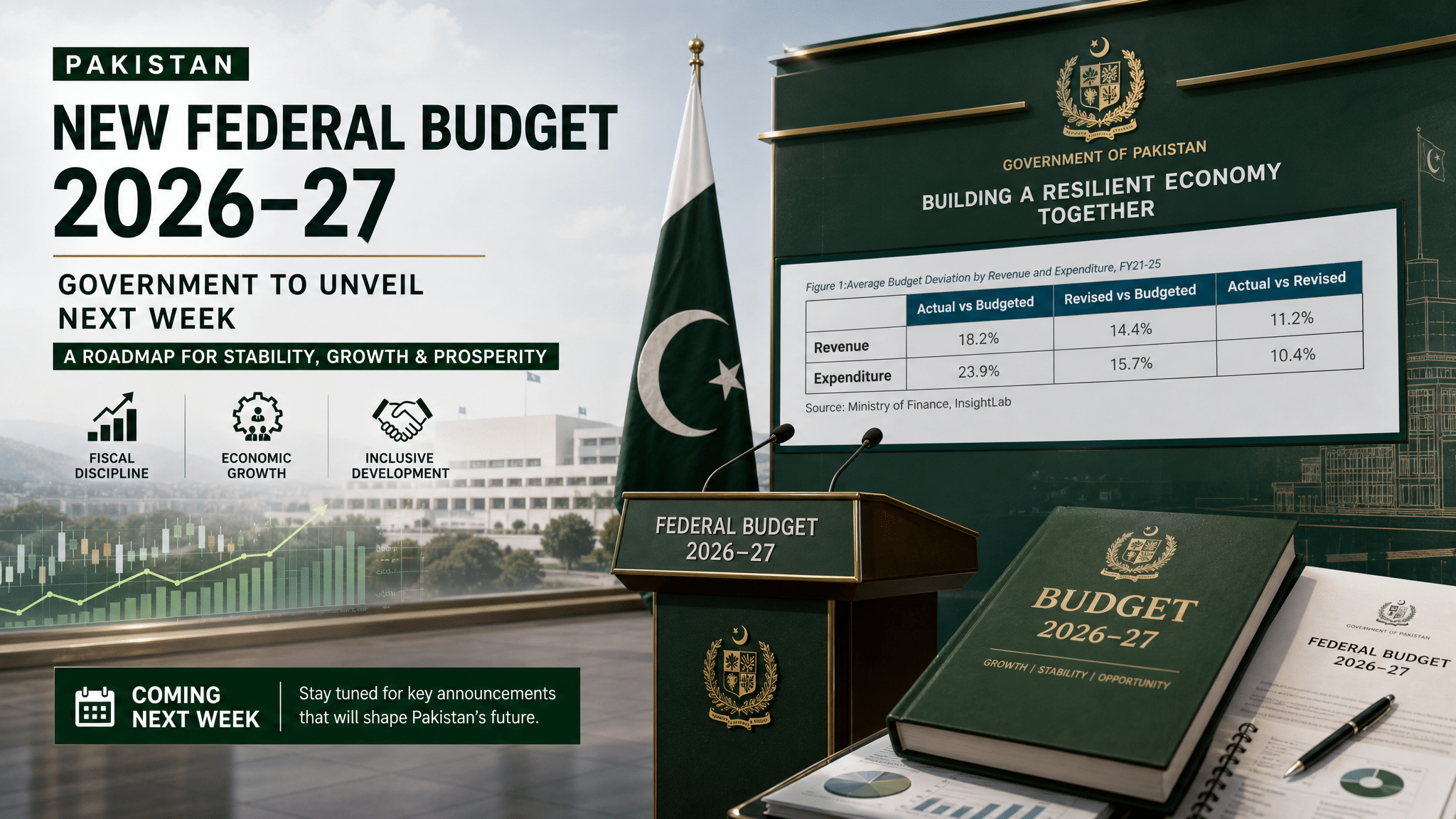
Pakistan’s failure to meet its Pakistan budget targets for five consecutive fiscal years (FY21-FY25) reveals a deep structural instability in our national financial architecture. A recent report by the Karachi School of Business and Leadership (KSBL) highlights that actual revenue collections deviated from original estimates by an average of 18.2%. Furthermore, expenditure figures differed by a staggering 23.9% during the same period. This recurring misalignment suggests a precision gap that demands immediate calibration to restore investor and public confidence.
The Precision Deficit in National Planning
Original budget estimates represent the government’s baseline fiscal commitment to its citizens and businesses. However, the data indicates that these commitments rarely align with reality. Even after mid-year adjustments, final outcomes still fluctuated by over 10% on both revenue and spending sides. Consequently, the budget functions less as a strategic roadmap and more as a moving target.

Specifically, the KSBL scorecard utilized a deviation-based grading system to evaluate performance. The results were concerning, as most budget categories fell into the weakest performance tier. Key findings include:
- Average Revenue Deviation: 18.2% higher or lower than projected.
- Average Expenditure Deviation: 23.9% variance from initial plans.
- Mid-year Revision Failures: 11.2% revenue variance despite corrections.
The Translation: What This Means
In technical terms, a budget is a forecasting tool meant to signal economic intent. When a state consistently misses its Pakistan budget targets, it signals a “Credibility Gap.” This means the government is either over-promising revenue potential or failing to control its internal spending habits. Essentially, the “fiscal roadmap” is being drawn with broken compasses, leading to a cycle of emergency borrowing and “mini-budgets” that disrupt the private sector.
The Socio-Economic Impact
For the average Pakistani citizen, these statistical deviations translate into daily financial stress. When revenue targets fail, the state often resorts to regressive indirect taxes or sudden cuts in development projects. Students face reduced funding for education infrastructure, while households deal with inflation driven by unplanned government borrowing. Ultimately, this lack of precision prevents long-term economic stability for urban and rural families alike.
The Forward Path: Architect’s Opinion
This development represents a Stabilization Move that is currently failing. We are currently in a cycle of “Maintenance” rather than “Progress.” For Pakistan to achieve a true Momentum Shift, the Ministry of Finance must adopt STEM-driven econometric modeling to ensure Pakistan budget targets are rooted in data, not political optimism. Precision in planning is the only catalyst for national trust.








