
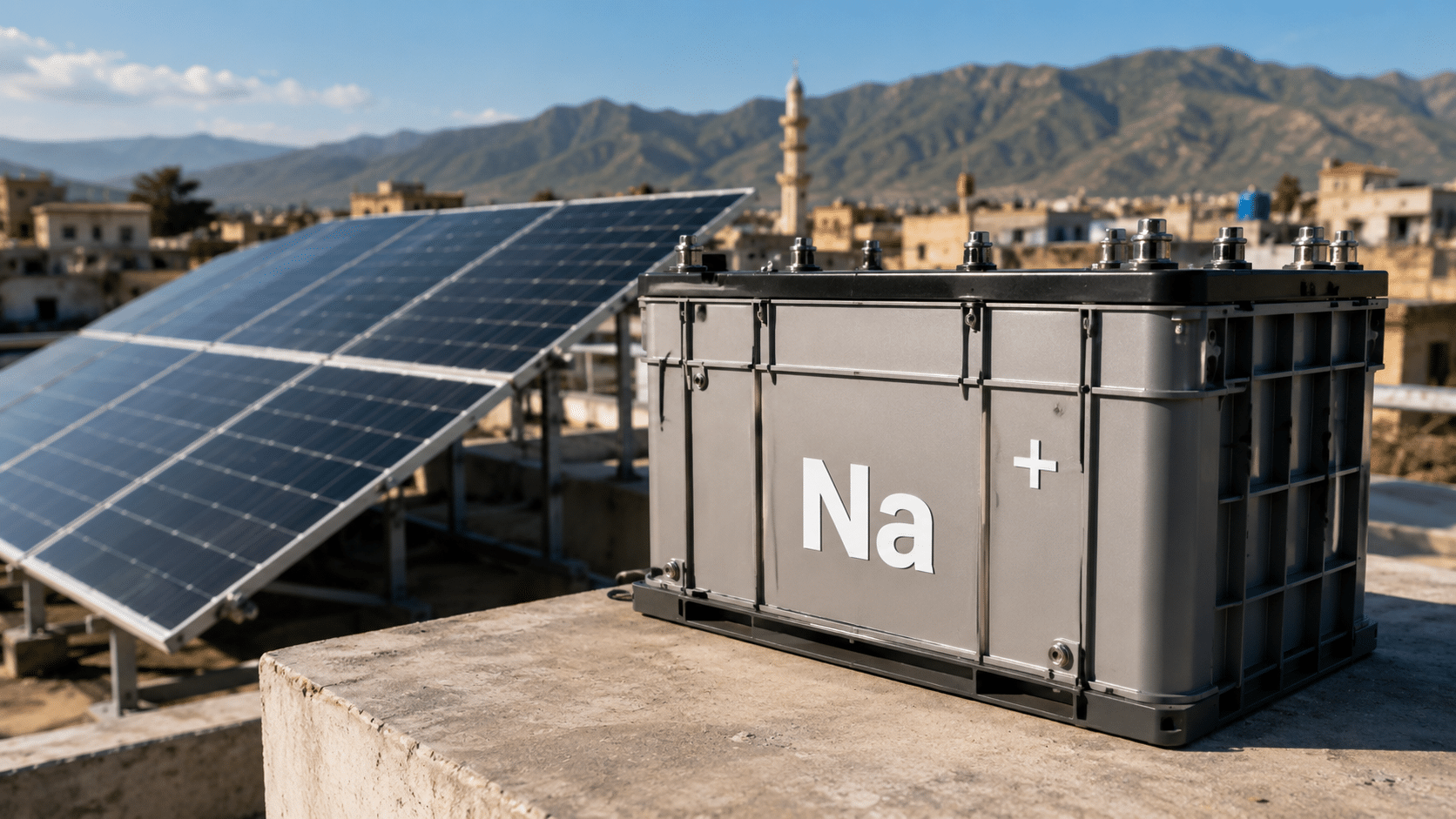
National energy security requires a structural transition toward sustainable storage solutions that bypass the volatile pricing of lithium. Researchers at the National University of Singapore have recently calibrated a breakthrough solid-state design for sodium-ion batteries. By utilizing a low-cost additive, this innovation significantly improves the safety, performance, and operational lifespan of renewable energy systems. Consequently, this development provides a precise roadmap for Pakistan to scale its solar infrastructure without the economic burden of imported rare-earth metals.
Calibrating Stability: The Role of Graphitic Carbon Nitride
The primary barrier to adopting sodium-ion batteries has historically been their structural instability during high-load cycles. To resolve this, engineers introduced graphitic carbon nitride (GCN), a material synthesized by heating urea at extreme temperatures. This integration helped reorganize the internal cell network, which allowed sodium ions to move with unprecedented efficiency. Furthermore, this structural modification enhanced both the conductivity and the physical resilience of the battery architecture.

Quantifiable Performance and Durability Baseline
Empirical testing confirms that ionic conductivity more than doubled at elevated temperatures. The modified system ensures a larger share of charge-carrying ions traverse the electrolyte during standard operation. Additionally, the strengthened electrolyte reduced dendrite growth by creating a uniform deposition layer. This precision engineering prevented internal short circuits, which are a common failure point in traditional lithium-based systems.
- Stability Baseline: Standard polymer electrolytes failed within 250 hours.
- Enhanced Durability: The GCN-modified version operated for over 2,000 hours without failure.
- Mechanical Resilience: Flexible prototypes remained functional even after being bent or cut.

The Situation Room: Analysis
The Translation
In simple terms, researchers have replaced expensive, flammable liquid components in batteries with a solid “safety net” made from urea—the same material used in common fertilizer. This “solid-state” approach prevents the battery from catching fire and allows it to store energy more efficiently. For Pakistan, this means solar batteries that are not only cheaper to manufacture but are also physically rugged enough to withstand local heat conditions.
The Socio-Economic Impact
The widespread adoption of sodium-ion batteries could catalyze a shift in household economics across urban and rural Pakistan. By lowering the baseline cost of solar storage, middle-class families can achieve 24/7 energy independence with a lower initial investment. Furthermore, since sodium is abundant and inexpensive compared to lithium, local manufacturing becomes a viable strategic goal, potentially creating high-tech jobs in the domestic energy sector.
The Forward Path
This development represents a Momentum Shift. While lithium remains the current industry standard, the NUS study proves that sodium-based systems have achieved the structural maturity required for commercial scaling. The next phase involves optimizing these cells for room-temperature efficiency. For Pakistan, the strategic move is clear: we must pivot toward sodium-ion research to decouple our energy future from the global lithium supply chain.









