The HBL PSL 11 ecosystem has reached a state of peak competitive equilibrium as the league enters its final round. While Peshawar Zalmi, Multan Sultans, and Islamabad United have secured their structural trajectories, PSL 11 qualification remains a complex variable for four remaining franchises. Consequently, the final league matches serve as a high-stakes catalyst for determining the tournament’s final playoff contender.
The Current Competitive Baseline
Islamabad United recently calibrated their standing by securing an eight-wicket victory against the Hyderabad Kingsmen. This strategic win propelled them to 11 points, effectively locking their position alongside the league leaders. In contrast, the defeat has marginalized the Kingsmen, leaving them in a precarious fifth-place position with a net run rate (NRR) of -1.037. Furthermore, the defending champions, Lahore Qalandars, currently maintain a fragile hold on the fourth position.
HBL PSL 11 Points Table Matrix
- Peshawar Zalmi (Q): 17 Points | +2.645 NRR
- Multan Sultans (Q): 12 Points | +0.450 NRR
- Islamabad United (Q): 11 Points | +1.766 NRR
- Lahore Qalandars: 8 Points | -0.558 NRR
- Hyderabad Kingsmen: 8 Points | -1.037 NRR
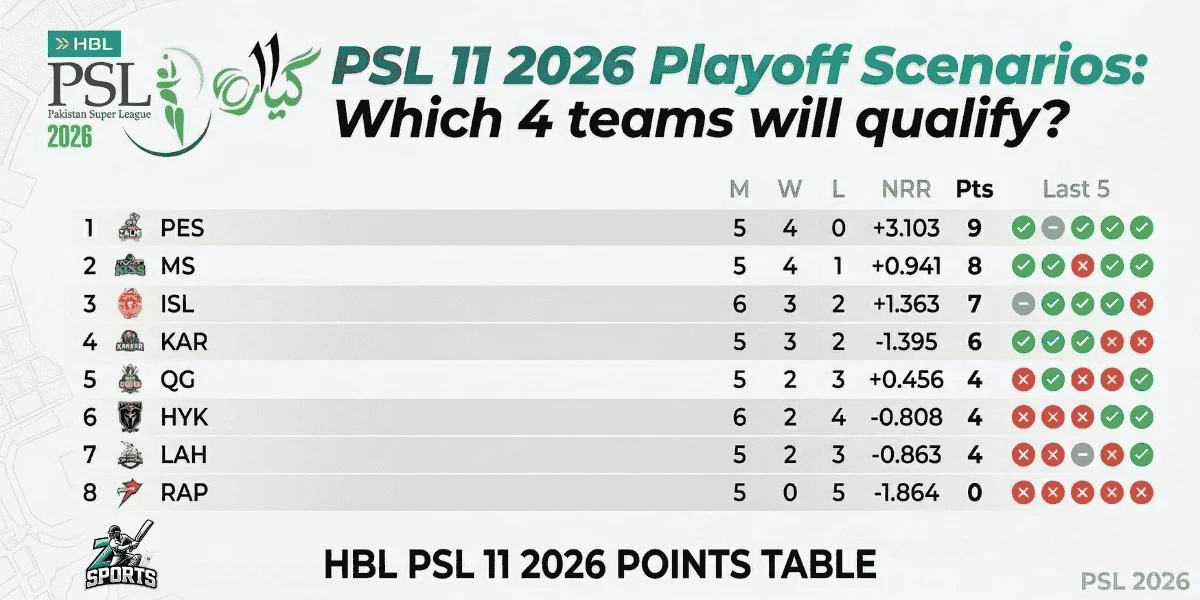
The Mathematical Blueprint for PSL 11 Qualification
The path to the final spot requires more than just a victory; it demands precise NRR management. Hyderabad Kingsmen must defeat RawalPindiz by a significant margin while simultaneously relying on losses from both Karachi Kings and Lahore Qalandars. Conversely, Karachi Kings face a “must-win” scenario against Quetta Gladiators. If they succeed and their rivals falter, they could mathematically leapfrog into the top four tier.
Even the seventh-placed Quetta Gladiators remain technically operational in this race. If they neutralize Karachi Kings while Kingsmen and Qalandars lose, a four-way tie at eight points will trigger a secondary NRR audit. This level of parity highlights the efficiency and balance of the PSL 11 competitive structure.

The Situation Room Analysis
The Translation (Clear Context)
In technical terms, the “points table” is no longer the primary filter; the Net Run Rate (NRR) is now the ultimate arbiter. Because four teams are clustered within a two-point range, a simple win is insufficient for teams like Hyderabad or Quetta. They must execute a “high-margin victory” to recalibrate their NRR, effectively requiring them to win by specific run counts or within a set number of overs to overcome their current deficits.
The Socio-Economic Impact
For the Pakistani citizen, this heightened competition drives the national “attention economy.” High-stakes cricket serves as a catalyst for increased retail activity in sports screenings, digital data consumption, and local hospitality. On a social level, the survival of regional franchises like Lahore or Karachi directly impacts the morale and engagement of their respective urban fanbases, fostering a sense of regional pride and national cohesion.
The Forward Path (Opinion)
This development represents a Momentum Shift. The fact that seven out of eight teams remained mathematically relevant until the final round proves the league’s structural maturity. While some may view NRR reliance as a complication, it actually ensures that every single delivery in the league stage carries maximum strategic value, preventing “dead rubber” matches and maintaining high-octane entertainment for the fans.