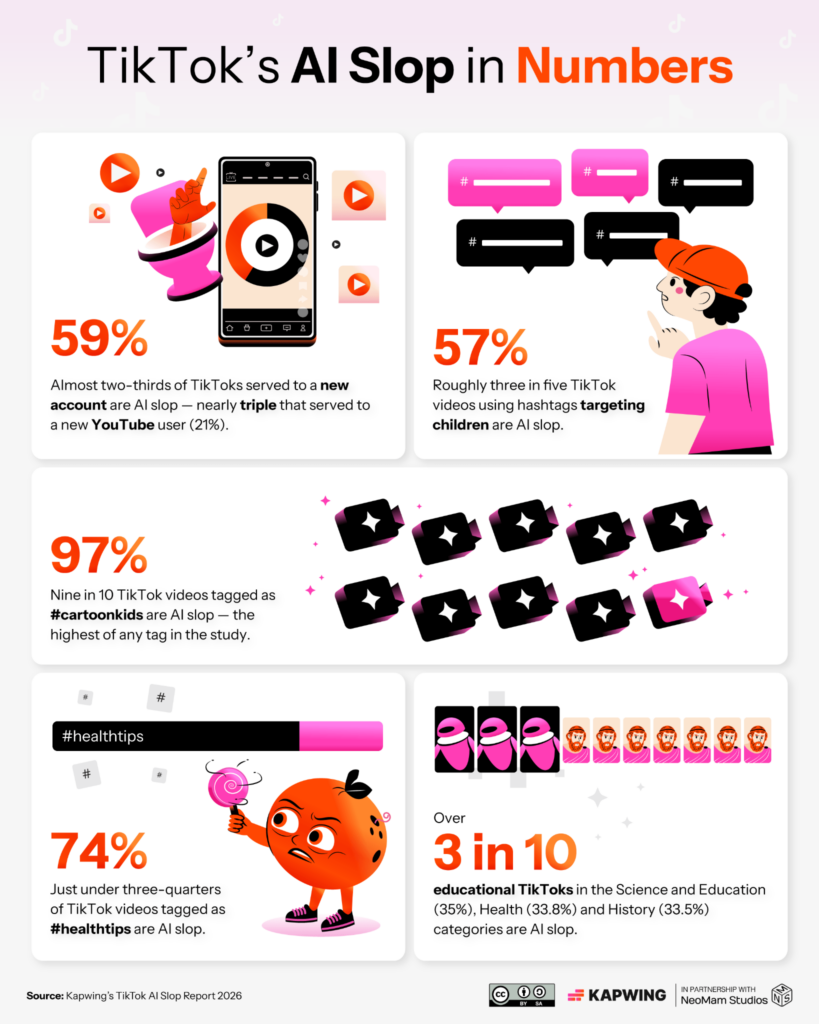
The digital ecosystem faces a calibrated threat as recent data reveals that TikTok AI slop now dominates 59% of new user feeds. This surge in automated, low-quality content represents a structural shift in how information is distributed to the most vulnerable demographics. While TikTok serves 1.3 billion AI-labeled videos, the precision of these algorithms specifically targets children with synthetic filler. Consequently, the disparity between platforms has widened, as YouTube Shorts maintains a significantly lower saturation of automated content at 21%.
Comparative Analysis: TikTok AI Slop vs. YouTube Shorts
Kapwing researchers established a baseline by reviewing the first 500 videos on fresh accounts across major platforms. They identified that 294 videos on TikTok met the criteria for TikTok AI slop, nearly triple the volume found on YouTube. This data suggests that TikTok’s content delivery engine prioritizes high-frequency synthetic uploads over verified human creativity. Furthermore, the report indicates that the sheer scale of this automation could disrupt the quality of digital discourse for emerging users.

Algorithmic Exploitation: Protecting the Kids Category
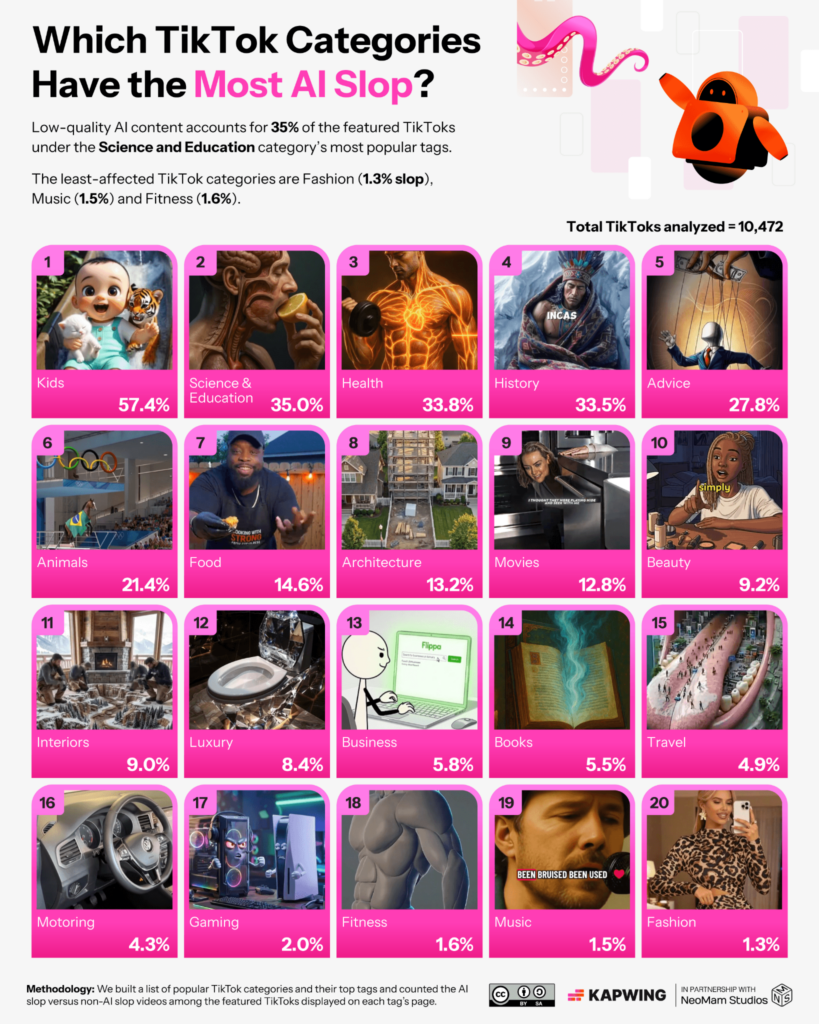
The most alarming metrics appear within the Kids category, where the concentration of TikTok AI slop reaches 57%. In contrast to categories like Fashion (1.3%) or Fitness (1.6%), children’s tags are flooded with synthetic animations. Specifically, the #cartoonkids tag exhibited a 97% saturation rate. This indicates that automated content farms utilize the #babysong and #forkids tags as catalysts for rapid view accumulation. Consequently, the physical demonstrations seen in human-centric categories remain the last bastion of authentic content.
The Situation Room Analysis
The Translation (Clear Context)
In this context, “slop” refers to mass-produced, AI-generated videos that lack educational or creative value. These videos are calibrated to exploit the platform’s recommendation engine rather than inform the viewer. For a Pakistani user, this means that the algorithm is increasingly prioritizing “engagement bait” over meaningful content. The logic is simple: synthetic content is cheaper to produce at scale, allowing bad actors to dominate the digital real estate that our youth consumes daily.

The Socio-Economic Impact
The saturation of TikTok AI slop directly affects the cognitive development and digital literacy of Pakistani students and households. When 59% of a child’s digital environment consists of synthetic noise, it reduces their exposure to high-quality educational material. Economically, this creates a “Digital Divide 2.0,” where users in urban and rural Pakistan are served low-effort content while sophisticated human-led education becomes a premium commodity. This structural imbalance threatens to stifle the innovative capacity of the next generation.
The Forward Path (Opinion)
This development represents a Momentum Shift toward algorithmic decay. We are witnessing the industrialization of content where quantity has decoupled from quality. To maintain system efficiency, Pakistan must advocate for more transparent algorithmic auditing and improved digital literacy for parents. The stabilization move must involve platform-level accountability to ensure that synthetic content does not become the primary baseline for our national digital consumption.