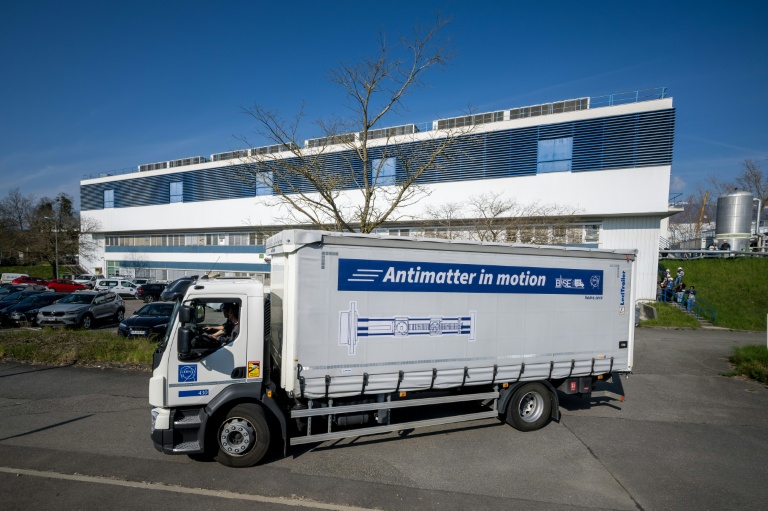
A structural advancement in fundamental physics has been achieved by scientists at CERN, successfully demonstrating the world’s first road-based antimatter delivery system. This pivotal breakthrough, involving the transportation of antiprotons over a 10-kilometer route, establishes a new baseline for accessing these rare particles. Consequently, it unlocks unprecedented opportunities for research laboratories across Europe to conduct high-precision studies into the universe’s most profound mysteries. This successful test signifies a calibrated step towards understanding the fundamental imbalance between matter and antimatter.
The Translation: Deconstructing Antimatter Dynamics
Antimatter represents the mirror counterpart to ordinary matter. While sharing many properties, antimatter particles possess opposite electric charges and magnetic characteristics. For instance, an antiproton carries a negative charge, contrasting with a proton’s positive charge. Scientists theorize that the Big Bang should have generated equivalent quantities of matter and antimatter. However, our observable universe exhibits a stark predominance of matter. This cosmic discrepancy remains one of the most significant unresolved puzzles in modern physics.
Furthermore, antimatter is inherently unstable when interacting with normal matter. Upon contact, both immediately annihilate in a burst of energy. This characteristic makes the storage and transportation of these particles extraordinarily challenging. The recent successful transport, therefore, represents a substantial engineering feat.
Socio-Economic Impact: Catalyzing Pakistan’s STEM Future
While the immediate applications of this advanced physics research may seem distant, such foundational scientific progress holds significant long-term implications for Pakistan. Specifically, developments in portable antiproton transport and precise scientific measurement serve as a catalyst for local STEM education and research infrastructure. Pakistani students and professionals gain access to global scientific discourse, inspiring innovation in fields like quantum computing, advanced materials science, and energy storage. Consequently, fostering engagement with cutting-edge physics strengthens our national capacity for technological self-reliance and global collaboration. This directly impacts the intellectual capital available for future generations.
The Forward Path: A Momentum Shift with the Antimatter Delivery System
This achievement represents a decisive “Momentum Shift” in the pursuit of fundamental physics. Previously, the localization of antimatter production severely restricted its study. The validated antimatter delivery system fundamentally alters this constraint, enabling broader access and diversified research environments. Stefan Ulmer, a physicist involved, states this marks the “starting point to a new era” for antimatter research. This innovation is not merely maintenance; it is a strategic expansion of our observational capabilities, propelling the global scientific community towards deeper insights into cosmic origins. It redefines the operational baseline for such intricate experiments.
Precision Engineering: CERN’s Antimatter Production Baseline
The antiprotons utilized in this pioneering test were meticulously generated at CERN’s antimatter factory. This facility stands as the world’s sole producer and storer of these unique particles, demonstrating unparalleled capabilities. Francois Butin, the technical coordinator, emphasizes the vast possibilities this opens. Scientists precisely captured 92 antiprotons, subsequently storing them within a portable cryogenic device known as a Penning trap. To mitigate annihilation risks, these particles were cooled to an exact 8.2 Kelvin (–268°C). This process effectively slowed their motion, preventing unwanted collisions and ensuring their stability for transport.

Navigating Challenges in Antimatter Logistics
The transport of antimatter presents formidable engineering and logistical challenges. Even minute vibrations or incidental contact with ordinary matter can lead to the instantaneous destruction of these delicate particles. Marcus Jankowski from CERN’s experimental physics department highlights the road journey as “the most critical part, because there you have additional vibrations.” During the experimental phase, the truck, prominently labeled “Antimatter in Motion,” traversed the campus at a carefully controlled speed, flanked by dedicated support vehicles. This operational precision was paramount to the mission’s success.

Calibrating the Future: Implications for Research Precision
The validated capability to transport antimatter is poised to structurally transform future physics experiments. Researchers anticipate that this innovation will allow scientists to relocate antiprotons to quieter, more isolated laboratories, distinct from the noisy electromagnetic interference of accelerator facilities. Such specialized environments are critical. They promise measurements that are 100 to 1,000 times more precise than current capabilities. Consequently, this enhanced precision will significantly advance our understanding of nature’s fundamental symmetries and provide deeper insights into the persistent cosmological mystery of the matter-antimatter imbalance in the universe. This is a strategic enhancement to global research infrastructure.