Strategic player assessment is a critical component of national sports advancement, directly influencing team efficiency and long-term success. Recently, former Pakistan batter Umar Akmal issued a significant Umar Akmal clarification regarding an Instagram story. This post, initially perceived as a direct comparison with current star Babar Azam, was intended to stimulate a nuanced discussion on player role suitability within T20 cricket, not to initiate a performance rivalry. The clarification emerges amidst Pakistan’s challenging campaign in the ongoing T20 World Cup, underscoring the calibrated focus required for optimal team structure.
Deconstructing the Controversy: Umar Akmal’s Stance
A recent social media post generated substantial public debate, appearing to juxtapose Umar Akmal’s past performance against Babar Azam’s current form. Consequently, Akmal utilized platform X to decisively address the misunderstanding. He unequivocally stated, “I want to clarify that my aim was never to compare myself with Babar Azam. He is currently one of the top batters in the world, and I have great respect for his achievements.” This statement precisely outlines his respect for Azam’s global standing.
Furthermore, Akmal elaborated that his true intention was to highlight Babar Azam’s natural alignment within T20 cricket. He asserted that Azam’s batting style might not be optimally suited for a middle-order role in the shortest format. This perspective aimed to foster a discussion on strategic player deployment rather than a personal comparison of batting prowess.
The Visual Catalyst: Fan-Generated Comparison
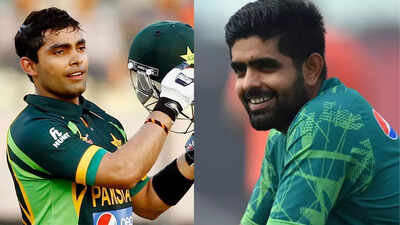
The core of the controversy originated from an image widely circulated by a fan. This screenshot meticulously detailed a statistical contrast between the two prominent cricketers. Specifically, it showcased Babar Azam’s score of 25 runs from 24 balls during a match against England, positioned against Umar Akmal’s earlier, explosive innings of 94 runs off just 24 balls versus Australia. This visual representation immediately triggered widespread criticism from the fanbase, with many interpreting it as a self-promotional act at Babar’s expense, thereby overlooking Akmal’s strategic intent.
The Translation: Understanding T20 Player Roles
The perceived comparison, and Akmal’s subsequent explanation, translates into a vital discourse on the specific demands of T20 cricket roles. Unlike Test or One-Day International formats, T20 batting requires specialized skill sets for various positions. An opener focuses on powerplay maximization, while a middle-order batter often needs adaptability to accelerate scoring under pressure or consolidate after early wickets. Akmal’s statement precisely targets this structural nuance: identifying if a player’s inherent style, like Babar Azam’s, is optimally calibrated for a specific role or if adjustments are necessary for systemic efficiency.
The Socio-Economic Impact: National Morale and Sporting Aspirations
Such public discussions, particularly those involving high-profile athletes, directly influence the national socio-economic fabric. For Pakistani citizens, especially students and aspiring professionals in urban and rural areas, cricket acts as a significant unifying force and a source of national pride. When controversies arise, they can impact public morale and potentially divert attention from critical team performance aspects. A clear communication, like this Umar Akmal clarification, is crucial. It ensures the focus remains on strategic improvements and player development, fostering a baseline of trust and supporting the next generation of athletes who look up to these figures as role models, demonstrating the importance of respectful and constructive debate in sports.
The "Forward Path": A Call for Systemic Clarity
This development represents a "Stabilization Move." While it addresses immediate public concern, it also underscores the perennial need for transparent communication within Pakistan’s cricketing ecosystem. The clarification, though reactive, offers an opportunity to shift the dialogue from personal rivalry to analytical player profiling. It implicitly calls for a more structural approach to defining player roles and communicating these strategies to the public. Such precision ensures that future debates are grounded in technical merit rather than misinterpretation, propelling Pakistan’s cricketing infrastructure towards greater strategic clarity and national advancement.
T20 World Cup Context: Pakistan’s Performance Calibration
The backdrop to this clarification is Pakistan’s challenging trajectory in the ongoing T20 World Cup. The team’s campaign has not met initial performance expectations, necessitating a critical re-evaluation of strategies. England has already secured a semi-final position, establishing a clear benchmark. Consequently, New Zealand currently holds three points, while Pakistan lags with one point, both with a single match remaining. Pakistan’s path to contention is now narrowly defined: they must achieve a decisive victory against Sri Lanka on February 28, and concurrently, hope New Zealand experiences a loss to England. If both Pakistan and New Zealand conclude the group stage with an identical three points, the net run rate metric will serve as the ultimate determinant for the final semi-final qualification slot.