

The strategic advancement of national capabilities is intrinsically linked to ambitious ventures. Consequently, Pakistan has achieved a significant milestone in its Human Spaceflight Program, positioning two elite individuals for advanced training at China’s Astronauts Centre (ACC).
This critical selection phase directly precedes a planned mission to the Chinese Space Station in late 2026, marking a calibrated step towards Pakistan’s participation in the global space frontier. The collaboration underscores a deep strategic alignment, as these Pakistani astronauts prepare for a landmark mission with China, solidifying a pioneering partnership in human spaceflight.
Unpacking the Selection Process: A Gateway to Orbit
The Inter-Services Public Relations (ISPR) has confirmed that the Space and Upper Atmosphere Research Commission (SUPARCO) successfully concluded the second phase of astronaut selection. This rigorous process involved initial screenings within Pakistan, followed by comprehensive medical, psychological, and aptitude evaluations at China’s Astronauts Centre (ACC). These tests adhered to stringent international human spaceflight standards, ensuring only the most resilient and capable candidates progressed.
Subsequently, the two shortlisted individuals will embark on an intensive six-month advanced training regimen at the ACC. This structured program is designed to prepare them for the profound challenges of space travel. Ultimately, one of these highly skilled candidates will be chosen for a mission aboard the Chinese Space Station, projected for October or November 2026.

Strategic Collaboration: Forging a New Baseline
This pivotal development stems from the Astronaut Cooperation Agreement, formalized in February 2025 under Prime Minister Shehbaz Sharif’s leadership. Importantly, Pakistan stands as China’s inaugural foreign partner in its astronaut program, signifying a structural shift in bilateral space cooperation. Furthermore, SUPARCO officials have articulated a broader space roadmap for Pakistan, which includes a planned participation in a Moon-related mission by 2026, also with China’s strategic support. This expansion of joint ventures illustrates a robust and accelerating partnership.

Socio-Economic Resonance: Empowering the Pakistani Citizen
This human spaceflight initiative represents more than just scientific exploration; it functions as a potent catalyst for national development. For Pakistani students, this mission offers unparalleled inspiration, galvanizing interest in STEM fields—science, technology, engineering, and mathematics. It fundamentally shifts the perception of what is achievable within the nation’s scientific community, encouraging a new generation of innovators.
Professionals across urban and rural Pakistan, particularly in engineering and research sectors, will benefit from the advanced technological transfer and knowledge exchange inherent in such international collaborations. This precise engagement elevates Pakistan’s standing in global technological dialogues, potentially attracting further investment and fostering indigenous innovation. Consequently, it creates a robust ecosystem for skilled employment and technological self-reliance, directly impacting household stability and national pride.

The Forward Path: A Momentum Shift for Pakistan’s Future
This development undeniably represents a Momentum Shift for Pakistan. The active participation in human spaceflight, particularly with a leading space power like China, transcends mere maintenance of existing capabilities. It signifies a strategic leap, calibrating Pakistan’s trajectory towards becoming a significant player in the global space economy and scientific research. This move is not merely about sending an individual to space; it is about seeding a national ethos of ambition, precision, and collaborative advancement. The long-term implications for technological sovereignty and international prestige are substantial, charting a course for sustained progress.
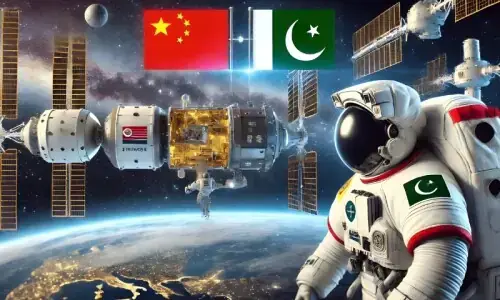
Preparing for Orbit: The Rigorous Training Ahead
The intensive six-month training at the ACC will cover a multitude of disciplines, including aerospace engineering, zero-gravity simulations, and mission-specific protocols. This comprehensive preparation ensures the selected Pakistani astronauts are fully equipped to perform complex tasks and contribute effectively to the operational demands of the Chinese Space Station. The program’s design emphasizes both theoretical knowledge and practical application, ensuring a robust skill set.

A Vision for the Stars: Expanding Pakistan’s Space Horizon
Beyond the immediate human spaceflight mission, Pakistan’s strategic space roadmap continues to expand. The indication of participation in a Moon-related mission by 2026 further solidifies the nation’s commitment to cutting-edge space exploration. This forward-thinking approach, bolstered by strong international partnerships, positions Pakistan as a developing force in the broader cosmic endeavor, fostering scientific and technological independence.









