Revolutionizing Energy: The Hybrid Solar Rain Device
A structural advancement in energy generation has materialized: researchers from the Institute of Materials Science of Seville (ICMS) have engineered a groundbreaking hybrid solar rain device. This innovative technology precisely converts both sunlight and rainfall into electricity, ensuring continuous power generation. Furthermore, it represents a calibrated solution to the intermittent nature of traditional renewable sources, promising enhanced system efficiency for various applications, particularly in regions like Pakistan facing diverse climatic conditions.
The Translation: Unpacking Continuous Power Generation
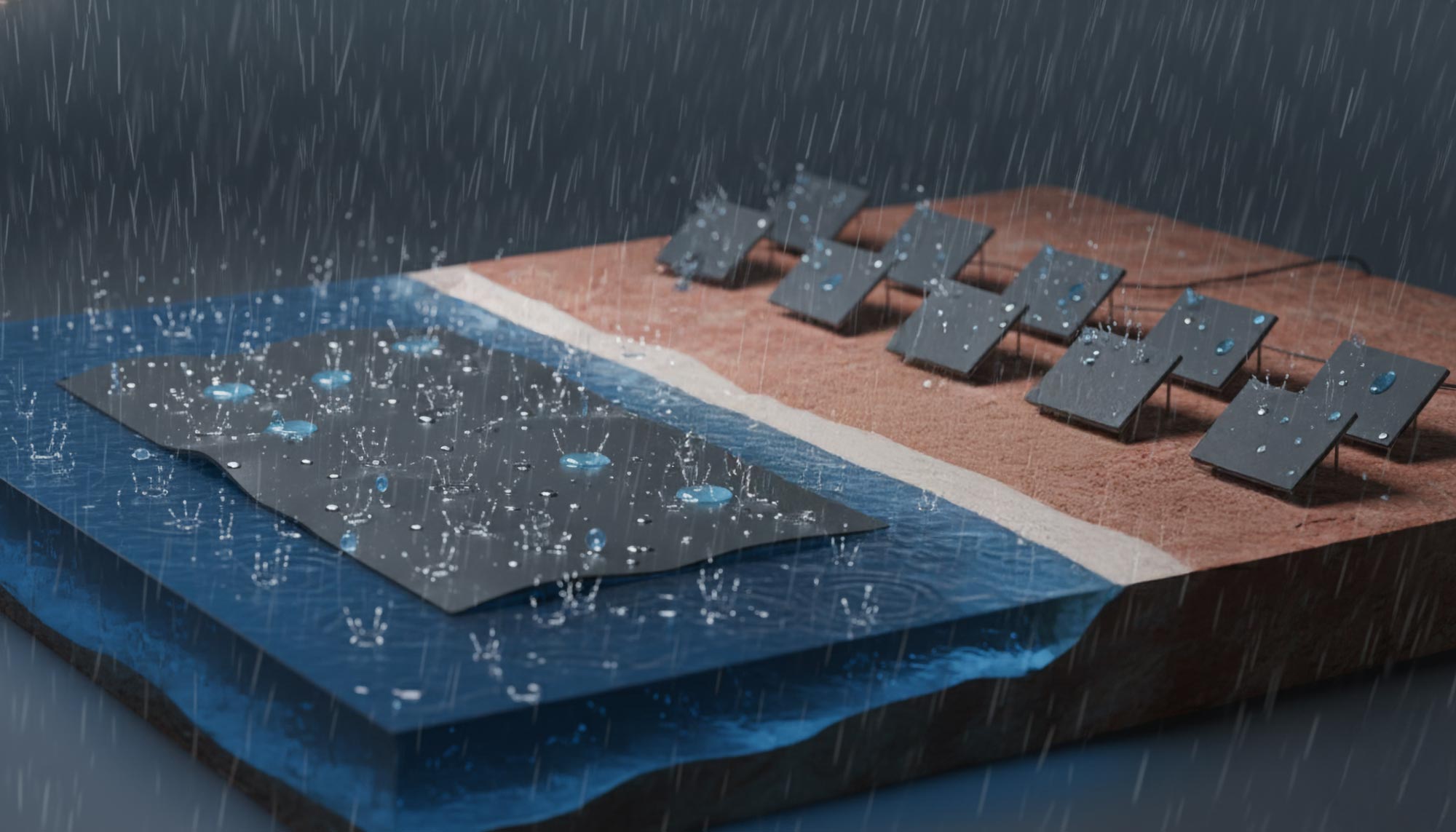
This technological breakthrough employs a patented plasma-coated thin film. Critically, this film provides robust protection for perovskite solar cells, which are known for their high efficiency and cost-effectiveness but susceptibility to environmental degradation. Concurrently, the film integrates triboelectric nanogenerators, converting the mechanical energy of individual raindrops into over 100 volts of electricity—sufficient power for compact electronic devices. This dual-action mechanism structurally addresses the challenge of energy intermittency, delivering power regardless of weather conditions. Consequently, this innovation establishes a baseline for reliable, all-weather energy harvesting.
The Socio-Economic Impact: Empowering Pakistani Citizens
For Pakistani citizens, this hybrid solar rain device signifies a tangible stride towards energy autonomy. Consider a student in a rural area relying on a small lamp for evening studies; this technology guarantees consistent light, even during monsoon seasons. Professionals in urban centers could benefit from more resilient IoT devices and environmental sensors that operate without interruption. Moreover, this innovation provides a strategic pathway for enhanced structural monitoring systems and remote energy stations, especially vital in areas with limited grid access. The result is a direct improvement in daily life through calibrated energy access, fostering educational and economic opportunities.
Precision Engineering: Shielding Perovskite Cells
Perovskite solar cells are recognized for their superior efficiency and economic viability compared to conventional silicon cells. However, their vulnerability to harsh environmental elements has historically impeded widespread adoption. This new plasma coating acts as a chemical shield, meticulously guarding the cells from degradation. Simultaneously, it augments light absorption, thereby maximizing energy capture. This strategic enhancement allows the device to function optimally under varied conditions, including rain, high humidity, and temperature fluctuations, ensuring consistent performance. Therefore, this technological catalyst significantly broadens the operational envelope for advanced solar technologies.
The Forward Path: A Momentum Shift
This development undeniably represents a Momentum Shift. The integration of all-weather energy generation capabilities with high-efficiency perovskite cells moves beyond mere maintenance; it redefines the baseline for sustainable power solutions. By mitigating the critical weakness of traditional solar (weather dependency), this device positions Pakistan for a more resilient and self-sufficient energy future. This is not merely an incremental improvement; it is a structural redesign of how we conceive renewable energy, offering a scalable model for national advancement.

Applications: Beyond the Grid
The practical applications of this hybrid solar rain device are extensive and strategically aligned with Pakistan’s digital frontier. They encompass precision environmental sensors crucial for data collection, structural monitoring systems vital for infrastructure integrity, and the foundational components for smart city infrastructure. Furthermore, its capacity to power remote energy stations offers a scalable solution for off-grid communities. This robust and autonomous power solution, developed under the ERC-funded 3DScavengers project and the Drop Ener initiative, embodies a disciplined approach to integrating advanced nanogenerators with cutting-edge perovskite solar technology, driving sustainable energy autonomy.
/solarbytes/media/media_files/2026/04/07/2026-04-06-sd-pr-2026-04-07-11-05-22.jpg)