

The systematic advancement of national infrastructure demands strategic operational adjustments. Consequently, the Excise, Taxation, and Narcotics Control Department has initiated a streamlined Punjab vehicle re-registration process for vehicles and motorcycles previously registered in other Pakistani provinces. This structural update, effective February 14, mandates biometric verification for all new requests, particularly benefiting residents in regions like Rawalpindi Division. This decisive move aims to enhance logistical efficiency and standardize vehicle ownership data across the province, representing a significant step towards integrated provincial asset management, which is critical for future development initiatives.
The Translation: Deconstructing the Policy Framework for Punjab Vehicle Re-registration
This new Standard Operating Procedure (SOP) by the Excise department marks a pivotal shift in how inter-provincial vehicle transfers are managed. Previously, individuals seeking to transfer vehicle registrations between provinces often encountered a labyrinth of complex administrative hurdles, leading to delays and frustration. Now, Punjab has strategically integrated a simplified process allowing vehicles of all types and engine capacities, originally registered in Khyber Pakhtunkhwa, Balochistan, Sindh, Gilgit-Baltistan, and Azad Kashmir, to obtain a Punjab registration number efficiently. This policy ensures a more cohesive national vehicle database.
The core logic behind this updated policy framework is multifaceted. Firstly, it aims to centralize and accurately catalog the provincial vehicle fleet, providing a clearer operational overview. Furthermore, it explicitly seeks to regularize vehicle documentation, thereby mitigating potential discrepancies, enhancing data integrity, and combating illicit vehicle activities. The process commences with mandatory biometric verification, ensuring a robust, tamper-proof, and secure identification protocol for vehicle owners, which is a baseline requirement for modern governance.
Understanding the Operational Shift
To qualify for this inter-provincial transfer, applicants must meticulously fulfill specific prerequisites. Fundamentally, an essential No Objection Certificate (NOC) from the originating province’s excise office is mandatory. This document serves as a critical clearance mechanism, confirming the vehicle’s legitimate status, ensuring no outstanding liabilities, and verifying its suitability for transfer. Without this baseline certification, the application cannot proceed.
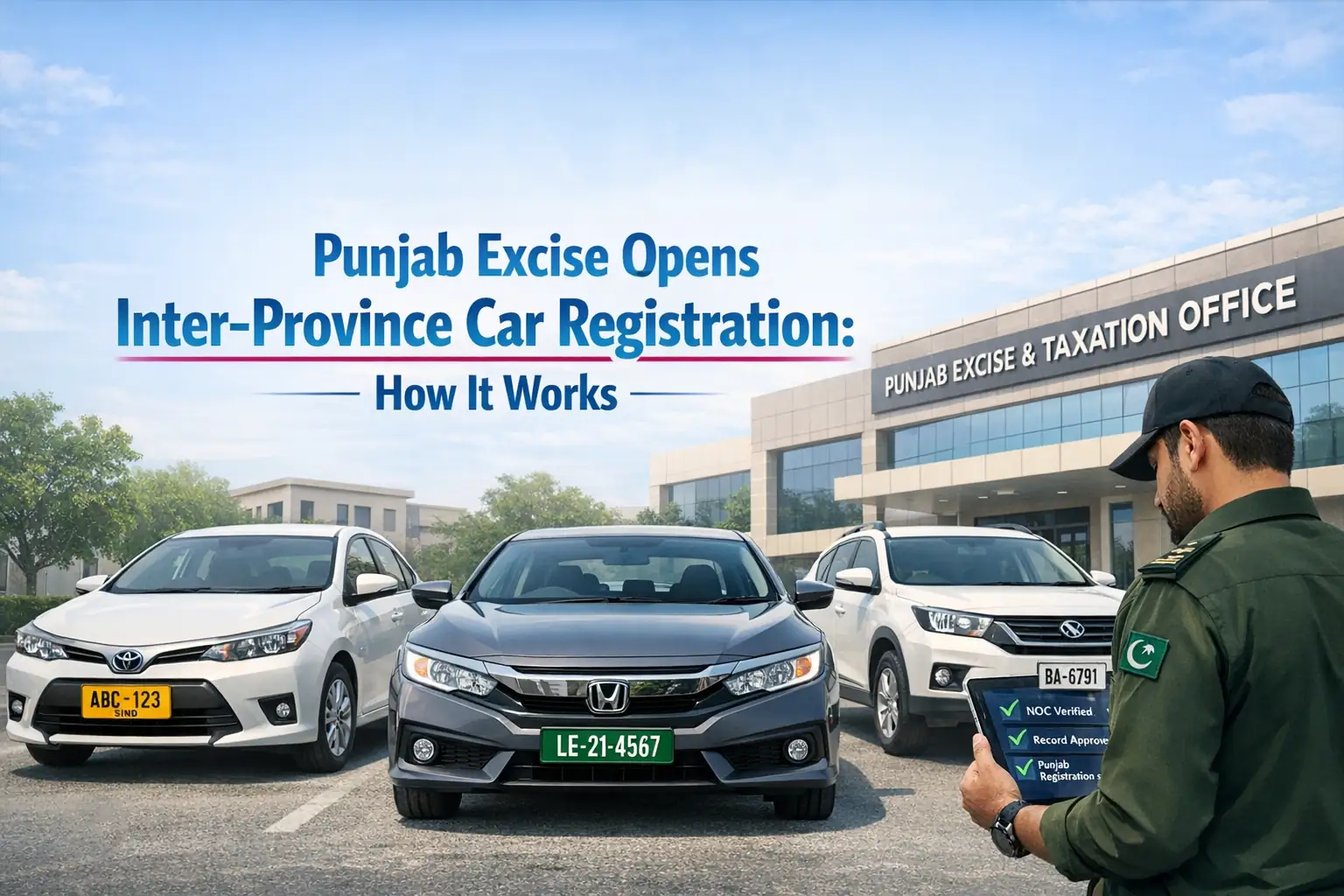
Moreover, the comprehensive procedure requires a precise set of documents to ensure complete transparency and legal compliance throughout the transfer. Upon successful completion of all stages, the authorities will issue a new Punjab-specific registration number for the respective city, subsequently cancelling the previous provincial identifier. The originating excise office will also receive formal notification of this new registration, maintaining a complete and auditable trail across both jurisdictions, which streamlines administrative oversight.
Essential Documentation & Fees
Applicants must furnish a precise set of documents to facilitate the re-registration, ensuring a smooth and rapid processing timeline:
- No Objection Certificate (NOC) from the relevant provincial excise office, confirming vehicle clearance.
- A valid vehicle clearance certificate, affirming its legal standing.
- A formal Police 15 report, verifying no theft or accident history.
- The vehicle’s complete original file, containing all historical documentation.
- A legally binding affidavit from the vehicle owner, attesting to ownership and compliance.
It is important to note that the registration fee structure remains entirely consistent with the existing rates applicable within Punjab. This calibrated fee approach avoids disparate charges for inter-provincial transfers, promoting equity and predictability across all applicants, which simplifies financial planning for citizens.
The Socio-Economic Impact: How This Changes Daily Life
This policy implementation directly impacts numerous Pakistani citizens, particularly those who have relocated between provinces for work, education, or family reunification. Previously, retaining an “out-of-province” registration could lead to various administrative inconveniences, including potential challenges during vehicle resale, law enforcement interactions, or even insurance claims. Consequently, this refined system significantly simplifies legal ownership transfers, demonstrably reducing bureaucratic friction for professionals, students, and households alike.
For students migrating to Punjab’s educational hubs and professionals seeking career opportunities, this means a more efficient and less burdensome integration into Punjab’s urban and rural economic fabric. Enhanced inter-provincial mobility, recognized as a critical catalyst for national economic growth and cohesion, is now administratively smoother and more accessible. Furthermore, the improved data accuracy resulting from this centralized system assists in better urban planning, calibrated resource allocation, and potentially improves traffic management and infrastructure development across the province. The increased transparency of the process also minimizes opportunities for informal or illegal vehicle transfers, directly safeguarding consumer interests and bolstering governmental revenue streams essential for public services.
The “Forward Path”: Momentum Shift or Stabilization Move?

This initiative represents a definitive Momentum Shift for Punjab. It is not merely a maintenance effort designed to uphold existing administrative norms but a strategic advancement towards a more integrated and efficient national administrative system. By standardizing vehicle re-registration, Punjab is laying a structural baseline for enhanced provincial coordination and robust data management, crucial for a developing economy. This move signifies a proactive approach to modernizing governmental services, ensuring that policy frameworks evolve precisely to meet the dynamic needs of a mobile population. The mandatory biometric verification component, in particular, fortifies security protocols, establishing a new benchmark for asset identification and ownership integrity. It is a precisely calibrated step towards optimizing civil processes for a digitally driven future, ultimately contributing to a more organized and progressive Pakistan.








