

Optimizing National Infrastructure: Introducing Structural Health Assessment Pakistan
Pakistan has strategically calibrated a new national initiative, launching a pioneering Structural Health Assessment Pakistan (SHA) system. This critical development, spearheaded by the Pakistan Engineering Council (PEC) alongside KnK Japan–Pakistan, the National Disaster Risk Management Fund (NDRMF), and GIZ Pakistan, marks a pivotal moment for climate-resilient infrastructure. Furthermore, this digital platform will provide engineers with advanced tools to precisely evaluate and reinforce public structures, ensuring a robust national framework against escalating climate impacts and disaster risks.
The Translation: A Proactive Shield for Public Assets
The Structural Health Assessment Pakistan system is a sophisticated digital framework designed to systematically analyze and monitor the integrity of existing infrastructure. Essentially, it translates complex structural data into actionable insights. This enables engineering professionals to identify vulnerabilities before they manifest as failures. Consequently, the system acts as a proactive shield, ensuring that public assets such as schools and hospitals maintain optimal operational safety and longevity. This precise diagnostic capability moves beyond reactive repairs, establishing a baseline for predictive maintenance.
The Socio-Economic Impact: Securing Daily Life and Future Prosperity
This initiative directly impacts the daily lives of Pakistani citizens by fundamentally enhancing safety and stability. For students, it signifies safer educational environments, reducing risks from natural hazards. Professionals benefit from more reliable infrastructure, enabling consistent economic activity and secure commutes. Moreover, households, both urban and rural, gain critical assurance through fortified essential services. The SHA system’s deployment is thus a direct investment in the security and operational efficiency of the nation’s foundational assets, fostering an environment conducive to sustained prosperity and well-being across all demographics.
The Forward Path: A Structural Momentum Shift
This launch represents a clear Momentum Shift for Pakistan’s infrastructure development trajectory. It is not merely a maintenance upgrade but a strategic pivot towards a data-driven, preventative paradigm. The integration of advanced digital assessment capabilities into engineering practice establishes a new, higher standard for national resilience. Therefore, this initiative is a catalyst for transformative change, structurally fortifying Pakistan against future climate challenges and fostering an era of strategic, sustainable growth.
00530-3/asset/fbe54dd0-0726-449f-9e36-31226f726a9c/main.assets/gr1_lrg.jpg)
Strategic Alliances for Nationwide Resilience
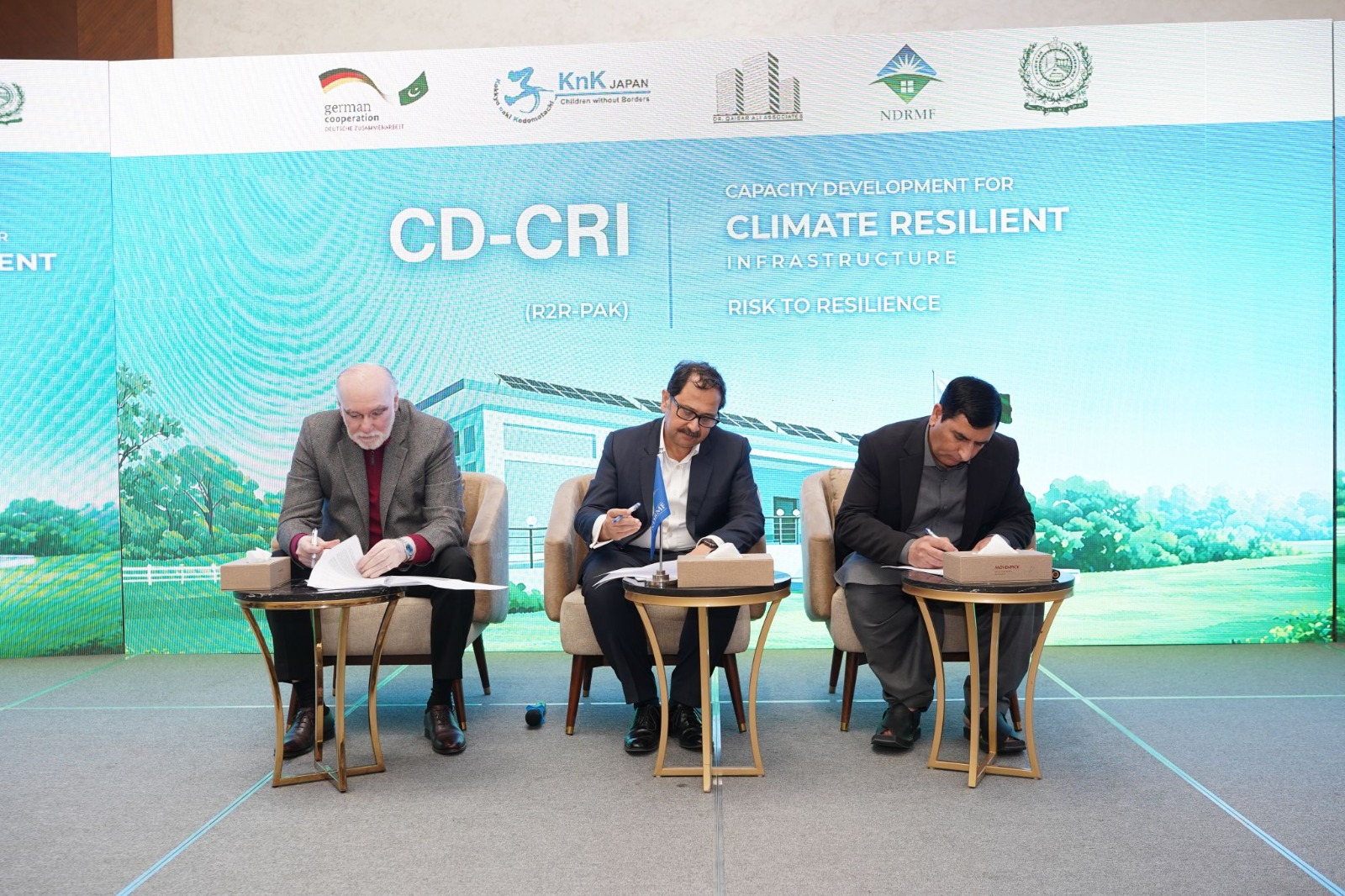
To ensure the widespread adoption and long-term sustainability of the SHA system, a critical Memorandum of Understanding (MoU) was formalized. This agreement involved PEC, NDRMF, and KnK Japan–Pakistan. Chairman PEC, Engr. Waseem Nazir, emphasized the national commitment inherent in this structural undertaking. “Resilience is not merely a project outcome; it is a national commitment,” he stated. PEC strategically equips engineers with modern tools, enabling them to safeguard lives and communities against escalating climate and disaster risks. Furthermore, significant appreciation was extended to NDRMF and GIZ Pakistan, acknowledging the leadership of Bilal Anwar (CEO NDRMF), Dr. Nicolai Dellmann (GIZ), Alex Forbes (UNRCO), and Dr. Qaisar Ali and Associates for their invaluable contributions.
International Cooperation: A Foundation for Climate-Resilient Infrastructure
The Capacity Development for Climate-Resilient Infrastructure (CD-CRI) project, the umbrella for this SHA launch, underscores robust international cooperation. Funded by the German Federal Ministry for Economic Cooperation and Development (BMZ) and supported by GIZ GmbH, this initiative highlights a structural commitment to global partnerships. Consequently, it solidifies Pakistan’s trajectory towards establishing a benchmark for structurally sound and environmentally conscious national development.








