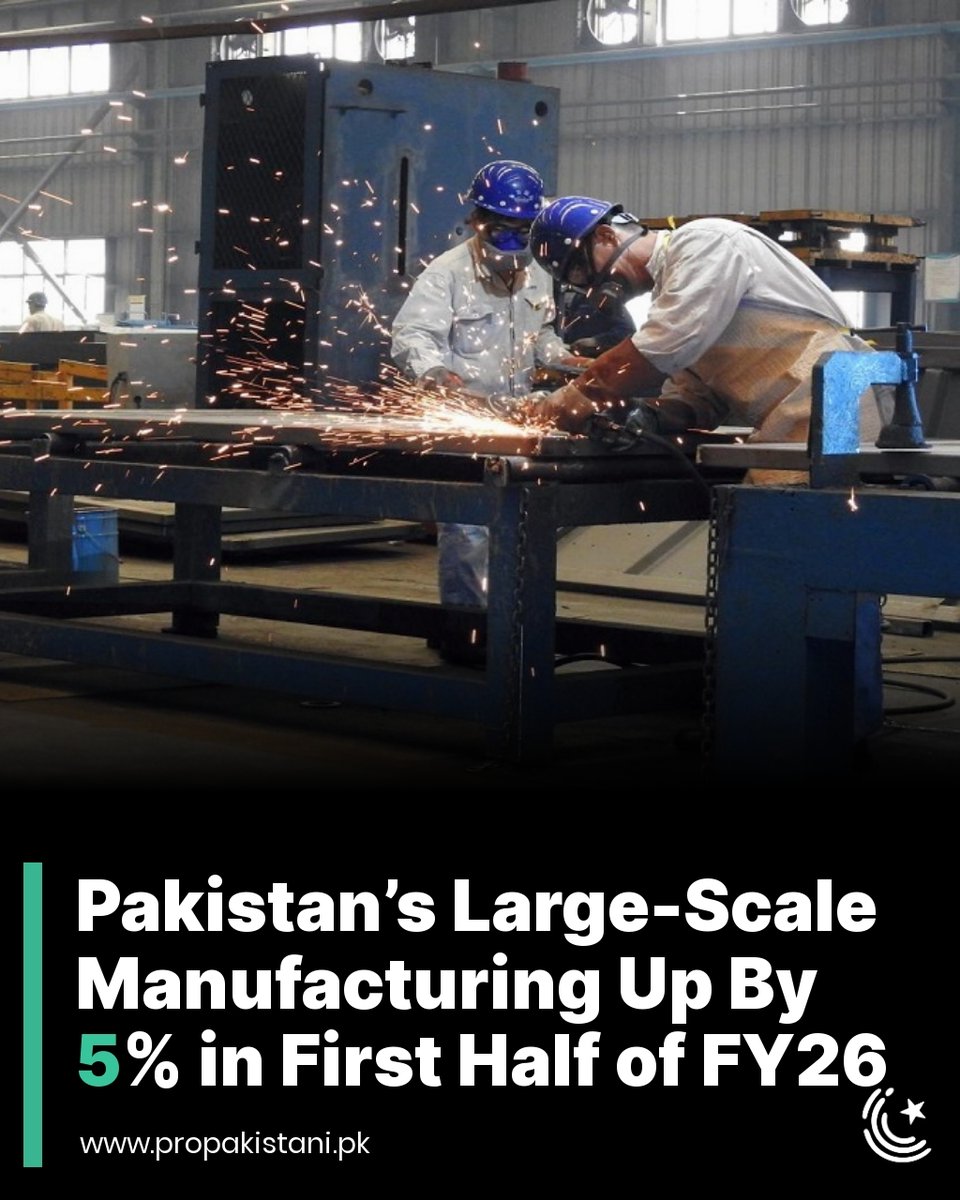
Pakistan’s Large Scale Manufacturing (LSM) growth recorded a significant 5 percent year-on-year increase during the first half of Fiscal Year 2026 (1HFY26), signaling a robust industrial rebound. This calibrated expansion, evidenced by a 0.4 percent year-on-year and a substantial 9.3 percent month-on-month surge in December 2025 alone, underscores a potent shift in the nation’s economic trajectory. Consequently, the LSM growth target for FY26 has been strategically revised upward to 4.0 percent, reflecting an enhanced industrial performance baseline.
Decoding Pakistan’s Manufacturing Growth Trajectory
The Large Scale Manufacturing (LSM) growth index serves as a critical barometer for Pakistan’s industrial health. In December 2025, the index registered a precise 0.4 percent year-on-year increment. Furthermore, a remarkable 9.3 percent month-on-month surge highlights a rapid acceleration in industrial output. During the entirety of the first half of FY26, the LSM index expanded by an impressive 5 percent year-on-year, confirming sustained positive momentum within the manufacturing sector.

This strategic expansion was primarily propelled by several key sectors. Automobile production experienced a substantial 31 percent year-on-year increase. Concurrently, wearing apparel saw a 9 percent growth, cement production rose by 3 percent, and non-metallic minerals also advanced by 3 percent. The textile sector, a foundational component of Pakistan’s industry, increased its output by 2 percent. In contrast, certain sectors experienced contractions. Fertilizer output declined by 10 percent year-on-year, while pharmaceuticals and food production each decreased by 6 percent. Additionally, petroleum and coke output recorded a 5 percent year-on-year fall in December 2025.
Calibrating Daily Life: The Socio-Economic Impact of Industrial Expansion
The sustained Pakistan manufacturing growth directly impacts the daily lives of citizens. The surge in automobile production, for instance, implies increased job opportunities within assembly plants and ancillary industries, providing stable income for professionals and skilled laborers. Growth in wearing apparel manufacturing fosters employment, particularly for women in textile hubs, improving household economic stability. Moreover, a 3 percent rise in cement and non-metallic minerals indicates accelerated infrastructure development, leading to improved housing, roads, and public facilities that enhance urban and rural connectivity and quality of life.
Conversely, declines in critical sectors like fertilizer (down 10 percent) could lead to higher agricultural input costs, potentially affecting farmers’ livelihoods and food prices for consumers. Reductions in pharmaceutical (down 6 percent) and food production (down 6 percent) warrant careful monitoring, as these directly influence public health and food security, impacting households nationwide. Understanding these calibrated shifts is vital for both economic strategists and the general populace.
A Momentum Shift or Strategic Stabilization for Pakistan?
Based on the data, the upward revision of the LSM growth target for FY26 to 4.0 percent represents a clear Momentum Shift for Pakistan’s industrial landscape. The concentrated growth in high-value sectors such as automobiles, combined with consistent performance in textiles and construction materials, indicates a structural strengthening. However, the concurrent declines in vital sectors like fertilizers and pharmaceuticals highlight areas requiring immediate strategic intervention. A forward-thinking approach necessitates targeted policies to stabilize and re-energize these critical segments, ensuring balanced and sustainable industrial expansion for National Advancement. This dual trajectory underscores the need for calibrated policy adjustments to sustain positive Pakistan manufacturing growth and address sector-specific challenges systematically.