

Revolutionizing Resource Utilization: The Art of Scrap Metal Transformation
A calibrated vision for national advancement is taking structural form in Islamabad, where artist Ehtisham Jadoon meticulously transforms discarded automotive components into colossal sculptures. This pioneering approach to Pakistani scrap metal art redefines waste material, elevating it into monumental figures inspired by iconic Transformers and prehistoric dinosaurs. Furthermore, Jadoon’s work establishes a compelling blueprint for resource optimization and sustainable creativity within Pakistan’s evolving industrial landscape. His studio, filled with cogs, chains, and engine parts, functions as a precision laboratory for artistic innovation, demonstrating the profound value hidden within what was once considered refuse.
The Translation: From Discarded Steel to Digital-Age Icons
The core principle at play is the systematic re-engineering of industrial by-products. Jadoon does not merely assemble; he deconstructs and recontextualizes, utilizing scrap metal’s inherent properties to create complex forms. For instance, a vehicle’s suspension spring becomes a limb, while a fuel tank is reformed into a spine. This process necessitates an acute understanding of material science and structural integrity. Consequently, each sculpture functions as both a visual spectacle and a testament to inventive engineering, showcasing how seemingly inert waste can achieve dynamic new purposes through disciplined craftsmanship.

Engineering Masterpiece: Optimus Prime’s Precision Assembly
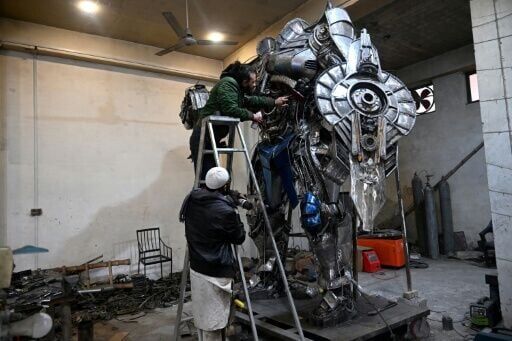
Jadoon and his team invested months in welding and reshaping various discarded vehicle components to construct his latest masterpiece: a 14-foot model of Optimus Prime. This monumental sculpture stands as his largest creation to date, with over 90 percent of its material sourced from scrap metal. The structural complexity is remarkable; motorbike springs and gears form the arms, while car rims define the shoulders. Furthermore, a fuel tank was expertly molded into the spine, and chains alongside suspension parts assembled the knees, culminating in a strikingly lifelike finish achieved by crafting the character’s eyes from vehicle bearings.
Beyond Optimus Prime, Jadoon’s workshop also houses other colossal creations. These include a magnificent steel-maned lion and a giant Tyrannosaurus rex, each piece constructed entirely from salvaged metal. These diverse sculptures collectively underscore the expansive possibilities within Pakistani scrap metal art, proving that imagination combined with technical skill can transcend traditional material limitations.

The Socio-Economic Impact: Catalyzing Innovation and Sustainability
Ehtisham Jadoon’s work profoundly impacts the daily life of Pakistani citizens by presenting a tangible model for innovation and resourcefulness. For students, particularly those in STEM fields, his sculptures offer a powerful example of applied engineering and artistic expression, stimulating interest in practical skill development. Professionals across various sectors can observe the economic potential in waste stream repurposing, which could lead to new businesses in sustainable manufacturing or recycling. Moreover, for urban and rural households, these artworks subtly promote a mindset of environmental consciousness and highlight the value in reusing discarded items, fostering a collective move towards a circular economy. Consequently, this initiative directly contributes to a more sustainable future.

A Visionary’s Blueprint: Self-Taught and Resilient Craft
Ehtisham Jadoon, a former martial artist and steel fabricator, possesses no formal art training; instead, he designs his large-scale sculptures spontaneously, relying on intuitive imagination and extensive practical experience. He articulates his creative process as visualizing forms within raw materials, stating, “Whenever I see an object, I visualize a form. I imagine a block transforming into a shape, then I solve the puzzle and bring it to life.” This methodology underscores a baseline discipline honed through his previous career paths.
His physically demanding craft, however, comes at a significant cost. Jadoon visits a doctor almost weekly to treat burns and eye irritation, direct consequences of constant welding sparks. Despite these inherent risks, he affirms that metal sculpting allows him to channel the intense focus and resilience he developed as a fighter. This dedication is a testament to his passion and the rigorous demands of transforming scrap into structural art.

The “Forward Path”: A Momentum Shift in Sustainable Art
This development undeniably represents a Momentum Shift for Pakistan. Jadoon’s work moves beyond mere artistic expression; it strategically positions art as a catalyst for environmental responsibility and economic ingenuity. By demonstrating the high-value potential of recycled materials on such a grand scale, he is not only creating awe-inspiring sculptures but also inspiring a re-evaluation of waste streams as viable resources. This visionary approach propels Pakistan towards a future where creativity and sustainability are structurally intertwined, establishing new benchmarks for artistic innovation and resource management. Consequently, it promotes a more efficient and aesthetically conscious national ecosystem.

Catalyzing Sustainability Through Creative Reclamation
Each week, Jadoon undertakes strategic tours of scrapyards across Islamabad, meticulously sifting through heaps of discarded metal to identify components that align with his artistic vision. Scrapyard owner Bostan Khan precisely articulates the impact of Jadoon’s work, stating, “What is waste to us becomes something valuable in his hands. It’s incredible to witness.” This perspective underscores the tangible value Jadoon adds to the material economy. Through his larger-than-life creations, Jadoon not only showcases profound artistic innovation but also critically highlights the systemic power of recycling. He effectively transforms industrial waste into awe-inspiring works of art, providing a clear model for sustainable practices in a rapidly industrializing nation. His work is a potent symbol of progress.
The Future of Recycled Art in Pakistan
- Inspiring Next-Gen Innovators: Jadoon’s art encourages young Pakistanis to explore careers at the intersection of engineering and creativity.
- Promoting Circular Economy: His work provides a visible exemplar of waste transformation, advocating for broader recycling initiatives.
- Enhancing National Image: These unique sculptures elevate Pakistan’s profile as a hub for ingenious and sustainable artistry.









