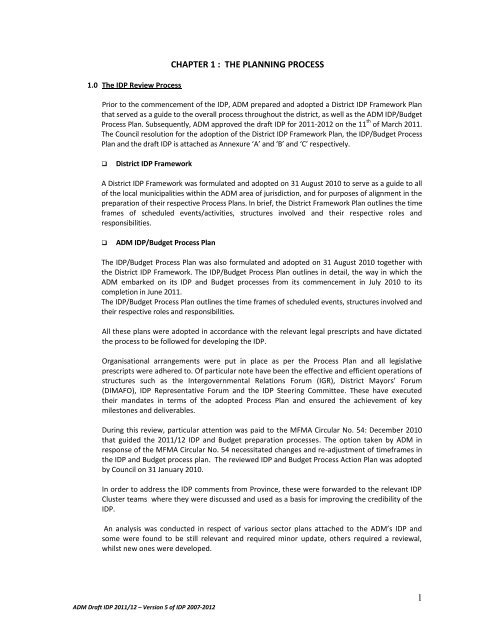
The strategic national calibration of educational standards faces a critical juncture as the implementation of Pakistan’s new grading policy for matric and intermediate examinations encounters unforeseen delays. Specifically, Punjab and Balochistan have not yet issued formal notifications, despite earlier approvals at the national level. This New Grading Policy Delay poses a significant challenge to the uniform enforcement intended for the 2026 annual exams, potentially creating systemic inconsistencies across the nation’s educational landscape.
The Translation: Deconstructing the Policy Framework
The Inter Board Committee of Chairmen (IBCC) and the Inter-Provincial Education Ministers Conference (IPEMC) meticulously approved this policy. Their objective was to ensure uniform enforcement across all provinces and Azad Kashmir. Crucially, the revised policy elevates passing marks for Classes 9 and 11 from 33 percent to a more rigorous 40 percent. Furthermore, it introduces distinct passing requirements for each individual subject, a structural shift designed to enhance academic accountability and depth of knowledge. This framework aims to standardize evaluation benchmarks, an essential step for national educational cohesion.
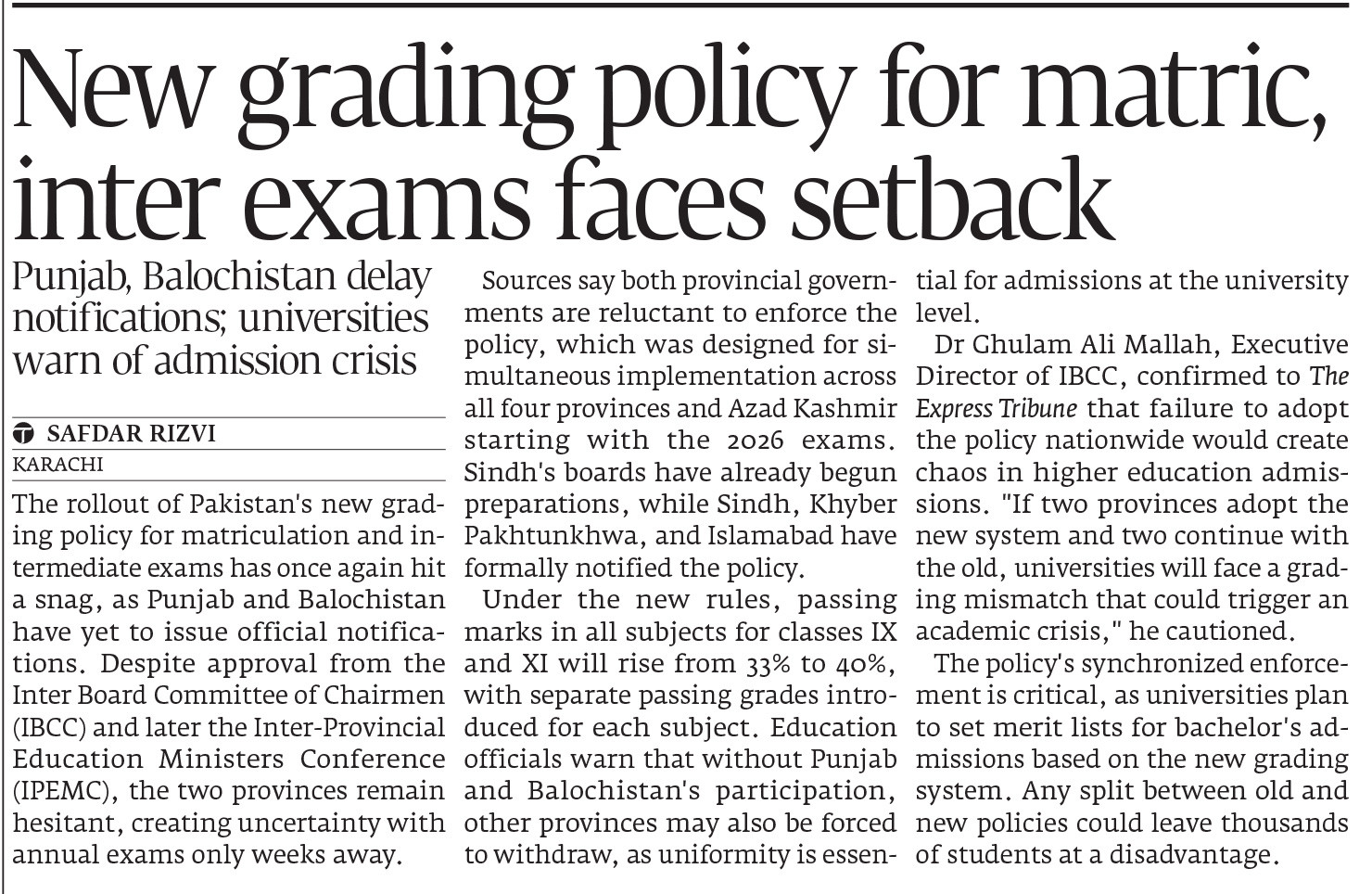
While Sindh, Khyber Pakhtunkhwa, and Islamabad have proactively issued their respective notifications and commenced preparations, the hold-up in Punjab and Balochistan introduces a critical divergence. This New Grading Policy Delay creates potential complications. Dr. Ghulam Ali Mallah, Executive Director of the IBCC, precisely articulated the potential for systemic destabilization. Adopting disparate grading systems across provinces could critically impact higher education admissions, jeopardizing national talent mobility. Therefore, synchronized enforcement remains a baseline requirement for a seamless transition.
The Socio-Economic Impact: Calibrating Student Futures Amidst Policy Uncertainty
This provincial disparity in policy adoption directly affects the daily lives of Pakistani citizens, particularly students and their families. For urban and rural students preparing for university admissions, a fragmented grading system creates significant ambiguity. Universities across Pakistan plan to prepare merit lists for undergraduate programs based on the new, elevated grading criteria. Consequently, any variation in evaluation standards between provinces may lead to discrepancies, potentially disadvantaging students from regions with delayed implementation.

Consider a student in Punjab applying to a university in Sindh. Without a uniform grading scale, their academic performance might be interpreted differently, impacting their admission prospects despite comparable effort. This systemic inconsistency undermines the principle of equitable opportunity. For professionals in the education sector, the delay necessitates adapting to multiple standards, increasing administrative complexity. Households, already navigating economic challenges, face added uncertainty regarding their children’s educational trajectory and future career pathways due to this critical New Grading Policy Delay.
The Forward Path: A Call for Structural Synchronization
This development primarily represents a Stabilization Move rather than a “Momentum Shift.” The initial national approval marked a significant step forward, signaling a commitment to elevating educational standards. However, the subsequent provincial delays introduce a destabilizing factor. Achieving true national advancement in education requires not just policy formulation, but also robust, synchronized implementation across all administrative units.

The imperative now is for Punjab and Balochistan to expedite formal adoption, ensuring all stakeholders—students, institutions, and families—operate under a singular, transparent system. This strategic alignment is paramount to prevent confusion and uphold the integrity of Pakistan’s higher education admissions process, directly addressing the implications of the New Grading Policy Delay. Furthermore, a unified approach ensures all Pakistani youth compete on a level academic playing field, reinforcing national unity through educational equity.
- Enhanced Transparency: Clear, unified grading criteria streamline evaluation.
- Equitable Admissions: Standardized scores ensure fair university entry.
- National Cohesion: A consistent educational system fosters shared national progress.