

In a strategic move towards national advancement, Punjab Chief Minister Maryam Nawaz has launched the “Maryam Ko Batayein” Helpline 1000. This initiative provides immediate Ramadan financial aid, offering Rs. 10,000 to deserving families during the holy month. This system ensures direct contact for citizens facing severe economic hardship, guaranteeing targeted support.
Optimizing Resource Distribution: The Maryam Ko Batayein Initiative
The “Maryam Ko Batayein” Helpline 1000 serves as a critical conduit for emergency relief. Consequently, citizens experiencing significant financial distress can directly access this support. Chief Minister Nawaz has affirmed that no qualifying family seeking assistance will remain unsupported throughout Ramadan, demonstrating a calibrated approach to welfare.
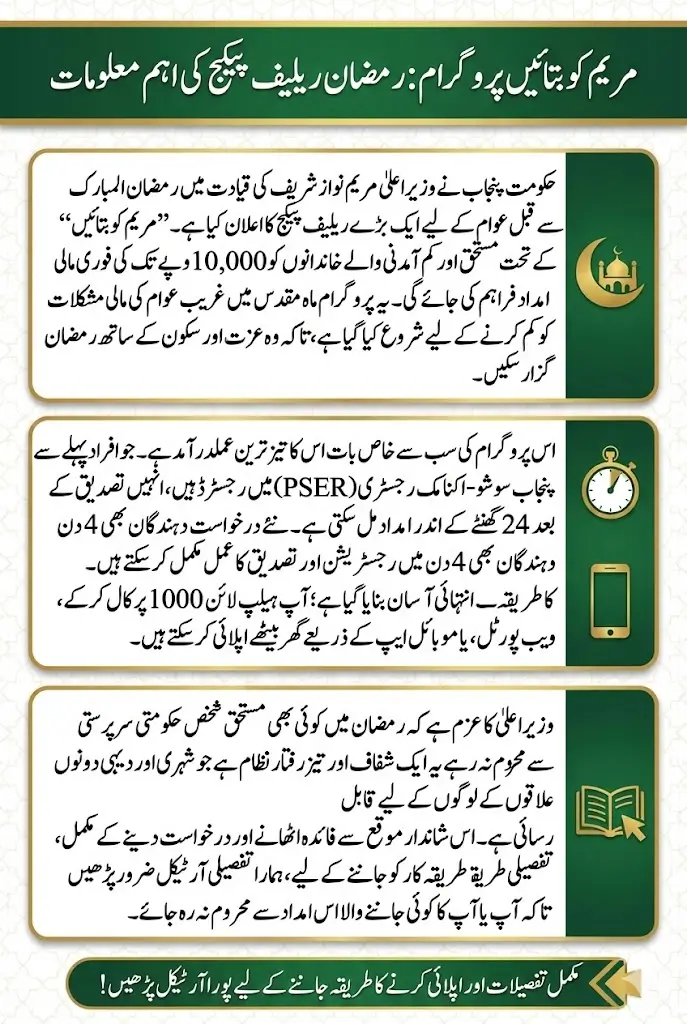
Precision in Aid: How the Rs. 10,000 Disbursement Operates
The operational mechanism for this program prioritizes efficiency and timely delivery. Eligible applicants will receive Rs. 10,000 within a 24-hour timeframe, contingent upon successful completion of the mandated verification process. Furthermore, accessibility is streamlined through multiple channels. Citizens possess the flexibility to apply via three distinct methods:
- Calling Helpline 1000 directly.
- Utilizing the official mobile application.
- Submitting details through the dedicated online web portal.
Applicants are uniformly required to input their CNIC number for registration, establishing a baseline for identification.

The Translation: Deconstructing the Aid Mechanism
The “Maryam Ko Batayein” program is more than just a helpline; it’s a structural approach to social welfare. It translates the urgent need for financial support into a structured, accessible process. Essentially, the government is creating a direct, verifiable channel for citizens to request and receive critical assistance, bypassing traditional bureaucratic delays. This system aims to establish a reliable pipeline for distributing aid swiftly.

The Socio-Economic Impact: Daily Life Transformed
This initiative profoundly impacts the daily lives of Pakistani citizens. For households in both urban and rural Pakistan, particularly those experiencing economic vulnerability, the provision of Rs. 10,000 support during Ramadan offers immediate relief. Students benefit from reduced household financial stress, allowing for greater focus on education. Professionals, struggling with rising costs, find a temporary but crucial buffer. Consequently, this program acts as a catalyst for stabilizing household economies, enabling families to meet essential needs during a significant religious period.

Ensuring Equity: Verification and Transparency Protocols
To uphold structural integrity and prevent resource misallocation, the government employs robust verification protocols. Specifically, applications undergo scrutiny via the Punjab Socio-Economic Registry (PSER). Furthermore, records are cross-referenced with the Benazir Income Support Programme (BISP) database. This meticulous process ensures that assistance reaches genuinely deserving families. Consequently, aid is exclusively provided to those who meet the stringent qualification criteria and are not already beneficiaries of other governmental relief schemes, promoting equitable distribution.

The “Forward Path”: Momentum Shift or Stabilization Move?
This development represents a Momentum Shift. The direct engagement via Helpline 1000 and the rapid disbursement mechanism signify a proactive, tech-integrated approach to social welfare. It moves beyond traditional, often slow, relief efforts towards a more agile and citizen-centric model. This structural change can serve as a baseline for future emergency support programs, enhancing the efficiency of public service delivery. The emphasis on transparency and targeted delivery further reinforces this as a progressive step for Pakistan’s social safety nets.









