

Driving National Advancement Through Calibrated Policy
A recent high-level policy dialogue at LUMS precisely addressed the imperative for Evidence-Based Education Reforms in Pakistan. This strategic gathering emphasized improving girls’ middle school retention and enhancing inclusion for children from religious minority backgrounds. Crucially, experts underscored the necessity of grounding policy decisions in robust data, moving beyond anecdotal approaches to systemic change. This initiative represents a foundational shift towards optimized educational outcomes for all Pakistani citizens, directly impacting national progress.
The Translation: Deconstructing Policy for “Next Gen” Clarity
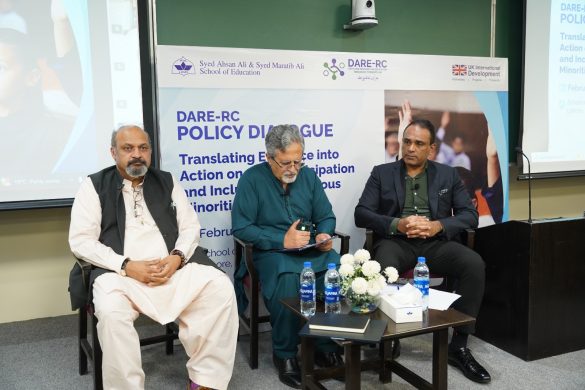
The Data and Research in Education – Research Consortium (DARE-RC), in collaboration with LUMS’s Syed Ahsan Ali and Syed Maratib Ali School of Education, convened this dialogue to bridge the chasm between academic research and actionable policy. Senior policymakers, leading researchers, and development partners converged to transform complex findings into practical, implementable measures. Consequently, this initiative directly aims to dismantle systemic barriers, ensuring that every child has equitable access to quality education.
Socio-Economic Impact: Reshaping Daily Life for Pakistanis
These proposed Evidence-Based Education Reforms directly impact the daily realities of Pakistani citizens. For urban and rural households, improved girls’ retention means greater female literacy and empowerment, leading to enhanced family incomes and societal stability. For students from religious minority backgrounds, enhanced inclusion translates into equitable opportunities, fostering social cohesion and allowing diverse talents to flourish. Furthermore, a stronger, more accountable education system uplifts the professional prospects of Pakistani youth, equipping them with essential skills for a competitive global economy.
- Students: Access to better learning environments and reduced dropout rates.
- Professionals: A more skilled workforce contributes to economic growth and innovation.
- Households: Increased literacy and empowerment, particularly for girls, leading to long-term societal benefits.
The “Forward Path”: A Momentum Shift for National Education
This dialogue signifies a definitive “Momentum Shift” for Pakistan’s educational landscape. Mudassar Riaz Malik, Secretary of the School Education Department, Punjab, articulated this precisely: “We need to ground our decisions in evidence and move firmly toward evidence-based policymaking, not policy-based evidence-making.” This structural recalibration from policy-based evidence-making to data-driven decision-making is a catalyst for genuine progress. Sustained engagement between academia and government will establish an enduring framework for accountability and inclusive reforms, accelerating national advancement.
Strategic Findings: Calibrating Systemic Challenges
Researchers presented critical data highlighting persistent educational barriers. Dr. Zainab Latif, Senior Fellow at Tabadlab, unveiled key factors contributing to girls’ middle-school dropout rates. Concurrently, Dr. Ibtasam Thakur, HOD Special Education at Lahore College for Women University, presented comprehensive research on the distinct educational experiences of children from religious minority backgrounds. These findings provide a baseline for targeted interventions.

Catalyzing Progress Through Unified Action
Ben Warrington, Head of the British High Commission Office in Lahore (FCDO), stressed that strengthening education demands an “ecosystem approach.” This integrated perspective necessitates connecting rigorous research to tangible policy actions and practical decision-making. The interactive panel, including LUMS faculty Dr. Faisal Bari and Dr. Tayyaba Tamim, further reinforced strategies for retention, teacher training reforms, and robust inclusive education frameworks. Ultimately, coordinated reforms and sustained collaboration are paramount to advancing equitable, quality education across Pakistan.








